ThunderCore Upbit warning designation and the market message delivered by Aave
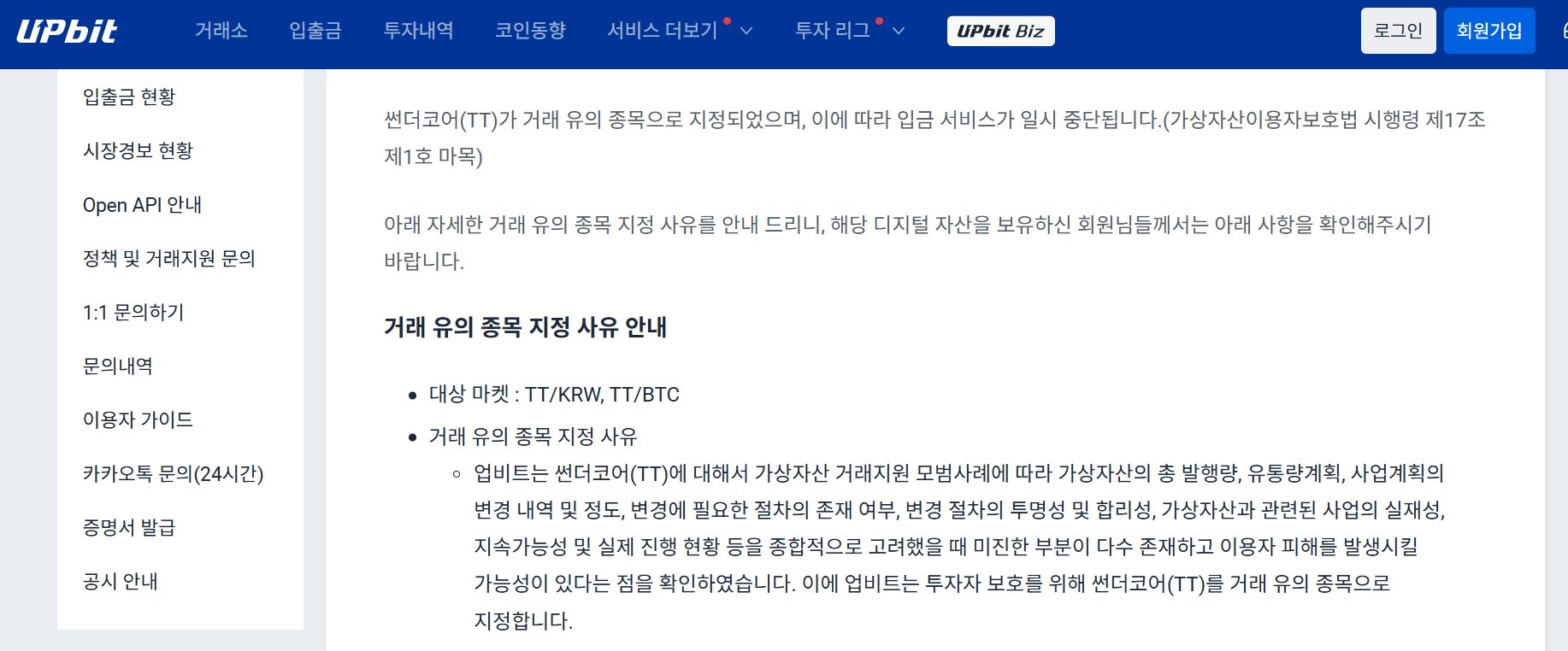
Today Upbit designated ThunderCore as a trade‑watch asset.
Upbit announced that the reason for the watch designation was based on a comprehensive review of total supply, circulation plans, changes to the business plan, the realism of the business, sustainability, and the actual progress status.
In this ThunderCore watch designation, I am focusing on the realism of the business.
ThunderCore is an EVM‑compatible, Ethereum‑compatible Layer1 that aims to build a diverse DApp and gaming ecosystem by emphasizing fast processing speed and low fees.
At that time, TPS and performance competition were important evaluation criteria for Layer1, and ThunderCore was also regarded as one of the next‑generation infrastructure projects.
But how has the market changed?
As Layer1 projects continue to increase, the market now looks not only at TPS but also at how many developers are participating, whether there are real users, and whether the ecosystem shows steady growth.
In that respect, Upbit’s mention of business realism and sustainability can be interpreted as checking whether the project’s promised ecosystem and operations are still functioning adequately. (Obviously this is a textbook interpretation, and from Upbit’s perspective, removing these coins for a reasonable reason benefits them.)
At the same time, the same trend is appearing in DeFi.
Recently, Aave governance discussed a phased cleanup of low‑usage assets and markets operating on certain chains such as Aptos and Sonic.
Rather than a negative assessment of specific projects, this reflects a reassessment of whether continuously providing liquidity to markets with insufficient demand is appropriate for the protocol’s overall efficiency and risk management.
Centralized exchanges and DeFi protocols!
Although the operating models differ, the two cases show a common direction.
The market is no longer about past hype but is now looking at actual usability!!
No matter how great the technology is shouted, if it is not actually used, it will be eliminated from the market – a warning sign.
In other words, whether there are real users, whether liquidity is maintained, whether development continues, and whether the project can sustain its ecosystem over time have become more important evaluation criteria.
I think this trend is likely to become even stronger in the future.
Domestic exchanges, under the pretext of protecting investors, will more strictly examine transparency and sustainability of project operations, and will attempt to delist coins that do not benefit them.
DeFi will continue to move limited liquidity to places with genuine demand.
Ultimately, the market will operate more efficiently.
Therefore, the questions we ask when looking at projects should change going forward.
What does this project pursue?
A more important question is,
Is the project still being used by people today?
Is real profit being generated by the project?
Does that profit translate into token value?
Therefore, is the business’s realism being maintained?
This ThunderCore trade‑watch designation and Aave’s tightened risk management convey the same message.
The crypto market’s evaluation criteria are shifting from technology to trust, and now to actual usability and sustainable ecosystems.
The projects that survive will not be those with the flashiest technology, but those that create reasons for people to keep seeking and using them over time.
The current down‑trend is a process of filtering out such projects.
And with this ThunderCore watch designation, Upbit now has a clearer picture of which altcoins might become the next challengers.