

Pundi AI x Drumee partnership: Redefining decentralized AI with data ownership and secure cloud collaboration. Verifiable data meets workspace sovereignty. Ready for the next level of trust and control? 🚀 https://t.co/6dzH8EzWQ3



 2.4K @im_serPAI
 Pundi AI x Drumee partnership: Redefining decentralized AI with data ownership and secure cloud collaboration. Verifiable data meets workspace sovereignty. Ready for the next level of trust and control? 🚀 https://t.co/6dzH8EzWQ3
 0
0
 0
0
 26
26
 67.4K @1YES_yes1
 Interpreting PlayAINetwork from a beginner's perspective
Brother Long (the author) has played many games before; as the saying goes, which youth hasn't played games?
We should know that previous games were actually very, very not worth playing.
Why?
Lack of interaction, true interaction.
NPCs and human players cannot communicate.
NPCs are just props, with only fixed programs.
And human players can only participate by following certain patterns.
And can only participate by themselves.
Or many cheats.
After researching projects for the past two days, I looked at PlayAI Network and found that it has a grand vision. It hopes to change all of this, allowing AI to become a co-creator in the gaming world.
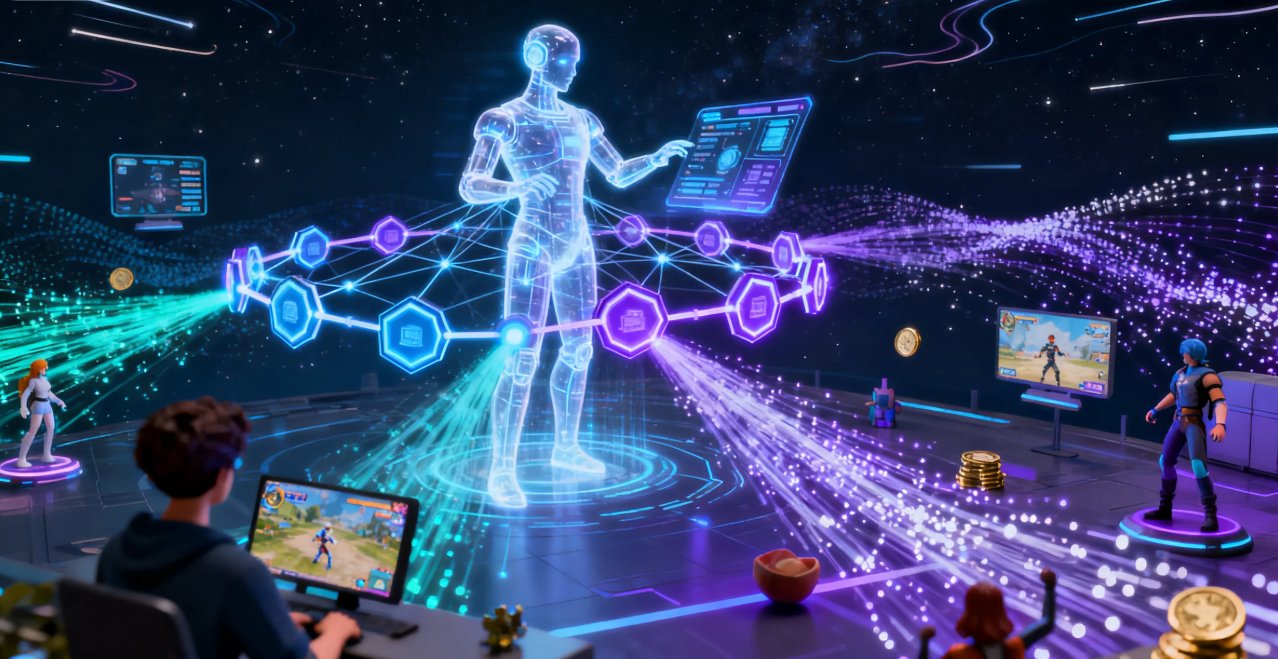
By combining decentralized networks, AI agents, and an on-chain economy, PlayAI attempts to create an ecosystem where games "self-generate, self-learn, and self-evolve."
This immediately caught my eye. If this approach is realized, it will bring a revolutionary experience to the entire gaming industry.
Even if we don't look at the technical roadmap, I believe that projects with such ideals will inspire more similar projects to emerge.
As the saying goes, there was no road in the world, but when many people walked it, a road appeared.
Below, I will elaborate on the project's positioning, technical architecture, ecosystem, and team background.
I. Project Positioning and Philosophy
@playAInetwork is positioned as a decentralized AI gaming platform, aiming to provide a creative space where developers and players can collaborate seamlessly. The core philosophy can be summarized as:
AI Agents as Creators: In the PlayAI world, NPCs, storylines, quests, and even game mechanics can be automatically generated by AI. Developers provide frameworks and constraints, and AI evolves itself based on rules and player interaction.
Player Behavior as Training Data: Every action, choice, and feedback from players in the game becomes input for AI learning and optimization, continuously enriching and adapting the game world.
Decentralization and Openness: Through on-chain identity, smart contracts, and token incentives, it achieves ownership of AI assets and traceability of behavior, while allowing ecosystem participants to earn revenue.
PlayAI attempts to integrate "creators, players, and AI" into the same ecosystem, making games no longer just products of humans, but dynamic worlds co-created by AI and players.
II. Technical Architecture
PlayAI Network's technical architecture can be divided into three major layers:
1. AI Fabric (AI Foundation Layer)
This is PlayAI's intelligent core, responsible for the generation and behavioral logic of all game agents:
Multi-model Fusion: Combines Large Language Models (LLM), Reinforcement Learning (RL), and simulation environments, enabling AI to understand game world rules and make autonomous decisions.
Reinforcement Learning Loop: AI continuously optimizes its behavior based on player feedback, presenting an adaptive and dynamic experience in the game world.
Differentiable Engine: Balances computational power consumption and AI inference efficiency while ensuring real-time performance, allowing complex interactions to be executed collaboratively on player devices and decentralized nodes.
This layer's design ensures that AI is not just pre-scripted logic, but an intelligent entity that can autonomously learn and generate content.
2. Creator Engine (Creator Engine)
This is PlayAI's creative toolchain for developers, including a no-code visual editor and SDK:
Supports direct import of Unity, Unreal, or WebGL game assets into PlayAI.
Provides PlayScript, a Python-based DSL (Domain-Specific Language), used to define agent behavior and interaction logic.
On-chain Asset Integration: In-game characters, items, and AI models can be put on-chain, ensuring the uniqueness and tradability of all creative works.
Through this layer, traditional game developers and AI developers can collaborate efficiently on the same platform, lowering development barriers.
3. AI Runtime Layer (Execution Layer)
This is the actual operating environment for AI, responsible for distributed inference and execution:
Modular Node Network: Adopts a distributed node structure similar to Akash or Bittensor, where each node can run agent tasks and receive token incentives.
Agent-as-a-Service: Any AI agent can be deployed on-demand to network nodes, enabling pay-per-use and revenue distribution.
Secure Sandbox: Ensures that AI does not overstep its authority during execution, while all behaviors are traceable on-chain, facilitating verification and management.
This layer ensures the decentralization and reliability of the PlayAI ecosystem, while laying the foundation for future cross-chain expansion.
III. Ecosystem
PlayAI's ecosystem development is divided into three core modules:
PlayAI Studio: Provides visual creation tools for creators, supporting agent creation, training, and debugging.
PlayAI Hub: A community sharing platform where developers can upload, sell, or reuse agent models, realizing the recycling of knowledge and assets.
PlayAI Chain: A dedicated Layer that provides infrastructure support for AI agent registration, behavior recording, and reward settlement, ensuring that each agent's identity and behavior records are uniquely verifiable.
In addition, PlayAI proposes the "AI Play Economy" concept: player actions are not only participation experiences but also training data for AI models. Through token rewards and on-chain settlement, a closed-loop economic system is formed.
IV. Team and Background
Founding Team: Core members come from Ubisoft, Unity, OpenAI, and Polygon Labs, possessing experience in game engines, AI inference, and on-chain economic design.
Chief Technology Officer (CTO): Previously led the R&D of large-scale game AI systems, including dynamic storyline generation and intelligent NPC frameworks.
Blockchain Lead: From the Polygon ecosystem fund team, responsible for on-chain economics and cross-chain compatibility design.
Advisory Team: Includes technical advisors who were early participants in Bittensor and Render Network, providing guidance for AI model training and decentralized execution.
From the product concept
Team composition
I see the spark of AI empowering games.
This is a concept that can absolutely subvert traditional Web2 architecture games. At the same time, it integrates AI AGENT and other models into games, already transcending gaming itself.
This is somewhat similar to the metaverse.
@playAInetwork @KaitoAI #KaitoAI
 6
2
4.9K
6
2
4.9K
 5.5K @MobWeth
 bullish on $PAI. big moves incoming
 109.7K @Jaineon0G
 0jm! 0G Aristotle Day 2 brought the first OG meme whitelisted.
🐼 @pandaion0G - $PAI/0G is now live on JAINE!
Did $PAI just started the meme season on $0G 🫧 https://t.co/Xwgeio0pTd
 4
0
100
4
0
100
