註冊
掃碼下載
iOS & Android
BitMart / 幣種 / QRL

Quantum Resistant Ledger (QRL)

$
$ 1.01 (QRL/USD)
-0.66%
24H

Quantum Resistant Ledger QRL 價格歷史 USD

跟蹤 Quantum Resistant Ledger 的今日價格、7天、30天和90天價格
週期
漲跌
漲跌幅 (%)
今日
$ 0.0066
-0.66%
7日
$ 0.0090
-0.89%
30日
$ 0.059
-5.55%
90日
$ 0.34
-25.58%

立刻擁有QRL

在 BitMart 輕鬆、安全地買賣QRL
立刻買賣QRL
立刻買賣{0}
Quantum Resistant Ledger 市場信息
最新價 $ 1.01
$ 1.01 24小時價格浮動區間 $ 1.02
歷史最高
‎$ 3.80‎
歷史最低
‎$ 0.84‎
24小時漲跌幅
‎-0.66%‎
24小時交易量
‎$ 815.21‎
流通供給
0.00 QRL
市值
‎$ 0‎
最大供給
105.00M QRL
完全稀釋的市值
‎$ 106.05M‎
交易 QRL

理財產品

輕鬆開啟理財之旅,餘幣寶、鏈上質押,多種產品讓閒置資產穩健增值。
立即申購
立即申購

Quantum Resistant Ledger 社交媒體動態

avatar
QRL is being exploited by LLM, its security is questioned.

Yep

avatar

You’re telling me that the quantum-proof coin meant to replace Bitcoin was exploited by an LLM? Can’t make this up.

view 1
view 0
view 31
2026-06-05 16:27
發佈後QRL走勢
看跌
QRL is being exploited by LLM, its security is questioned.
avatar
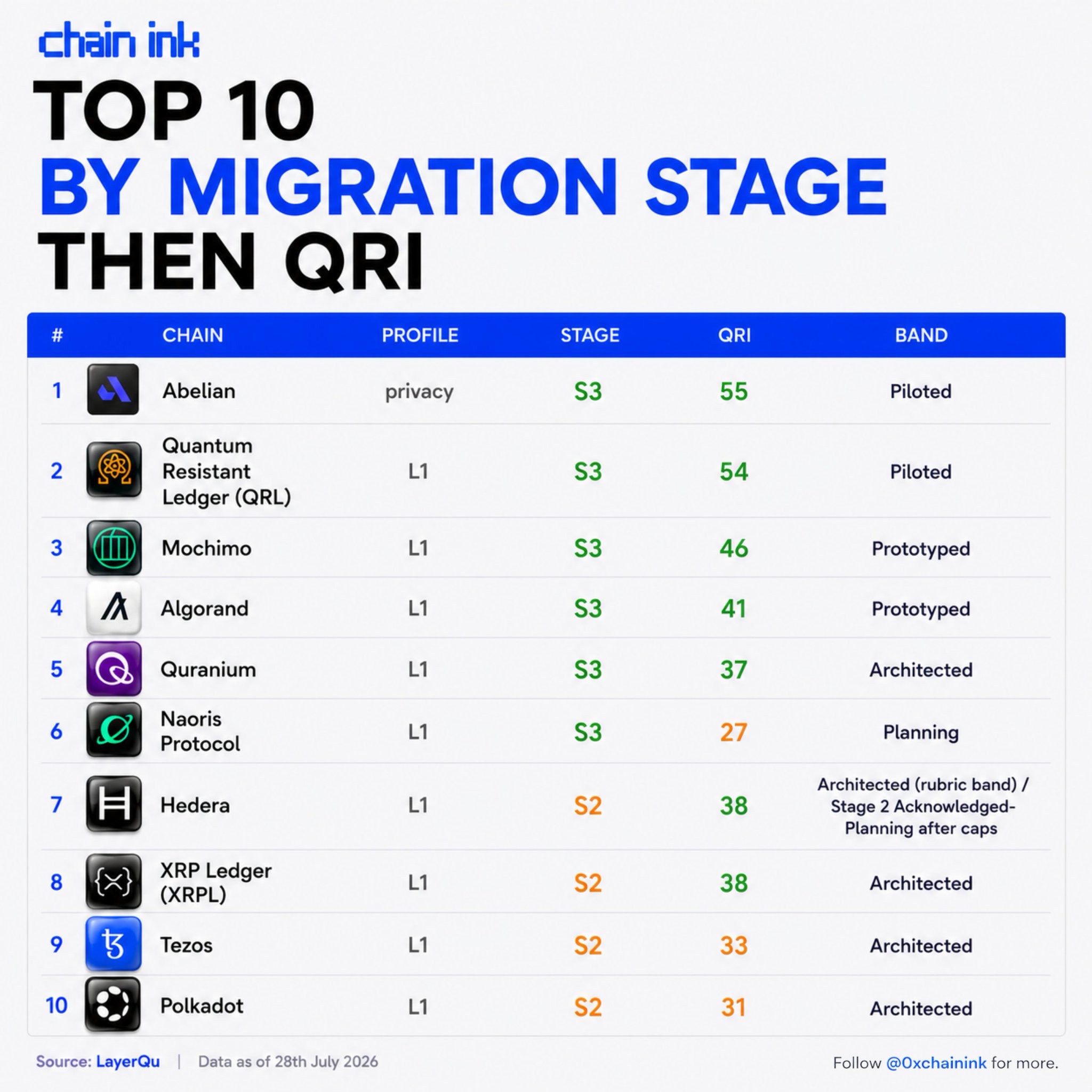
QRL, ALGO, SOL and other chains need to watch the new PQ signatures; migration remains challenging

🔔Post-Quantum Signatures: NIST's Second Wave

In August 2024, NIST finalized its first PQC standards: ML-KEM (key exchange), ML-DSA, and SLH-DSA (signatures). A third signature, Falcon (FN-DSA, FIPS 206), is still in draft.

Last week, NIST announced the nine candidates advancing to Round 3 of a parallel competition aimed at additional signature schemes, explicitly chosen to fill the gaps left by the first wave.

Each of the standardized signatures comes with sharp trade-offs. None of them is naturally suited to threshold signing, and all have signatures that are large compared to ECDSA's 64 bytes.
➡️ SLH-DSA (SPHINCS+, hash-based) The most conservative choice: its security rests only on the collision resistance of a hash function. The price is enormous signatures (7–50 KB !!!). It is the safest pick for very long-lived signatures (firmware, archival, some blockchains such as QRL).
➡️ML-DSA (Dilithium, lattice-based). Compact and fast, while elegant, is younger than hash-based assumptions. It is becoming the default for TLS, PKI, and most non-blockchain ecosystems (~2.4 KB signatures).
➡️Falcon (FN-DSA, lattice-based). The smallest of the three (~666 B at NIST-I), which is why Algorand and Solana selected it. Its drawback: signing relies on floating-point arithmetic, making error-prone and side-channel-resistant/ constant-time implementations notoriously hard. Its FIPS 206 standard is still in draft.

🔍Most blockchains are leaning towards customized shorter versions of SLH-DSA.

NIST is organizing a second wave of standardization. The goal is twofold: shrink signature sizes and diversify the underlying mathematics so a single cryptanalysis breakthrough cannot break everything. The nine Round 3 finalists span five families:
🔸 Isogeny: SQIsign
🔸 Lattice: HAWK
🔸 MPC-in-the-Head: MQOM, SDitH
🔸 Multivariate: MAYO, QR-UOV, SNOVA, UOV
🔸 Symmetric-based: FAEST

Notably, no code-based scheme survived. Both Round 2 candidates were eliminated: LESS and CROSS were dropped because of 2 attacks

👉 Two candidates worth watching
⏩ SQIsign produces the smallest known post-quantum signatures by a wide margin: from 148B to 292B (depending on the level of security), with sub-130-byte public keys. That is the only PQC signature scheme today that even approaches the bandwidth profile of ECDSA, extremely attractive for blockchains, certificates, and firmware. The catch: isogeny-based cryptography is still young, signing is mathematically intricate, and side-channel hardening is an active research area.
⏩HAWK is essentially "Falcon without the floating-point." It is a lattice hash-and-sign scheme producing 555 B signatures at NIST-I (smaller than Falcon's 666 B) and can be implemented purely with integer arithmetic, a major engineering win.

NIST has said the Round 3 review will last roughly two years and that any multivariate winners are unlikely to be standardized without yet another round. Realistically, the earliest a new signature standard will land alongside ML-DSA and SLH-DSA is 2028.

The urgency to migrate has grown sharply, yet the current standards still have significant drawbacks, and this last-minute selection round, while necessary, collides head-on with the migration timeline.

view 81
view 12
view 14.7K
2026-05-18 13:37
發佈後QRL走勢
中性
QRL, ALGO, SOL and other chains need to watch the new PQ signatures; migration remains challenging
avatar
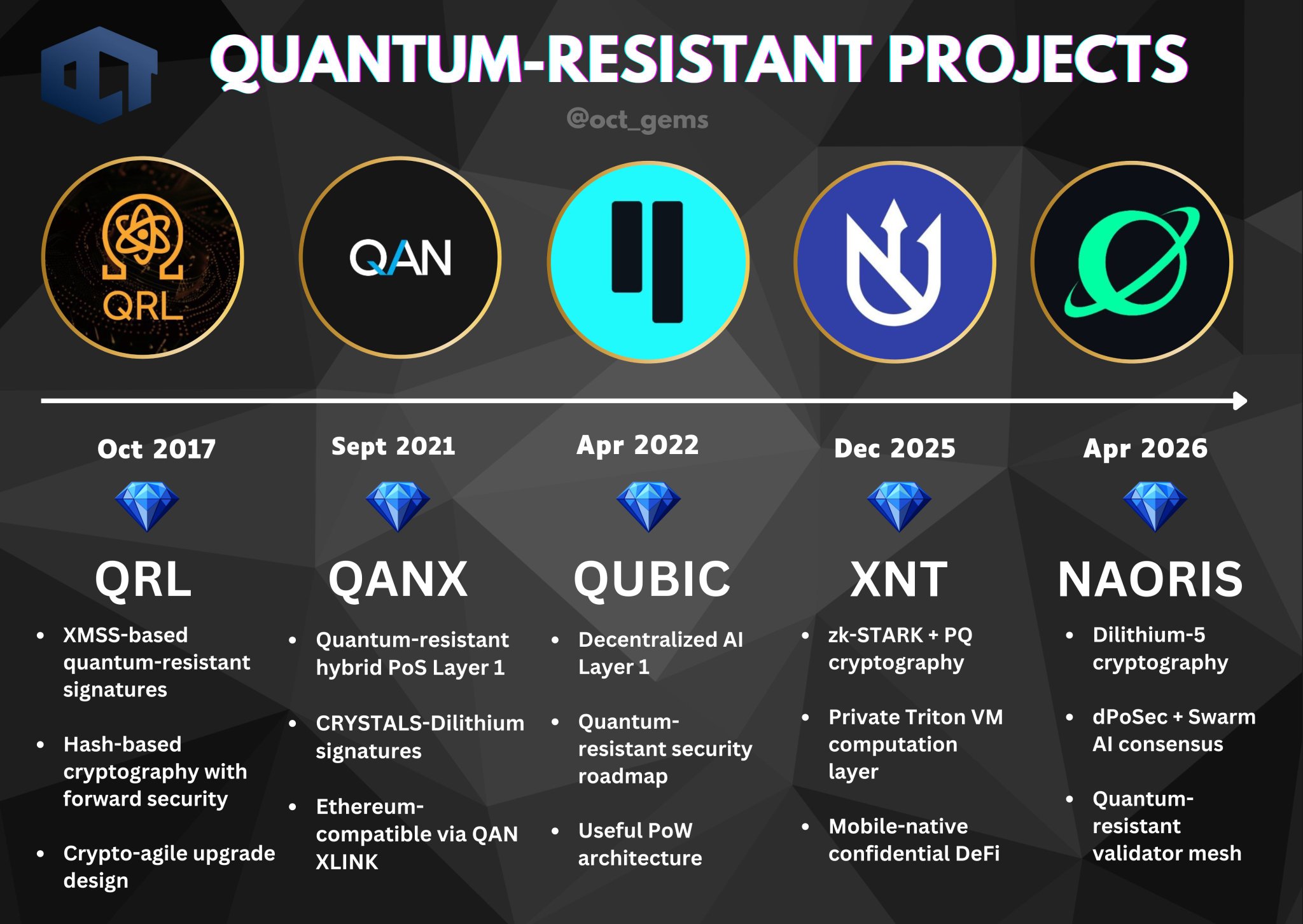
Recommend five top quantum-resistant cryptocurrency projects, emphasizing their technical features and future potential.

Top Quantum-Resistant picks you should definitely check out 👀

💎 $QRL 💎 ( @QRLedger )

💎 $QANX 💎 ( @QANplatform )

💎 $QUBIC 💎 ( @_Qubic_ )

💎 $XNT 💎 ( @NeptunePrivacy )

💎 $NAORIS 💎 ( @NaorisProtocol )

Which ones are on your radar? https://t.co/HajpxK8rA3

view 51
view 6
view 2.3K
2026-05-08 16:57
發佈後QRL走勢
看漲
Recommend five top quantum-resistant cryptocurrency projects, emphasizing their technical features and future potential.
詳情

價格預測

什麼時候是購買QRL的好時機?我應該現在買入還是賣出QRL?

在判斷現在是否是買入或賣出 Quantum Resistant Ledger (QRL) 的合適時機時,首先需要結合自身的交易策略和風險承受能力。長期投資者與短期交易者對市場信號的解讀往往不同,因此建議根據個人交易計劃做出決策。 根據最新的 QRL 4 小時技術分析,當前交易信號為持有。 根據最新的 QRL 1 天技術分析,當前交易信號為持有。
53
持有
QRL的4小時技術分析
最後更新時間:2026-06-11 15:59:59
49
持有
QRL的1天技術分析
最後更新時間:2026-06-12 00:00:00
beacon

Beacon預測

概率價格預測(未來24小時)
i
Beacon預測免責聲明
當面頁面的數據結果基於當前交易對的實際交易數據(OCHLV)和相應的指標計算,然後進行分析得出結果。
此預測為實驗性技術產品,僅供參考,不構成投資建議。現實生活中的任何突發事件都可能對交易行為產生重大影響,因此交易者應謹慎決策。
關於 Quantum Resistant Ledger
Quantum Resistant Ledger (QRL) is a cryptocurrency launched in 2016. Users are able to generate QRL through the process of mining. Quantum Resistant Ledger has a current supply of 79,620,322.93146174 with 0 in circulation. The last known price of Quantum Resistant Ledger is 1.07332046 USD and is up 4.73 over the last 24 hours. It is currently trading on 10 active market(s) with $41,095.02 traded over the last 24 hours. More information can be found at https://theqrl.org/.
查看更多
購買 QRL
交易 QRL