 USDC (USDC)
- 87社交熱度指數(SSI)+25.34% (24h)
- #38市場預警排名(MPR)+70
- 7624小時社交提及量+153.33% (24h)
- 41%24小時KOL看好比例62位活躍KOL
- 概要USDC sees large-scale minting and the largest transfer ever, institutional holdings upgrade; meanwhile, a hack and the SpaceX IPO cancellation cause negative sentiment.
- 看漲訊號
- Solana mints 1B daily
- Circle transfers 4.4B to Coinbase
- Coinbase holds 190B USDC
- HyperEVM injects large liquidity
- Strong institutional demand
- 看跌訊號
- Raydium hack loses USDC
- SpaceX IPO cancelled
- USDC dips slightly 0.06%
- Supply surge drives price down
- Whale self-custody potential sell-off
社交熱度指數(SSI)
- 總體資料87SSI
- 社交熱度趨勢(7D)價格(7D)情緒分佈極度看漲 (8%)看漲 (33%)中性 (41%)看跌 (16%)極度看跌 (2%)社交熱度洞察USDC social heat is high (87/100, +25.34%), activity surged 125.71% driven, KOL gave full support, sentiment dropped due to hack and SpaceX cancellation association.
市場預警排名(MPR)
- 預警解讀USDC warning rises to #38 (↑70), social abnormality 100/100 ↑188.72% and KOL attention shift 41.5 ↑112.82% are notable, linked to large minting and expanding institutional holdings.
相關推文
 curb VC OnChain_Analyst C77.99K @CryptoCurb
JUST IN: $750,000,000 $USDC MINTED ON SOLANA IN THE PAST 24 HRS! #SOLANA ⚡️ https://t.co/AnCPHGFRuO
 7 6 180 閱讀原文 >釋出後USDC走勢看漲USDC worth $750 million minted on Solana, indicating a huge boost in ecosystem liquidity.
 pamanberuang 🇮🇩 Educator DeFi_Expert C14.92K @bukanpamanmu
DeFi offers great opportunities, but also brings risks that need to be clearly understood. Here are the five main risks in DeFi along with their basic mitigations: 1⃣Smart Contract Risk Code errors in a smart contract can be exploited. Mitigation: Choose protocols that have been audited by trusted firms (such as Certik or OtterSec) and have a long track record. 2⃣Impermanent Loss Temporary loss due to asset price changes in a liquidity pool. Mitigation: Use stable pairs or concentrated liquidity (e.g., Kamino Vaults), and rebalance regularly. 3⃣Liquidation Risk Borrow positions can be liquidated if collateral value falls below the threshold. Mitigation: Keep LTV below 50-60%, monitor Health Factor, and have reserves ready for top‑up. 4⃣Oracle Risk Reliance on price feed oracles that can be manipulated or fail. Mitigation: Choose protocols that use decentralized oracles like Chainlink or Pyth Network. 5⃣Exploit / Hack Direct attacks on protocols that cause loss of funds. Mitigation: Diversify across protocols, start with small amounts, and regularly revoke approvals via your wallet. DeFi provides financial freedom, but success depends on understanding the risks and disciplined management.
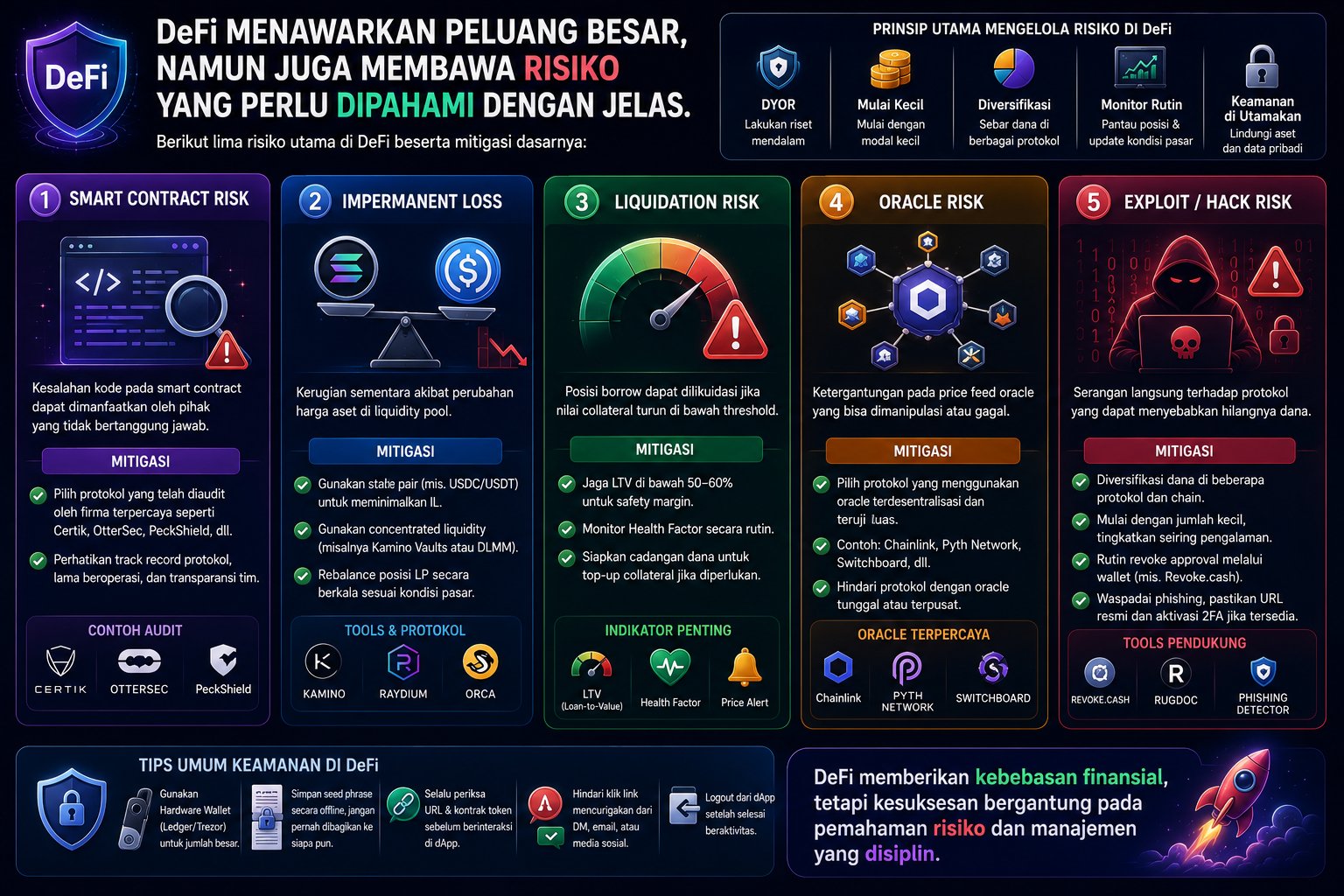 4 1 165 閱讀原文 >釋出後USDC走勢中性DeFi opportunities and risks coexist, requiring understanding and managing five major risks.
 Powerpei🦅 Dev Quant S33.30K @PWenzhen76938
Last night, Binance cancelled the SPCX new share offering. The reason is straightforward: there aren't enough real shares to distribute. The allocation that SpaceX gave to crypto platforms is far smaller than the amount everyone wanted. Institutions swept up the supply early, and the remaining pool cannot support so many participants. Normally, a cancellation would just trigger a refund and be the end of it. Binance went a step further. The USDC that was locked was fully refunded via the original route. Most people received their refunds last night. In addition to the refunds, there was an additional compensation awarding all participants an average airdrop worth $1,000,000 in SPCXB. This SPCXB is the SpaceX token from bStocks. It is 1:1 pegged to real shares, backed by a custodial institution, and is expected to be fully distributed before June 18. Watching this compensation makes me find it more interesting than the original offering itself. The new share offering was blocked by the scarcity of "real shares". The compensation, however, delivers split portions of real shares that can be put on-chain. The old problem and the new answer converge on the same issue. // First, let’s explain that old problem thoroughly. In the old world, if you wanted to own such an asset, you were stuck at the share level. One share of SpaceX is exactly one share. Institutions want it, retail investors want it, but supply is limited. You have to line up, have the right channels, and gather enough capital. Many people don’t even qualify to line up. Cryptocurrency made the first move back then. It changed how you enter the market. Previously, buying US stocks or overseas assets required opening foreign accounts, wire transfers, dealing with time‑zone differences, and passing numerous checks. Crypto removed a chunk of those barriers; a single wallet lets you get on board. People from emerging markets experienced global markets up close for the first time. Now tokenization makes the second move. It changes how you hold the asset. It's not just about whether you can buy it, but what happens after you own it. Who controls the asset, where it can be used, and when it can be moved. bStocks stands on this second line. → → → So what exactly is bStocks? >>> In one sentence: map supported US stocks onto the blockchain 1:1. Each bStock you purchase is backed by a real US stock. The underlying stocks are held by a regulated custodial institution. You can verify the collateral yourself; Binance provides a public "collateral proof" page. Dividends and similar entitlements are automatically processed by the system. Therefore it is not a shadow of a stock, not a contract, nor a derivative; it is backed by an actual real stock. How does it differ from the share in your brokerage account? - First, self‑custody. You can place bStocks into your own wallet; you retain control, instead of being locked in a broker’s system. - Also, it doesn’t care about market hours. Traditional stock markets are bound by opening and closing times, whereas this is 24/7 spot trading; you can act even at midnight without anyone stopping you. - Most importantly, it can be on-chain. After tokenization, it can interact with supported DeFi applications. A conventional brokerage share cannot do that. - The entry barrier is also low. With a minimum of $5, you can participate with fractional shares, without needing a whole share. A single NVIDIA share costs several hundred dollars, but with $5 you can still get on board. —— This is actually Binance playing a bigger next move. From pre‑IPO perpetual contracts to direct US stock purchases, and now bStocks, it is consolidating private placements, public markets, and tokenized assets into a single ecosystem. Crypto, stocks, and payments are managed on the same platform. What it manages is a financial super‑app. Returning to last night’s event. The cancellation of the new share offering hits the ceiling of the old ownership model. Real shares are scarce, ordinary people can’t get in line. The compensation using bStocks delivers a new way of ownership. It’s still backed by real stock, but broken into shares that anyone can obtain and placed on-chain. Thus this is more than just compensation; it’s like an impromptu demonstration. Crypto originally changed "how to enter the market." Tokenization now changes "how to hold." bStocks is positioned at that next step. The significance isn’t about a single cancellation or how much compensation was issued. It lies deeper. Ordinary people’s distance from global assets has been further narrowed. // But a few sentences need to be stated up front. bStocks is not risk‑free. Tokenized securities can rise and fall; you may lose part or all of your principal. It’s not available to everyone. It is only open to eligible users. Whether you can use it depends on your regional eligibility and local regulations. Don’t get carried away just because it’s on‑chain. First confirm you’re eligible, then assess how much loss you can bear. Refund progress, compensation distribution, and activity rules should all be referenced to Binance’s official announcements; do not rely on second‑hand accounts, including mine. Note: The above are personal opinions only and do not constitute investment advice. Tokenized securities carry risks; availability depends on qualification requirements and local regulations. Do your own research! #Binance #Stocks @binance @binancezh @cz_binance @heyibinance
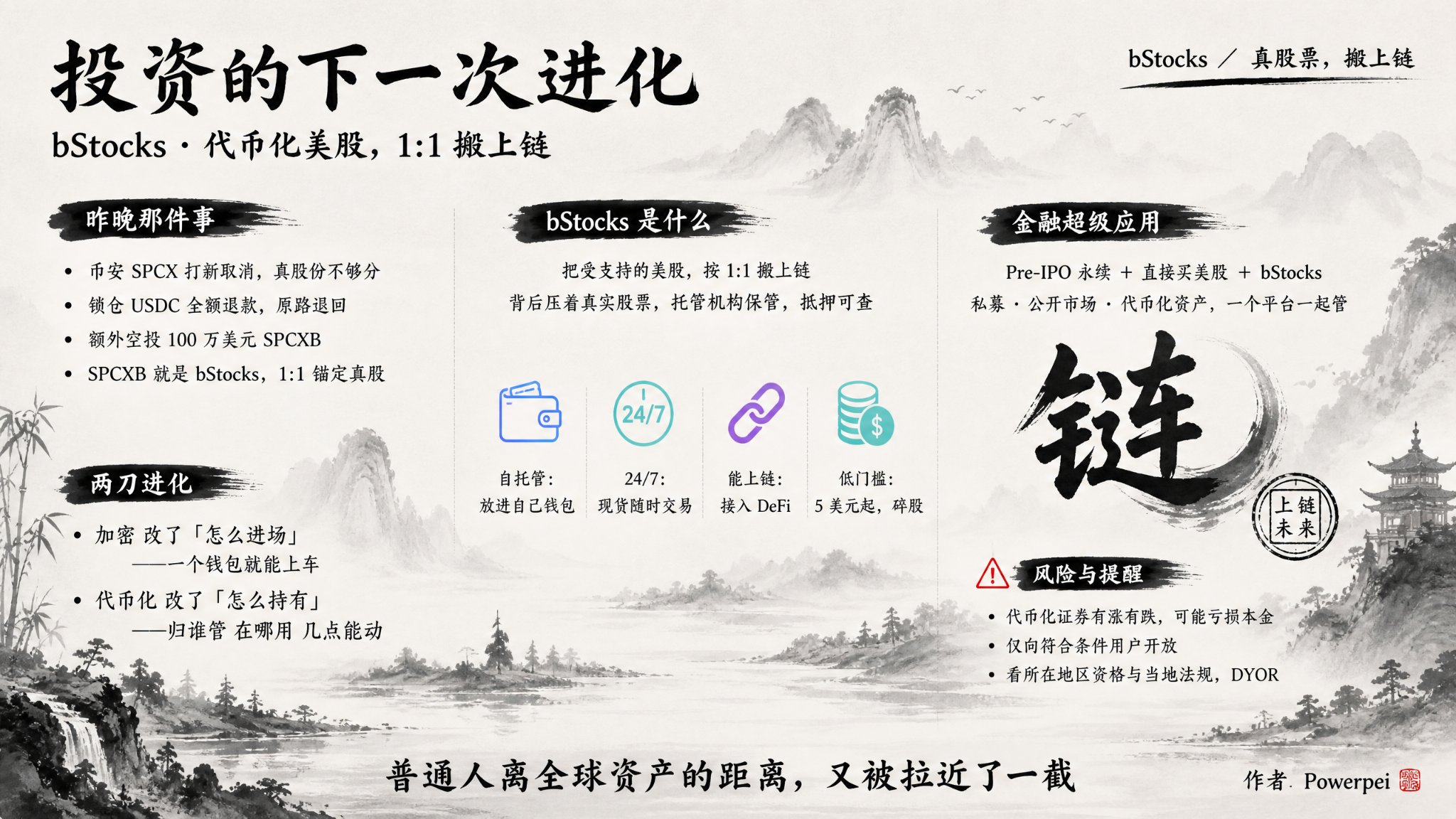 121 93 4.07K 閱讀原文 >釋出後USDC走勢極度看漲Binance bStocks tokenizes US stocks on-chain, lowering the barrier and bringing ordinary people closer to global assets.
 Eli5DeFi DeFi_Expert OnChain_Analyst C46.25K @Eli5defi
 THEDEFIPLUG FA_Analyst OnChain_Analyst B52.29K @TheDeFiPlug
Over the past year, several large institutions have expanded their presence in DeFi. @BlackRock launched BUIDL. @Coinbase expanded cbBTC and USDC integrations. @FTI_US expanded BENJI’s onchain reach. @apolloglobal and @Morpho announced a strategic partnership that includes up to 90 million MORPHO tokens vesting over 48 months. At first glance, these look like separate initiatives. The common thread is easy to miss. The easiest way to interpret these developments is through adoption. Institutions are entering DeFi. The more important question is integration. How are institutions choosing to participate once they arrive? A pattern is starting to emerge. Institutions are not entering DeFi by becoming crypto-native. They are entering by making their assets usable as collateral. That distinction matters because financial systems are built around collateral, not assets. The first phase of tokenization focused on issuance. Can Treasuries be tokenized? Can institutional funds exist on public blockchains
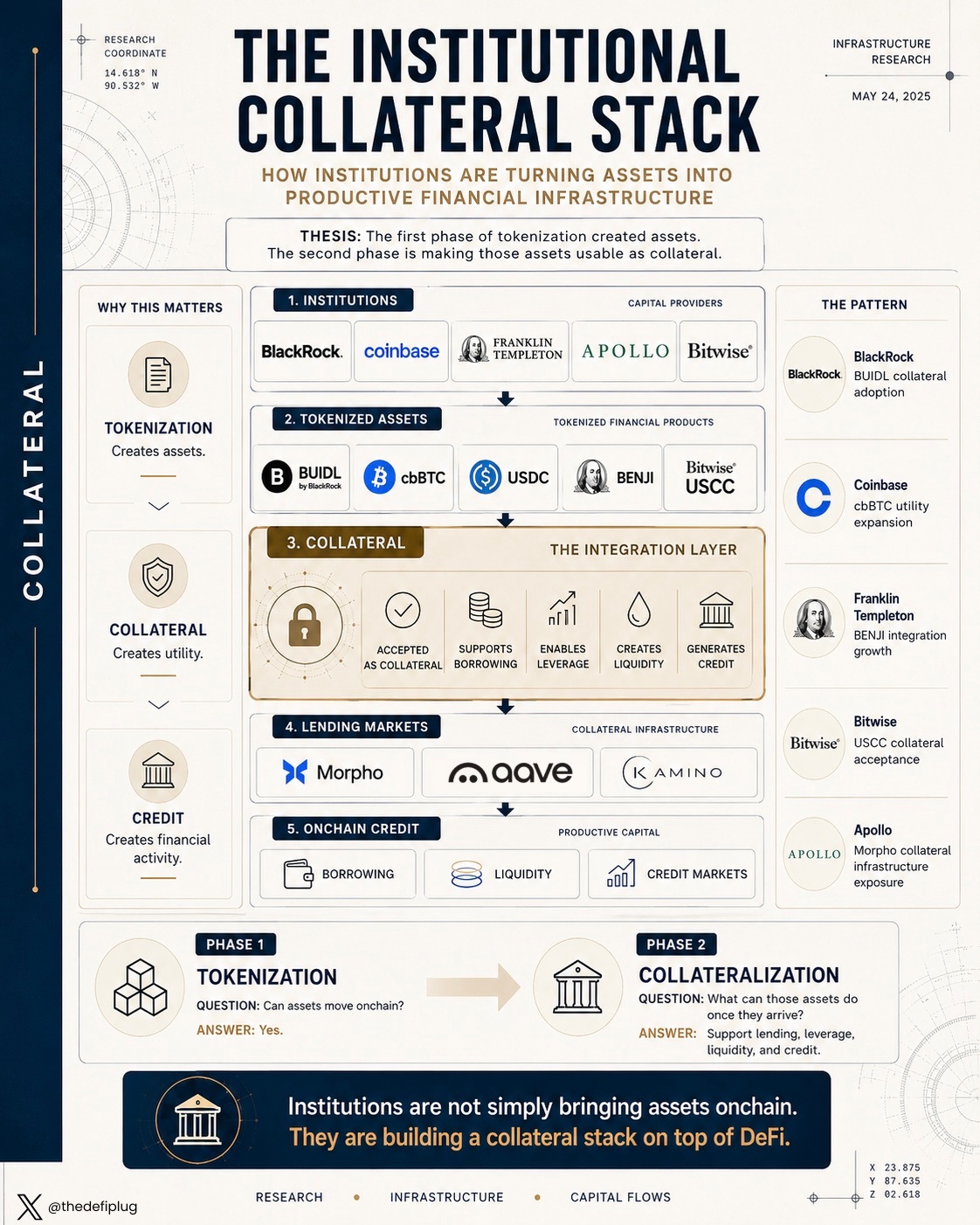 82 49 4.96K 閱讀原文 >釋出後USDC走勢極度看漲Institutions are deeply integrating assets as collateral into DeFi, building financial infrastructure.
 kimcĦi.ℏ/acc Media Educator B4.32K @HederaKimchi
 John Kikko D819 @JohnKikko
The bond market hasn't fundamentally changed how it pays investors in decades. Monthly or semi-annual coupons, batch settlement, cash sitting idle between distributions. @ArchaxEx and @hedera just shipped something that challenges that assumption at its core: real-time streaming cash flows for tokenized securities, distributing interest payments on a near second-by-second basis via Circle's USDC directly to investors' wallets. The benefits include: 🧵 #AI #Tokenization
13 1 495 閱讀原文 >釋出後USDC走勢看漲USDC enables second-level revenue streams through Hedera, enhancing payment efficiency for tokenized securities Lao Bai FA_Analyst Derivatives_Expert C74.90K @Wuhuoqiu
Indeed, anything that everyone piles money into cannot make everyone profit (the 2019 Binance IEO might be the only exception). This time it didn’t drop, but they collectively issued refunds. However, there's another ‘but’—Senior brother talked about the Commonwealth Bank of Australia's IPO subscription. Although the hit rate is a staggering 40%, there are two points that will deter many people. 1. Extremely high wear and fees – the bank automatically converts your Australian dollars to US dollars, charging a foreign exchange fee (the spread is very opaque). The portion that doesn’t win is then converted back to Australian dollars with another fee; the winning portion also incurs a hefty subscription fee. Three layers of loss—the more you trade, the more you lose! 2. Anyone who has used CommSec in Australia knows that unless you spend an hour or two, you can’t figure out the system. I have more than one friend who spent an entire night fiddling with CommSec’s ‘SpaceX’ just to get in. Compared with our space, where you click a link on any exchange, deposit USDT, and it’s done in about five seconds, you can’t help but think – what kind of junk is traditional finance giving people? Just from this point, I have no doubt about blockchain’s future. Of course, it may no longer be closely related to what we used to call “altcoins.”
 土澳大狮兄BroLeon | 🔶BNB | D115.44K @BroLeon
In the end, all participants submitted their papers. Binance’s plan also emerged: they personally spent $1,000,000 to airdrop stocks to participants, being generous and not passing blame to upstream parties. Based on 27,000 people, that’s about $40‑something per person, enough to cover the USDC conversion loss. Gate may be the biggest winner in this round; although we can’t calculate everyone’s time weight and capital proportion, they did fulfill the stock delivery immediately, clearly not following the xStocks approach. Trust level +++ Bitget refunded a $10 gas voucher. Bybit refunded and gave a 10% interest on the principal for 4 days (about $11 on a $10,000 principal). Kraken deducted $600 from everyone and gave 4.2 shares. You can feel each platform’s sincerity and scope yourself; it’s just a hollow celebratory drama. The crypto world isn’t short on money, it just doesn’t want to spend it on buying coins. Yet the crypto sector’s position in the financial chain remains weak; even with money, it can be arbitrarily manipulated, and blatant breaches of contract leave you helpless. Previously, I thought the Australian CommSec system was outdated and hard to use, making it a prime candidate for blockchain revolution, so I never considered using it. Yet this time, the 40% average hit rate outperformed all CEXs across the network. Blockchain still has a long way to go to infiltrate traditional finance...
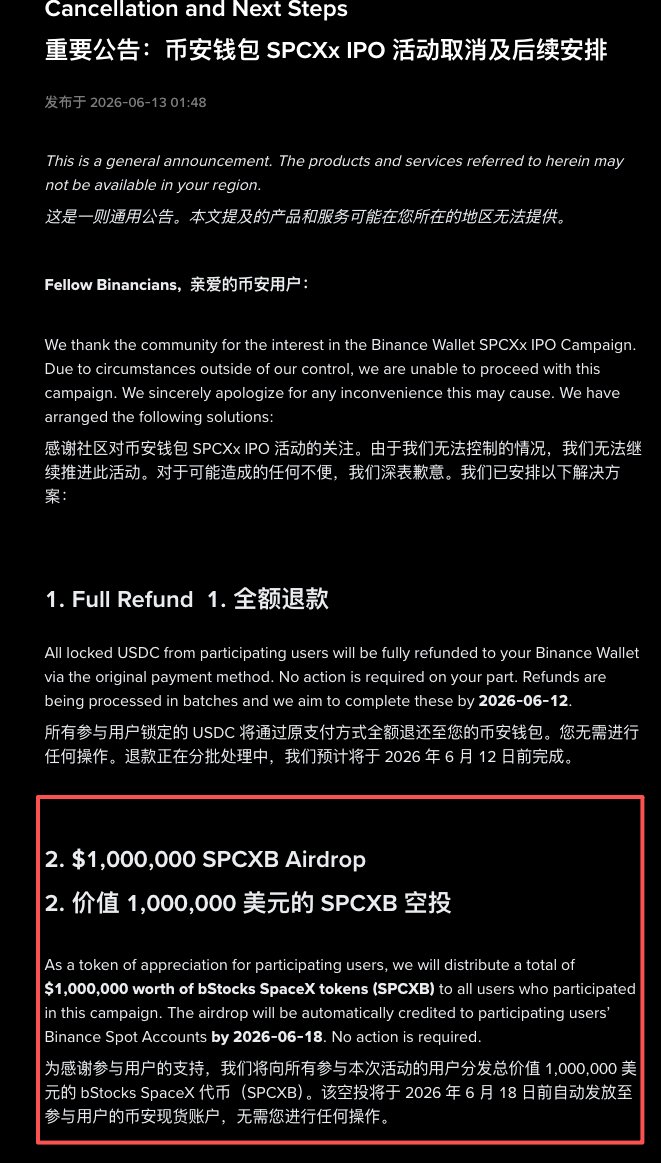
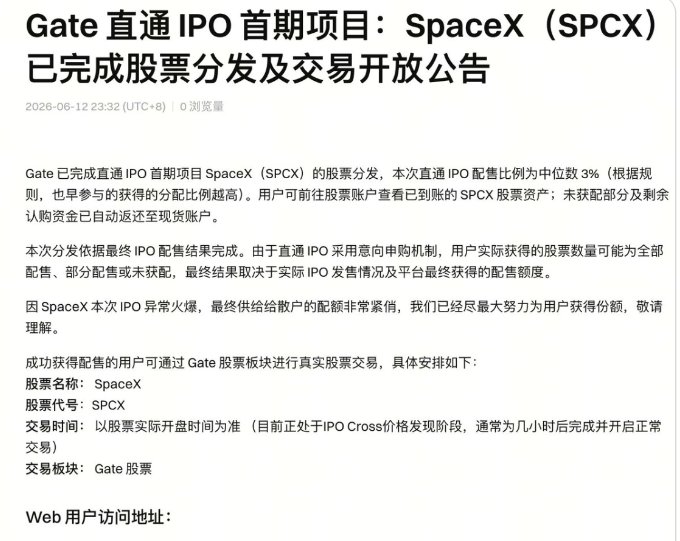 9 11 4.34K 閱讀原文 >釋出後USDC走勢看漲The tweet compares the pros and cons of cryptocurrency exchanges and traditional finance in handling IPO events, bullish on the future of blockchain but noting its position remains limited.
 ۟ Trader Educator C74.73K @MINHxDYNASTY
how safe is a high yield usdc account? https://t.co/OaLbxCxu9I
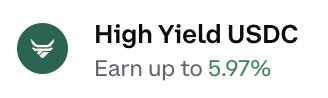 31 13 2.01K 閱讀原文 >釋出後USDC走勢中性The tweet asks about the safety of a high-yield USDC account that offers up to 5.97% yield.
 Olivia Vande Woude FA_Analyst OnChain_Analyst B2.58K @cryptoreine
tokenized SpaceX trading went live in minutes but sourcing the actual shares took down a few campaign the blocker in 2026 is access to the float
 Crypto India D426.51K @CryptooIndia
BREAKING: Binance, Bybit and Bitget cancel SpaceX IPO allocations and issue full refunds after failing to secure the underlying shares. https://t.co/iUNe0WanFG
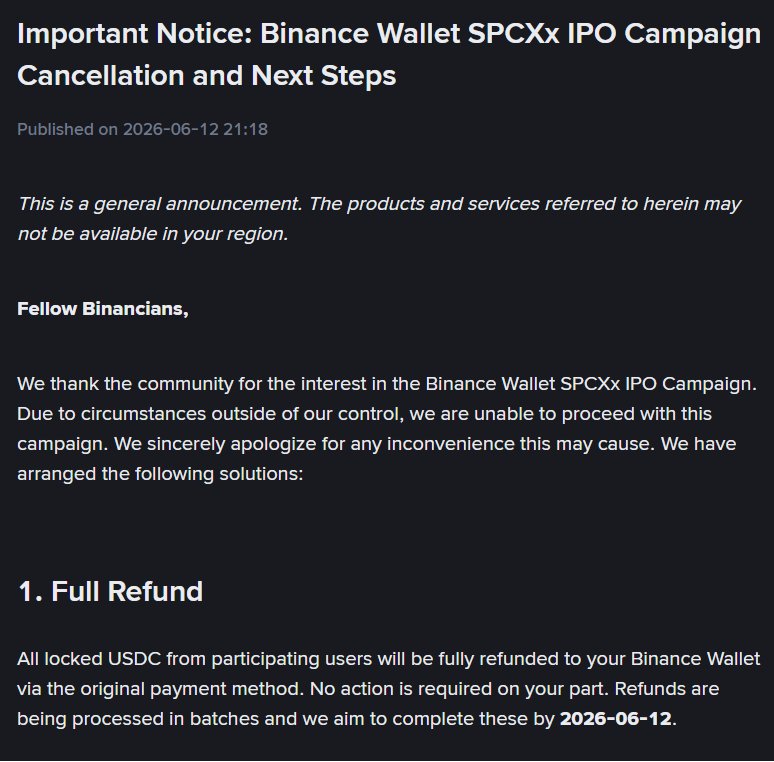
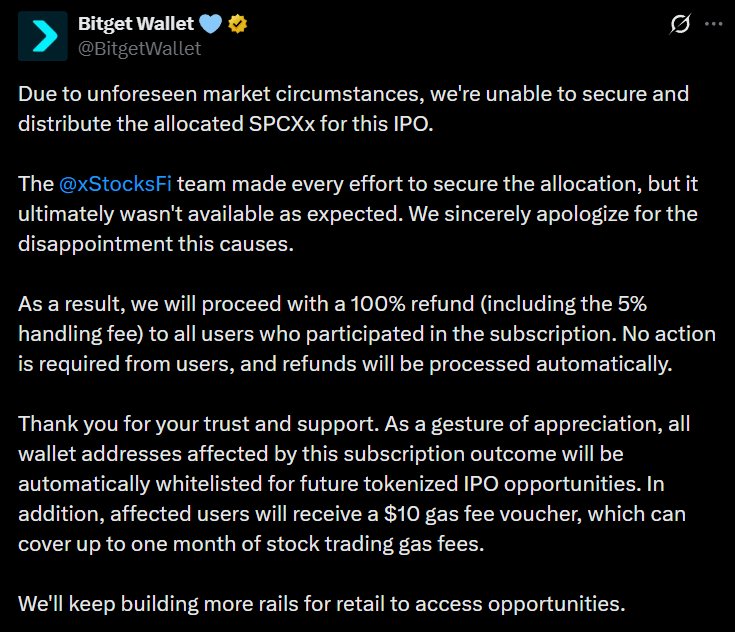
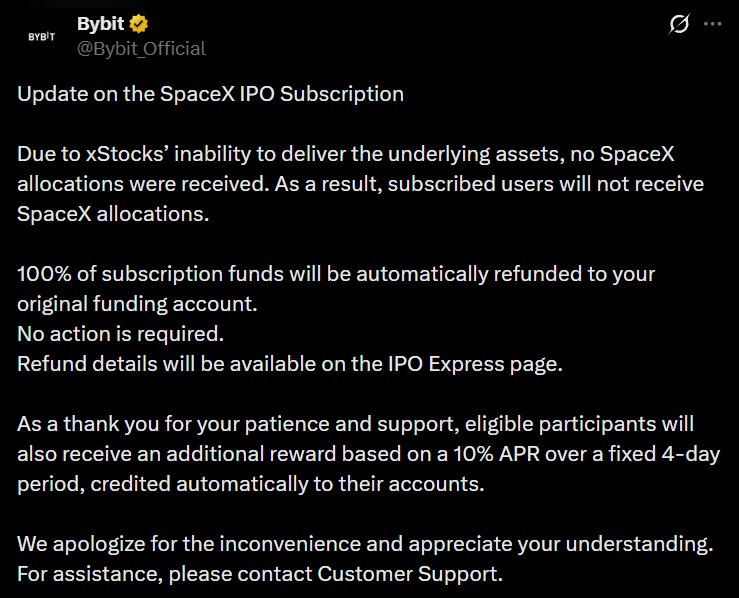 1 1 230 閱讀原文 >釋出後USDC走勢看跌Binance and other platforms cancel tokenized IPO of SpaceX and issue full refunds due to failure to obtain SpaceX shares.
 Cointelegraph Media Influencer D2.94M @Cointelegraph
⚡️ TODAY: Coinbase reports that roughly $4.4 billion in $USDC was transferred to the Coinbase Hyperliquid deployer, marking the largest $USDC transfer on record. https://t.co/WlqixFGI2I
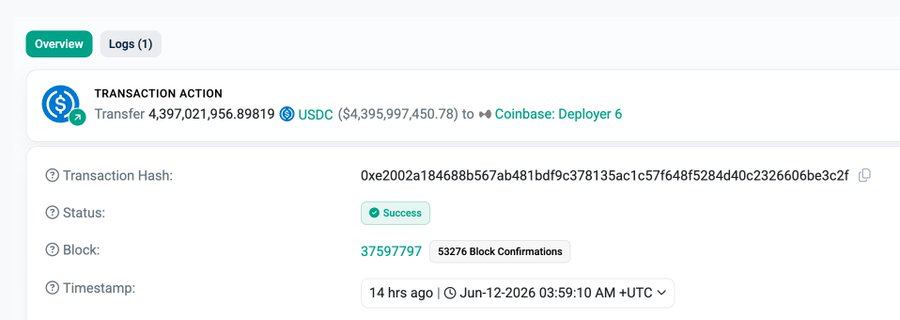 244 46 17.61K 閱讀原文 >釋出後USDC走勢看漲Coinbase reports a $4.4 billion USDC transfer to the Hyperliquid deployer, setting a historic high.
 Crypto Onizuka FA_Analyst DeFi_Expert B15.97K @slamboto_v2
 Aerodrome D129.57K @AerodromeFi
Aerodrome is coming to @Arc Arc is a stablecoin-native ecosystem developed by @Circle, built to bring real-world economic activity onchain. Aerodrome will be there, standing up critical FX infrastructure. https://t.co/V4sP401Tmr
300 45 15.82K 閱讀原文 >釋出後USDC走勢看漲Aerodrome will land on Arc, enhancing cross-chain FX services for stablecoins such as USDC


