Hyperliquid (HYPE)
- 69社交熱度指數(SSI)-5.10% (24h)
- #114市場預警排名(MPR)-69
- 3524小時社交提及量-33.96% (24h)
- 74%24小時KOL看好比例34位活躍KOL
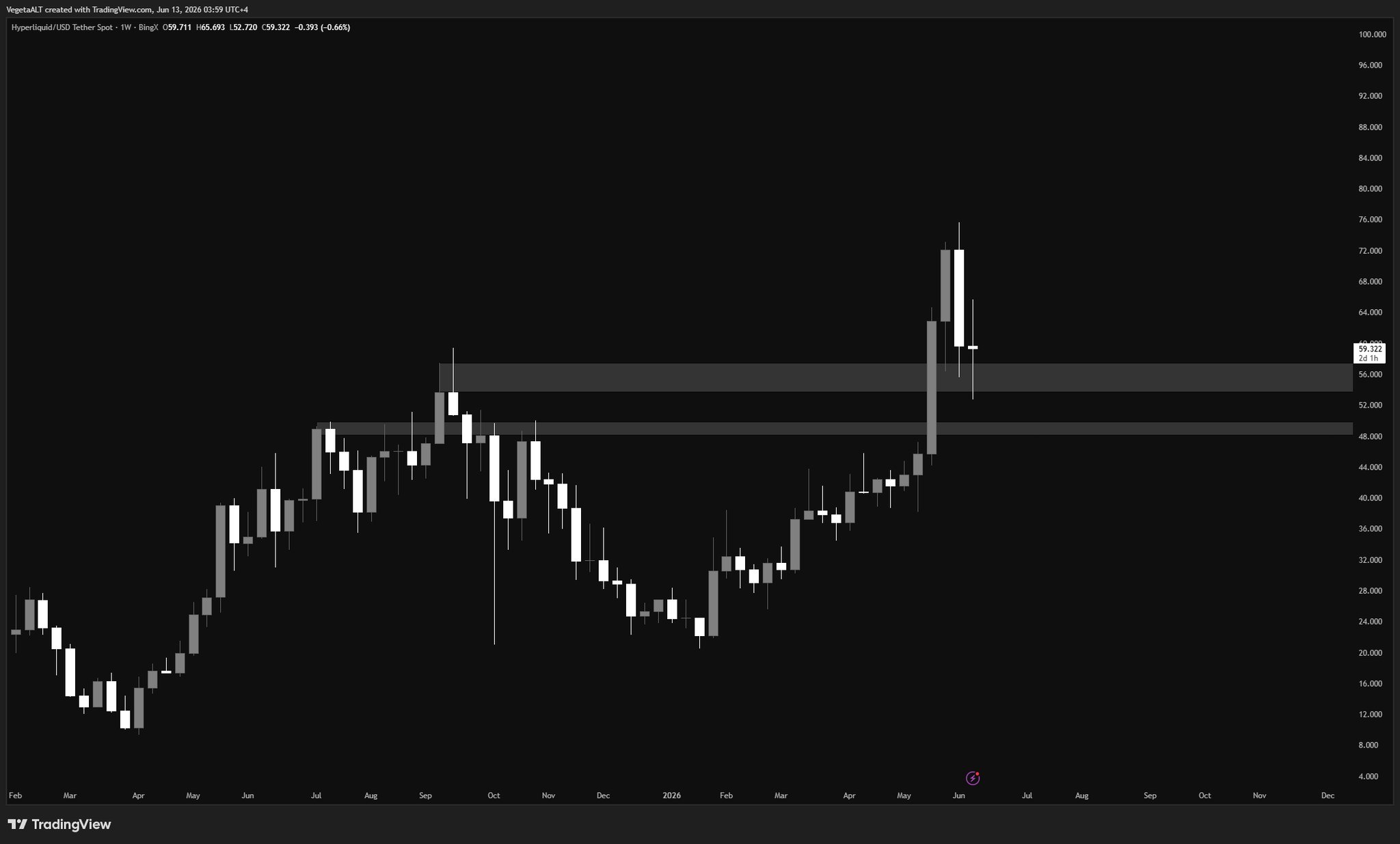
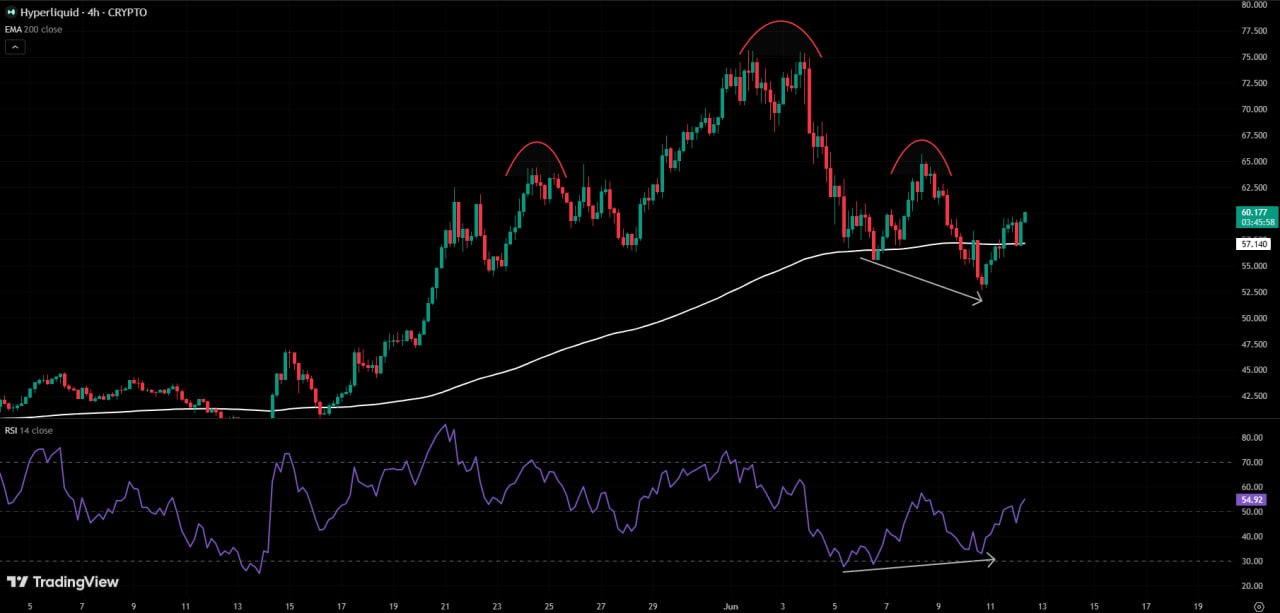
- 概要HYPE holds steady at $25.86, up 0.23%, OI leading, buyback and support levels firm, daily chart still shows bearish flag pressure.
- 看漲訊號
- Open Interest leads at $7‑13B
- Key support $25.2
- Buyback funds $1M/day
- Trading volume continues to rise
- Most KOLs are bullish
- 看跌訊號
- Daily chart shows clear downtrend
- Forming a bearish flag
- Resistance $29.4‑$30.3
- Negative community toxicity
- Competitor Lighter moving up
社交熱度指數(SSI)
- 總體資料69SSI
- 社交熱度趨勢(7D)價格(7D)情緒分佈極度看漲 (14%)看漲 (60%)中性 (11%)看跌 (9%)極度看跌 (6%)社交熱度洞察HYPE social heat is moderate (69.28/100, -5.1%) due to a sharp 30.6% drop in activity, positive sentiment up 30.6% and KOLs fully engaged (30/30), buyback support lifts sentiment.
市場預警排名(MPR)
- 預警解讀HYPE warning rank fell to #114 (down 69), sentiment polarization surged 1100% to 17.01/100, social anomaly dropped to 43.34, linked to daily bearish flag and negative community sentiment.
相關推文
Tobias Reisner FA_Analyst Influencer B16.50K @reisnertobiasHyperliquid is still strong
Henrik D9.46K @Henrik_on_HLHyperliquid’s open interest ratio vs CEX is back to pre-10/10 levels https://t.co/oPQnD98US1
23 9 1.15K 閱讀原文 >釋出後HYPE走勢看漲Hyperliquid's open interest ratio has recovered to a high, showing strong market performance.
Tobias Reisner FA_Analyst Influencer B16.50K @reisnertobiasStay Hyperliquid https://t.co/bsJ9Ci3LN7
13 6 353 閱讀原文 >釋出後HYPE走勢看漲The tweet uses a luxurious setting to imply a positive outlook and wealth vision for the HYPE token.
加密韋馱|Skanda 🔶 OnChain_Analyst Trader A49.47K @thecryptoskandaThis thing is hard to be feasible in practice @Wuhuoqiu used to be a VC, so I will only speak from the VC perspective First premise: > First, VC investment itself is a kind of mutual‑splitting‑position attribute, essentially very similar to the old VDS "resonance" (newcomers can look it up) That is: the lower the tier, the higher the price, the larger the supply. But the premise is that the upper tier must be fully filled. The premium of the next tier over the previous tier is artificially set, not discovered by secondary‑market price discovery: For example, a public chain pre‑seed 50M, Seed 200M, TGE might be 500M. These valuations are set by the project team and exchanges. On this chain there are very mature liquidity solutions and 1.5‑level market "consensus" (e.g., OTC selling) VC business "earns" deterministic paper wealth that is not affected by secondary‑game dynamics > Second, especially North‑American VCs, they rarely use their own money; the vast majority is money raised at extremely low cost. This leads to a philosophy that often is: - Patience - Not afraid of a single project zeroing out - But they want a 100x upside as soon as they act Going back to Lao Bai's scenario, this approach is equivalent to: - The project only raises effective funding in the VC round - About 10‑20% of the original VC tokens are fully unlocked at TGE What problems does this cause? 1. TGE cannot offer a premium above the VC round Because the project only has the money raised at the VC‑round valuation, and this portion of tokens is unlocked on Day 1. Exchanges, retail investors, market makers and funding parties all know this. If there is a premium here, who pays for it? 2. No value for VCs who did not invest Since there is no deterministic next‑round premium for VCs, and even if TGE could pour everything to retail exit, the discounted prior VC round would not yield many multiples. There is no incentive for them to participate. 3. No benefit for the project team either Assume the project team does not act maliciously and wants a long‑term path. Original logic: - Do pre‑TGE farming to grow users - At TGE, circulating tokens consist only of the airdrop actually distributed + MM liquidity provision + exchange‑run token allocations, generally less than 10% (most often less than 5%) Current logic: - TGE must unlock 10‑20% of tokens - There is simply no budget to run months‑long user growth. The pre‑TGE farming that earned an ICO whitelist has historically only been possible for a handful of "king" projects in a bull market; generally you cannot hold market attention for that long. - You cannot cut the listing cost to a penny. - Unable to price high, meaning the project cannot leave enough market‑cap buffer before its own token unlocks. Whether it zeroes out or not, it’s equivalent to the team working hard for half a day while retail and exchanges take the money. If that’s the case, why would the project team waste so much effort raising money from VCs just to cover product costs? Secondary‑market games have no premium room whatsoever. The closest idea is a “money‑pump” like Slerf, Bome. Of course their thinking is opposite: they start with a high‑average‑cost FOMO game, push price up, then trap people before considering what product to build, aiming to list on more exchanges. This process does not need the project team, only market makers. That is why I think Hyperliquid’s HIP‑3 has the biggest product‑market fit.
Lao Bai VC FA_Analyst B74.34K @WuhuoqiuThe foreign blogger’s idea is indeed interesting, especially from my former VC investor’s perspective; the logic and method make sense. Let me outline his core points: 1. It’s not ideal for retail investors to get in too early in early fundraising rounds, nor is it a good solution, because retail lacks the risk‑bearing capacity of VCs. 2. Before each project’s TGE, create an IDE – Initial Decentralization Event – similar to today’s pre‑price trading. The difference is that it’s an auction and VCs must hand over all their tokens. For example, if you as a VC entered at a $10 million valuation and the auction ends at $100 million, you exit with a 10× return. After that, there will be no VC unlocks in the circulating market. Conversely, if you entered at a $100 million valuation and the auction ends at $10 million, you incur a 90% loss; profit and loss are two sides of the same coin. First, I agree with point 1 – why? It’s not that retail shouldn’t eat the meat, only that they should be the last bite. In my past posts I mentioned that over two years I discussed over 1,000 projects and invested in 40, a small‑ratio “best of the best”. Roughly half still go to zero, some make small gains, and maybe one or two hit big. Traditional VC circles have a similar ratio. Imagine if those 1,000+ projects were all offered to retail as ICOs. How would investors differentiate? A flat 10 U or 100 U airdrop for everyone? Or would they spend time reading 1,000+ decks/whitepapers and then concentrate their bets? Do you really have confidence you could pick a MegaETH/Monad/Ethena type of target? At the time MegaETH only had Yilong’s early PPT, I jumped in after the call. When I later introduced it to a few familiar VCs, many passed on the deal. If institutions are hesitant, can a retail investor handle such a hardcore technical PPT? Now point 2 – this basically complicates the pre‑game. First, this pre‑trade isn’t like HIP‑3 or Binance’s pre‑contract trading; the auction involves real cash liquidity, meaning retail must “buy” the early VC stakes from them, and the multiple (0.1× or 10×) depends on project consensus and on‑chain liquidity. Second, after doing this for each project, the initial circulating supply would rise from today’s 5‑10% to 20‑40%. New coins on exchanges would have low circulation but high control, making contract‑based volume‑drawing tactics ineffective. Market makers and CEXs may not like it. Moreover, tokens would be heavily dispersed among retail; even high‑consensus projects could see “the car is too heavy, the dealer can’t push the market”. Retail investors know that for a main‑player to lift price, token concentration is essential – retail alone can’t move the market.
30 18 4.18K 閱讀原文 >釋出後HYPE走勢看漲Hyperliquid HIP-3 may become a more rational token issuance scheme
加密小师妹|Monica FA_Analyst Educator C146.86K @Monica_xiaoMBy the end of December 2025, the perpetual DEX market has formed a CLOB (central limit order book) dominated landscape led by Hyperliquid, accounting for about 70-75% of market share. The AMM model has retreated mainly to long‑tail assets and retail‑friendly markets. We once thought GMX was the endgame, but now we see it was only a transition. Why does on‑chain trading ultimately revert to a "centralized exchange" experience? Let's briefly discuss the logic behind it and my observations on @StandX_Official. One sentence to explain the difference between AMM and CLOB models: AMM model: you are betting against a pool (smart contract). Prices are determined by a mathematical formula or oracle, and you can trade instantly without a counter‑party. CLOB model: you are betting against other traders or market makers. Prices are set by the limit orders of buyers and sellers, and a trade only occurs when someone takes the opposite side. Why does CLOB dominate the market? The main reason is pricing power. AMM is forever just a shadow of CEX; it relies on oracles to copy Binance prices. CLOB, by allowing market makers to place orders, can generate an independent primary price during major market moves. For institutions and professional traders, trading in a place without pricing power is like handing your neck to oracle attackers. For quant traders and market makers, AMM's capital efficiency is extremely low—LP funds must be locked 1:1 in the pool. In a CLOB model, capital turnover is very high. This is why on Hyperliquid we feel silky depth and ultra‑narrow spreads. "Let the professionals do professional work" is the fundamental reason CLOB wins. Is the current CLOB perfect? Not yet. Although Hyperliquid solved the "trading experience", if you don’t trade, your U (margin) sitting in the account is dead money. In traditional CLOBs, margin must sit idle to avoid liquidation, earning no yield and suffering inflation erosion. This is the problem the next‑generation Perp DEX aims to solve: extreme capital efficiency. StandX’s design philosophy was born for this: not only to build a high‑performance CLOB, but also a "yield‑earning margin". Their core DUSD is essentially a delta‑neutral, yield‑bearing stablecoin similar to Ethena. In StandX, you don’t need to deposit money into a savings product; your trading margin itself earns yield. If GMX is DeFi 1.0 (solved "can we play"), Hyperliquid is DeFi 2.0 (solved "is it fun"), then StandX points toward DeFi 3.0: a fusion of Trading + Yield. Not only earn from trading fees, but also capture the time value of capital.
62 50 3.92K 閱讀原文 >釋出後HYPE走勢看漲The CLOB model dominates the perpetual DEX market, with Hyperliquid leading, and StandX innovatively combines trading and yield, representing the direction of DeFi 3.0.
crypto.news Media Influencer D111.66K @cryptodotnewsLighter flips Hyperliquid in 30-day perps volume as competition heats up Lighter has overtaken Hyperliquid in 30-day perps volume, though Hyperliquid still dominates open interest and revenue.
crypto.news Media Influencer D111.66K @cryptodotnews👉 Learn more: https://t.co/s7DqxuXary
2 1 407 閱讀原文 >釋出後HYPE走勢中性Hyperliquid's 30-day perpetual contract volume was overtaken by Lighter, but open interest and revenue remain ahead.
Stacy Muur OnChain_Analyst Researcher B73.70K @stacy_muur
Stacy Muur OnChain_Analyst Researcher B73.70K @stacy_muurWatching Theses 2026 on DeFi: Perps & Equity Perps, Prediction Markets, Stablecoin Yield w/ @MessariCrypto Alumni. Top narrative: equity perps. The thesis: Equity perps are hitting an inflection point where the infrastructure is finally good enough (60-70% complete) that novelty alone drives adoption. The numbers back this up - @tradexyz reached $6B volume and became the 8th largest perp DEX by open interest after just one month of launching equity markets. Why this works: • Crypto natives want higher leverage on familiar assets (stocks > memecoins when returns compress) • TradFi retail wants cleaner directional exposure than 0DTE options provide • 24/7 trading with no brokerage accounts needed is genuinely novel • Onchain platforms have structural regulatory advantages over traditional exchanges The critical insight: This isn't just a crypto trend. It's where ALL trading is heading - people want more asymmetric returns. Perps deliver clean levered exposure better than short-dated options. But the skep
154 57 8.47K 閱讀原文 >釋出後HYPE走勢極度看漲DeFi equity perpetual contracts have huge potential, and the tradeXYZ platform's trading volume is growing strongly.
Neo Nguyen DeFi_Expert Educator B3.03K @Neoo_NavA sleeping giant!
Blockworks D428.23K @Blockworks_Everyone’s focused on Hyperliquid vs. Lighter, but the sleeper play in perps might be Pendle’s Boros, positioned to benefit regardless of who wins https://t.co/xZhaH4DmTa
5 1 276 閱讀原文 >釋出後HYPE走勢極度看漲Pendle's Boros is seen as a sleeping giant in perpetual contract DEXs, with huge potential.
Mike Dudas VC Tokenomics_Expert C194.23K @mdudas
Mike Dudas VC Tokenomics_Expert C194.23K @mdudas@printer_brrr @Plasma he's still here $1m / day in buybacks 2nd highest on-chain revenue app in december much higher https://t.co/eoxrq7XX6E
27 10 13.54K 閱讀原文 >釋出後HYPE走勢看漲Hyperliquid on-chain revenue is strong, with daily buybacks of $1 million.
Andy Media Influencer B74.39K @andyyyHyperliquid. https://t.co/zuQep1Miru
The Rollup D53.54K @therollupcoHyperliquid wins The Rollup's Revenue Meta award. $844 million in revenue, just behind Solana in L1 earnings, with 80% perp market share at peaks. They "broke the entire industry's mental model" while delivering centralized exchange performance at 15,000+ TPS on-chain. https://t.co/c09Ay1YB00 https://t.co/b5LhLVAZ5Z
32 10 3.35K 閱讀原文 >釋出後HYPE走勢看漲Hyperliquid (HYPE) generated $844 million in revenue, held an 80% market share, and demonstrated ultra‑high performance of over 15,000 TPS.
Alpha co Influencer Trader C36.06K @ALPHACOETHMy thesis is the perps dex will grown exponentially over the coming years to >$1 trillion especially if there is novel tech it’s a fight to take marketshare from cexs there is enough for hyperliquid, lighter, and aster to win
34 12 2.11K 閱讀原文 >釋出後HYPE走勢看漲HYPE and other perpetual DEX are expected to break the $1 trillion scale, outlook looks positive