Today we’re turning a page in @ionet’s story.
We’re moving from tokenomics that helped us bootstrap to a demand-driven, self-regulating economy we call the Incentive Dynamic Engine (IDE).
This shift is about building a network that can last decades, not just quarters.
- What We Had to Outgrow -
Our first token model did its job: it helped us bootstrap supply. But it also carried the classic tradeoff - fixed emissions mean persistent inflation and weak coupling to real usage.
When incentives are too detached from demand, you get fragility.
Most importantly, supplier income was exposed to token volatility.
In a downturn, this could trigger a negative feedback loop:
Price falls → supplier ROI falls → suppliers leave → network utility weakens.
We cannot have a compute network that’s only healthy when markets are euphoric.
So we rebuilt the incentive layer from the ground up.
- What's the IDE? -
Think of the IDE as a real-time economic controller for decentralized compute.
Instead of “emit tokens and hope demand catches up,” the IDE uses actual GPU utilization and real revenue to shape rewards, supply dynamics, and long-term token supply.
We’re shifting from an inflationary, supply-driven model to a demand-driven system that stabilizes supplier payouts and ties $IO value to real network activity.
- Under the Hood: IDE Fundamentals -
- Two Vaults -
We introduced two new "buffers" between fluctuating demand/revenue and stable supplier payouts:
◼ Reward Vault — holds $IO emissions.
◼ Fee Vault — holds fees from real users who consume compute.
When paying suppliers, the system draws from these vaults in this order:
◼ Reward Vault – first, payouts are funded with $IO emissions.
◼ Fee Vault – next, the system uses fees collected from compute users.
◼ If the combined flow can’t sustainably support target payouts, the IDE adjusts parameters (like hardware pricing or target ROI) to protect the long-term health of the network.
These vaults act as shock absorbers: they smooth out fluctuations in token price, demand, and payment cycles so suppliers can rely on stable, USD-denominated earnings even when conditions are unpredictable.
- Why Supplier Earnings Are Now Predictable -
Suppliers will earn in stable USD terms, but receive those payout amounts denominated in $IO tokens.
This protects the people providing real infrastructure from short-term swings, which is critical if you want professional-grade, long-term compute supply.
- The Health Metric to Watch -
We’re introducing a simple transparency anchor:
ψ = Revenue (R) / Payout obligations (H)
ψ > 1 → surplus → burns/deflation
ψ = 1 → stable equilibrium
ψ < 1 → temporary expansion/buffering to protect suppliers
This is the clearest mathematical signal that @ionet’s economy is now being driven by actual utility.
- What This Upgrade Enables for Everyone -
◼ For Suppliers
You get predictable earnings tied to real economic activity, not pure token volatility.
We believe this attracts long-term, professional infrastructure partners - not short-term opportunists.
◼ For Users
You get a network that stays online across market cycles - a key requirement for startups, scale-ups, and enterprises who need stability.
◼ For Token Holders
The IDE introduces a deflationary orientation: part of net revenue is designed to be burned, enabling a meaningful long-term supply reduction.
- What This Means for the Entire Sector -
DePIN needs higher standards to move from infancy to maturation.
Most networks in this space still rely on the same early-stage logic: heavy emissions and light demand coupling. The IDE is our attempt to prove that decentralized networks can be stable, resilient, and utility-first - not just exciting during bull markets.
- Governance, Reality, and Risk -
This is not designed as a "set-and-forget" system.
Governance will monitor:
> the sustainability ratio
> reserve runway
> vault balances
> and total burns
Risks include moral hazard, reserve drift, and reflexive dynamics - but these are mitigated through:
> circuit breakers
> diversified reserves
> dynamic parameter adjustment
We used emissions to bootstrap the network. Now we’re building an economy that self-regulates around real usage, protects suppliers, and offers predictability for users, developers, and enterprises.
If decentralized compute is going to be a real backbone for AI, it can’t be powered by market sentiment and hope.
It has to be powered by usage, resilience, and a model that works in every market environment.
That’s what the IDE is for.
 IO.NET (IO)
 Altcoins France 🇫🇷 Media Influencer A23.26K @AltcoinsFrance
 io.net D453.07K @ionet23 4 5.12K Оригінал >Тенденція IO після випускуБичачий
 Taken🎒 Educator Tokenomics_Expert B11.58K @T_A_K_E_N_1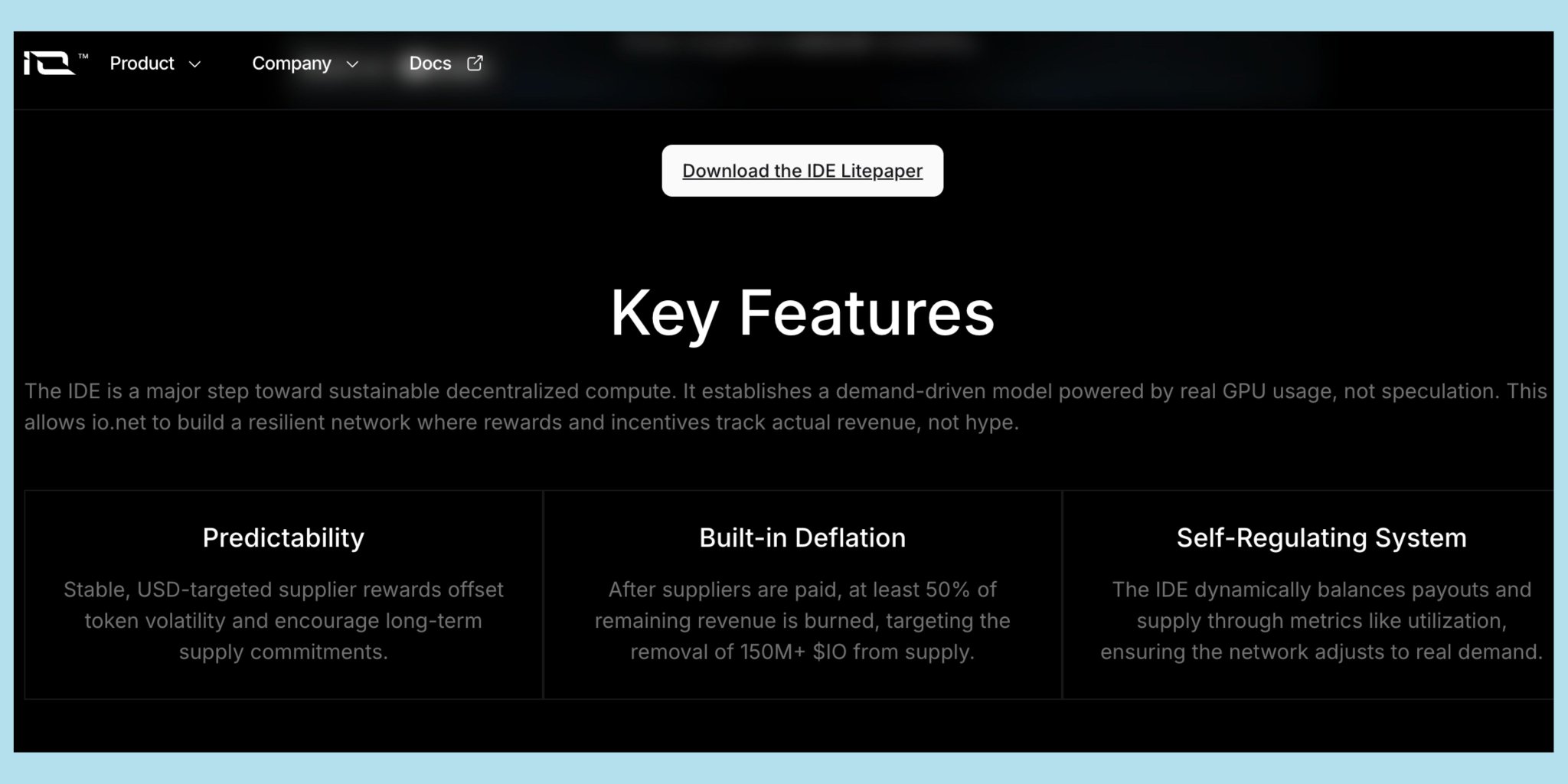
 Bukky (Builder Arc) Community_Lead Influencer B7.23K @XBukkyExplorer
 146 136 13.61K Оригінал >Тенденція IO після випускуНадзвичайно бичачий