Comprar criptomoedas
cartão
Negociação P2P
Compre USDT via marketplace
Cartão de Crédito/Débito
Compre criptomoedas com Visa ou Mastercard
Pagamento de terceiros
Compre criptomoedas pela MoonPay, Simplex e outras
Cartão BitMart
Fortalecendo sua jornada no mundo cripto
Cartão Pré-pago de Cripto
Obtenha seu Mastercard utilizável na hora
USDⓈ-M
Usando USDⓈ como garantia
COIN-M
Usando a própria MOEDA como garantia
TradFi
Negociação em um só lugar para metais, ações e forex
Demo de Trading
Aprenda a negociar sem risco
Visão geral dos Futuros
Plataforma única para tudo o que é relacionados aos Futuros
Futures King
478.000 USDT em prêmios
Evoluir
Visão Geral do Earn
Ativos Parados, Ganhos com Facilidade no Earn
Economia
Ganhe juros com participações
Apostando
Aposta fácil, recompensas altas
Gestão de Patrimônio
Evolua seu patrimônio com uma equipe de ativos de alto nível
RWA
Mantenha BMRUSD e Aproveite os Rendimentos
Exclusivo VIP
Ganhos de forma estável para usuários VIP
Rewards
Hub de recompensas
Descubra recompensas exclusivas de até 14.000 USDT
LaunchPrime
Uma plataforma de lançamento de token e NFT
Programa de Afiliados
Entre para ganhar altas comissões
Powerdrop
A Solução de Última Geração para Airdrops já está DISPONÍVEL!
Centro de eventos
Seu Hub para Todas as Operações Comerciais
Sorteio Diário de Futuros
Chance de ganhar em todas as negociações diárias
Sorteio diário Spot
Ganhe 8.888 USDT em Prêmios Incríveis
Stake to vote
Ganhe airdrops votando
Instituição
Serviços profissionais e exclusivos
VIP
Desbloquear recompensas exclusivas
Academia
Aprenda rapidamente sobre trading e blockchain
Estágio na BitMart
Comece sua carreira em cripto aqui
BitMart Travel
Serviços globais de viagem em um só lugar
INO
Uma plataforma de lançamento de NFTs
Faça Stake de BMX para Listagem
Compartilhar taxas de transação
APIS
Estabilidade robusta e inúmeros terminais
Programa de Corretores
Ganhe comissões pela integração da API
Notícias
Últimas notícias e visualizações
NFT MARKETPLACE
Um mercado de NFT como nenhum outro
Recarga de Celular
Recarregue celulares online de forma fácil e segura
Send
Send money globally, fast and secure
BitMart Mall
Viva com cripto

Bittensor Dados de preços ao vivo
O preço atual de Bittensor é $ 319.70 (TAO/USD). Com um Market Cap de $ 3.69B USD, Volume de Trading em 24 horas de $ 377.36M USD, Uma Variação de Preço em 24 horas de +5.07%, E um Fornecimento Circulante de 11.54M TAO.
Bittensor TAO Histórico de Preços USD
Acompanhe o preço de Bittensor hoje e nos últimos 7, 30 e 90 dias
Período
Mudar
Alterar (%)
Hoje
$ 15.44
5.07%
7Dias
--
--
30Dias
--
--
90Dias
--
--
Adquira TAO agora
Compre e venda TAO de forma fácil e segura na BitMart.
Bittensor Informações de mercado
$ 300.37 Intervalo de 24h $ 319.26
Máximo histórico
$ 0
Mínimo histórico
$ 0
Alteração 24h
5.07%
24h Vol
$ 377,359,446.44
Fornecimento circulante
11.53M
TAO
Capitalização de mercado
$ 3.69B
Fornecimento máximo
21.00M
TAO
Capitalização de mercado totalmente diluída
$ 6.71B
Comércio TAO
Ganhar
Coloque suas criptomoedas ociosas para trabalhar e ganhe renda passiva com poupança, staking e muito mais.
Bittensor X Insight

2xnmore
FA_Analyst
OnChain_Analyst
B
 45.2K @2xnmore
 Altista
TAO is still at a low level; early positioning can avoid later chasing higher prices
2xnmore
FA_Analyst
OnChain_Analyst
B
45.2K @2xnmore Nobody rings a bell at the bottom.
$TAO is not loud right now. That is exactly the point.
The people who move before it makes sense are the ones who never have to chase it later.
This is still early. For now. https://t.co/FT4SuITGy2
 83
83
 8
8
 3.5K
3.5K
2026-08-03 15:37
Tendência de TAO após o lançamento
Altista
TAO is still at a low level; early positioning can avoid later chasing higher prices

Flippix D
3.9K @Flippix_sol Extremamente Bullish
After a period of absorption and shake‑out, the author predicts that TAO will experience a strong rally.
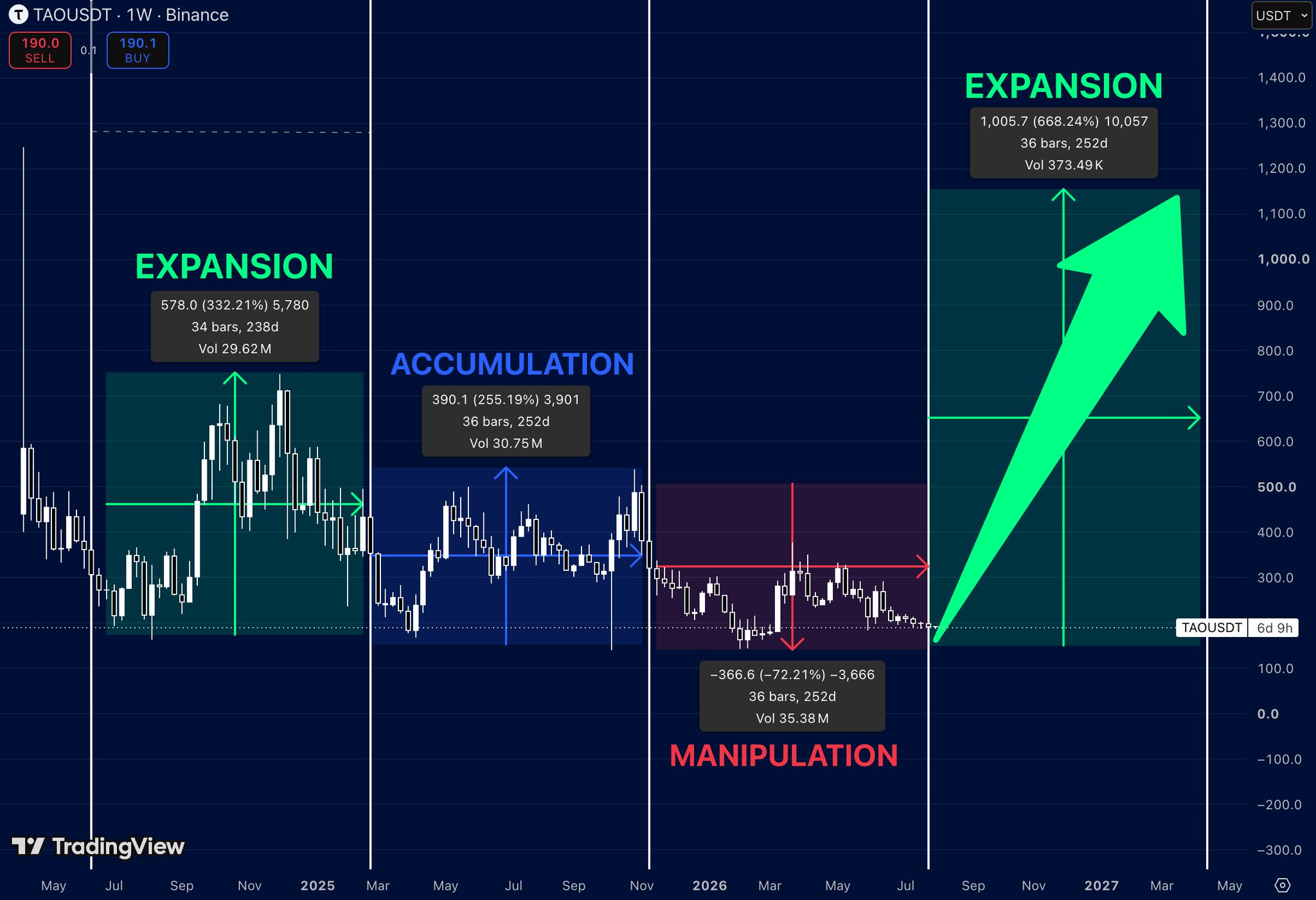
$TAO has been doing one thing for months.
Making people lose interest.
The hype disappeared.
The volatility faded.
Everyone moved on to the next shiny narrative.
And that’s usually when the market quietly starts preparing for its next move.
First came the expansion.
Then a long accumulation phase.
After that, months of manipulation that made it look like the trend was completely dead.
That’s exactly how strong trends often reset.
Not with excitement.
With boredom.
Now imagine what happens if buyers finally take control again.
The same people ignoring $TAO today will be chasing green candles a few months later.
Price doesn’t wait for the crowd.
The crowd waits for price.
If this structure plays out, the next expansion could be the strongest move we’ve seen since the last major rally.
The biggest opportunities almost never feel exciting at the bottom.
That’s why so few people are there before the move begins.
 1
0
172
1
0
172
2026-08-03 15:08
Tendência de TAO após o lançamento
Extremamente Bullish
After a period of absorption and shake‑out, the author predicts that TAO will experience a strong rally.

Kyoshi.tao
Founder
Trader
A
1.6K @KyoshiTakeshiro Altista
The tweet stresses that investing in Bittensor ecosystem projects requires due diligence and praises EnigmaSN63's innovative governance model.
Good to see more people doing actual due diligence before investing their bittensor:native into subnets.
Don’t just look for reasons to buy.
Look for reasons not to.
More often than not, you’ll find plenty.

Ragnarao (ᚱᚱ) D
660 @LordRagnarao My last post was really about project-specific risk.
The more I look around #Bittensor, the more I appreciate teams that spend as much time thinking about incentives and governance as they do the technology itself.
That’s what caught my attention about @EnigmaSN63.
Thank you, @Timmer56566787, for pointing me towards them!
They became the first subnet to implement the treasury wallet model, where prize funds are controlled by validator consensus instead of a single wallet. That makes large, winner-take-all research challenges possible without relying on trust in one operator.
It’s a clever way to fund deep‑tech research without asking participants to simply trust one team with the prize pool.
Whether I invest my $TAO or not is a separate question 😅
But I enjoy learning from projects like @EnigmaSN63 that experiment with governance mechanisms like this.
 1
0
101
1
0
101
2026-08-03 14:37
Tendência de TAO após o lançamento
Altista
The tweet stresses that investing in Bittensor ecosystem projects requires due diligence and praises EnigmaSN63's innovative governance model.
Previsão de preço
Quando é um bom momento para comprar TAO? Devo comprar ou vender TAO agora?
Ao decidir se é um bom momento para comprar ou vender Bittensor (TAO), é importante primeiro se alinhar à sua própria estratégia de trading e perfil de risco. Investidores de longo prazo e traders de curto prazo geralmente interpretam as condições de mercado de forma diferente, então sua decisão deve refletir a sua abordagem pessoal. De acordo com a análise técnica de 4 horas mais recente de TAO, o sinal de trading atual é Hold.

Previsão do Beacon
Previsão Probabilística de Preço (Próximas 24 horas)Aviso de Isenção de Responsabilidade de Previsões do Beacon
Os resultados dos dados exibidos nesta página são analisados com base em dados de negociação reais (OHLCV) do par de trading selecionado, juntamente com indicadores técnicos correspondentes.
Esta previsão é um produto técnico experimental, fornecida apenas para fins de referência. Ela não constitui uma orientação de investimento. Eventos inesperados no mundo real podem afetar significativamente o comportamento do mercado. Os traders devem tomar decisões com cautela.
Esta previsão é um produto técnico experimental, fornecida apenas para fins de referência. Ela não constitui uma orientação de investimento. Eventos inesperados no mundo real podem afetar significativamente o comportamento do mercado. Os traders devem tomar decisões com cautela.
Sobre Bittensor
Bittensor (TAO) is a cryptocurrency launched in 2021and operates on the Bittensor platform. Bittensor has a current supply of 21,000,000 with 11,535,152.9447983 in circulation. The last known price of Bittensor is 261.76193113 USD and is down -0.61 over the last 24 hours. It is currently trading on 327 active market(s) with $299,844,216.24 traded over the last 24 hours. More information can be found at https://bittensor.com.
Leia mais
Comprar TAO
Comércio TAO