Rewards
Futures Daily Draw
100% Chance To Win With Daily Trades
Spot Daily Draw
Win 8,888 USDT In Grand Prizes
Mobile Top-Up
Top up mobiles easily, online, secure
Send
Send money globally, fast and secure
BitMart Mall
Live on crypto

Lido wstETH (WSTETH)
$ 3,346.90 (WSTETH/USD)
0.57%
24H
Lido wstETH Live Price data
Today's price of Lido wstETH Is $ 3,346.90 (WSTETH/USD). With A Market Cap Of $ 12.74B USD. 24-Hour Trading Volume Of $ 9.69M USD, A 24-Hour Price Change Of +0.57%, And A Circulating Supply Of 3.81M WSTETH.
Lido wstETH WSTETH Price History USD
Track the price of Lido wstETH for today, 7 days, 30 days and 90 days
Period
Change
Change (%)
Today
$ 19.07
0.57%
7days
$ 97.97
3.01%
30days
$ 248.72
8.02%
90days
$ 1,413.19
72.92%
Own WSTETH Now
Buy and sell WSTETH easily and securely on BitMart.
Lido wstETH Market Information
$ 3,328.03 24h Range $ 3,392.32
All time high
$ 6,451.44
All time low
$ 894.10
24h Change
0.57%
24h Vol
$ 9,689,911.30
Circulating supply
3.80M
WSTETH
Market cap
$ 12.74B
Max supply
--
Fully diluted market cap
$ 12.74B
Trade WSTETH

Lido wstETH X Insight

Bubbafox
FA_Analyst
Influencer
B
 26.4K @bob4punk
 Neutral
CCIP transfers $13.1M, wstETH leads, encourages staking LINK.

CCIPMetrics D
3.8K @CCIPMetrics #CCIP today
Value transferred: $13,148,079.2
Top sent token: $wstETH @LidoFinance: $3,513,052.7 (26.7%)
Transactions: 1,820
Fees: $1,916.9
Top sender: @Predictstreet: Tx: 872 (47.9%), Fees: $1,431.8 (74.7%)
Pools open. Stake your LINK today at https://t.co/yhMFfpGi0K
 124
124
 9
9
 6.0K
6.0K
2026-07-12 00:57
Trend of WSTETH after release
Neutral
CCIP transfers $13.1M, wstETH leads, encourages staking LINK.

StakingCabin
OnChain_Analyst
Tokenomics_Expert
B
2.8K @stakingcabin Bullish
wstETH can be bridged to Robinhood, continuing to earn ETH staking rewards
One of the biggest challenges in DeFi is fragmented liquidity.
By enabling wstETH to move to Robinhood Chain while continuing to accrue staking rewards, capital can flow into a new ecosystem without sacrificing its underlying yield.

Lido D
228.8K @LidoFinance Staked ETH, meet Robinhood Chain.
Your wstETH can now cross over to @RobinhoodCrypto, carrying its Ethereum staking rewards with it and unlocking a new ecosystem to put it to work in.
↓ https://t.co/23u0Vlp9rE
1
0
110
2026-07-07 14:27
Trend of WSTETH after release
Bullish
wstETH can be bridged to Robinhood, continuing to earn ETH staking rewards

Mars_DeFi
Researcher
Educator
B
26.2K @Mars_DeFi Extremely Bullish
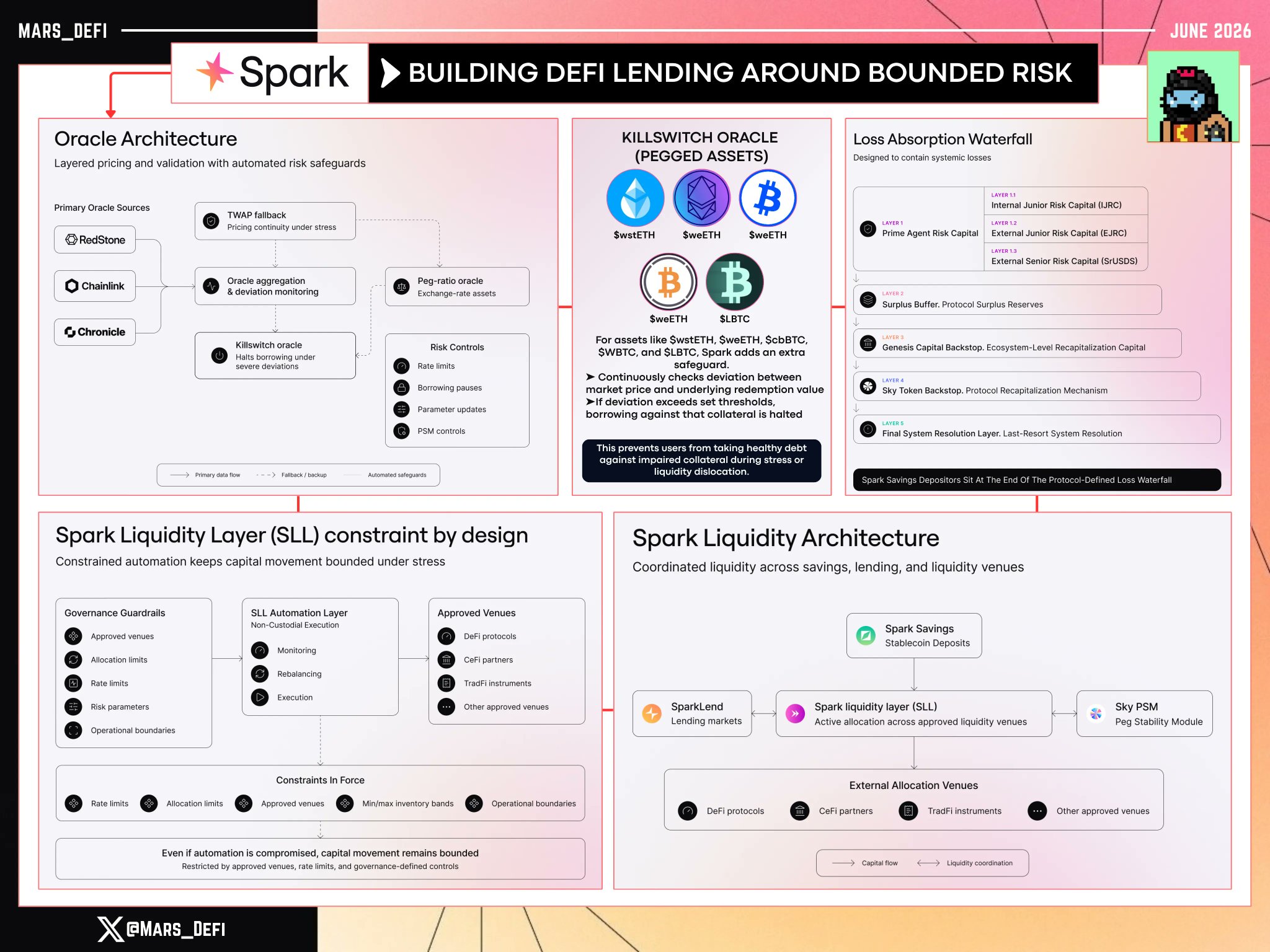
Spark builds a safe and robust DeFi lending infrastructure through multi‑layer risk control, oracles, and liquidity management.
Most lending markets optimize for liquidity and capital efficiency first, then try to manage risk after the fact while @sparkdotfi ’s security/risk framework is one of the better examples of where DeFi lending is heading.
The whole architecture is built around bounded risk, controlled capital movement, layered loss absorption, oracle redundancy, and stress-response mechanisms.
Here’s how Spark does it.
—
Spark keeps a deliberately narrow collateral set, which reduces exposure to fragmented liquidity, weak redemption assumptions, and long-tail collateral risk.
Instead of trying to list every possible asset, it prioritizes predictable liquidation behavior and deeper market structure during stress.
For assets with more unique or chain-specific risks, Spark uses isolated markets. That means risk can be priced more precisely per collateral type, and a single collateral issue does not automatically contaminate the broader pool.
—
The oracle setup is also important.
Spark uses a three-oracle median system drawing from @redstone_defi , @chainlink , and @ChronicleLabs oracle.
When all three return valid prices, the median is used. If only two valid sources are available, the average is used, with fallback logic under degraded conditions.
That reduces dependency on any single oracle provider.
For pegged or exchange-rate assets like $wstETH, $weETH, $cbBTC, $WBTC, and $LBTC, Spark adds another layer through a killswitch oracle.
• This continuously checks whether market pricing is diverging from the underlying exchange-rate or redemption value.
• If deviation passes predefined thresholds, Spark can halt new borrowing against that collateral.
That is a very important safeguard because it prevents users from borrowing healthy debt against impaired collateral during periods of stress, liquidity fragmentation, or pricing dislocation.
—
The liquidity architecture is another strong part of the design.
Spark’s Liquidity Layer is not just idle capital sitting passively in a pool. It coordinates liquidity across Spark Savings, SparkLend, the Sky PSM, and other approved venues.
But the key part is that this liquidity movement is constrained by design.
All venues must be pre‑approved by governance. Capital movement is subject to;
• allocation limits
• rate limits
• min/max inventory bands
• risk parameters
• operational boundaries
Spark’s framework is built around controlled risk, not unlimited automation.
Capital can only move through approved venues, rate limits, allocation limits, and governance‑defined boundaries. So even if automation fails, the damage is contained.
The same idea applies to losses.
Before depositors are affected, losses pass through multiple buffers: risk capital, surplus buffer, Genesis Backstop, SKY backstop, and final resolution.
Spark Savings also has 1:1 USDS backing, liquidity buffers, fast withdrawal routing, real-time transparency, Credora risk reviews, and limited bridge exposure.
—
Overall, the theme is simple:
Spark is not just chasing higher yields.
It is building DeFi credit infrastructure around constrained liquidity, layered protection, and limited blast radius.

Spark D
69.7K @sparkdotfi Inside Spark’s loss absorption & risk frameworks.
Spark’s security architecture is designed around:
• bounded capital movement
• explicit loss absorption layers
• coordinated liquidity management
• multi-layered oracle systems
• constrained automation under governance-defined limits
This deep dive breaks down how Spark structures risk, liquidity, and loss absorption across Spark Savings, SparkLend, and the Spark Liquidity Layer before losses propagate toward user deposits.
Including:
• updated loss absorption waterfall
• Prime Agent risk capital
• Genesis Capital Backstop
• oracle and killswitch architecture
• programmatic liquidity coordination
• constrained allocation design under stress
Security by design.
Resilience by architecture.
See what sits between losses and user deposits: https://t.co/JQrfSxMB4z
30
18
1.7K
2026-06-03 14:12
Trend of WSTETH after release
Extremely Bullish
Spark builds a safe and robust DeFi lending infrastructure through multi‑layer risk control, oracles, and liquidity management.
Price Prediction
When is a good time to buy WSTETH? Should I buy or sell WSTETH now?
When deciding whether it’s a good time to buy or sell Lido wstETH (WSTETH), it’s important to first align with your own trading strategy and risk profile.Long-term investors and short-term traders often interpret market conditions differently, so your decision should reflect your personal approach. According to the latest WSTETH 4-hour technical analysis, the current trading signal is Hold. According to the latest WSTETH 1-day technical analysis, the current signal is Hold.

Beacon Prediction
Probabilistic Price Forecast (Next 24 Hours)Beacon Prediction Disclaimer
The data results displayed on this page are analyzed based on actual trading data (OHLCV) of the selected trading pair along with corresponding technical indicators.
This prediction is an experimental technical product and is provided for reference purposes only. It does not constitute investment advice. Unexpected real-world events may significantly impact market behavior. Traders should make decisions with caution.
This prediction is an experimental technical product and is provided for reference purposes only. It does not constitute investment advice. Unexpected real-world events may significantly impact market behavior. Traders should make decisions with caution.
About Lido wstETH
Lido wstETH (WSTETH) is a cryptocurrency launched in 2020and operates on the Ethereum platform. Lido wstETH has a current supply of 3,807,834.45169063. The last known price of Lido wstETH is 3,305.89974941 USD and is up 1.19 over the last 24 hours. It is currently trading on 798 active market(s) with $6,757,557.09 traded over the last 24 hours. More information can be found at https://www.lido.fi.
Read More