Rewards
Futures Daily Draw
100% Chance To Win With Daily Trades
Spot Daily Draw
Win 8,888 USDT In Grand Prizes
Mobile Top-Up
Top up mobiles easily, online, secure
Send
Send money globally, fast and secure
BitMart Mall
Live on crypto

Bittensor Live Price data
Today's price of Bittensor Is $ 312.47 (TAO/USD). With A Market Cap Of $ 3.60B USD. 24-Hour Trading Volume Of $ 372.00M USD, A 24-Hour Price Change Of +3.39%, And A Circulating Supply Of 11.54M TAO.
Bittensor TAO Price History USD
Track the price of Bittensor for today, 7 days, 30 days and 90 days
Period
Change
Change (%)
Today
$ 10.24
3.39%
7days
--
--
30days
--
--
90days
--
--
Own TAO Now
Buy and sell TAO easily and securely on BitMart.
Bittensor Market Information
$ 300.36 24h Range $ 319.24
All time high
$ 0
All time low
$ 0
24h Change
3.39%
24h Vol
$ 371,998,292.48
Circulating supply
11.53M
TAO
Market cap
$ 3.60B
Max supply
21.00M
TAO
Fully diluted market cap
$ 6.56B
Trade TAO

Bittensor X Insight

2xnmore
FA_Analyst
TA_Analyst
B
 45.5K @2xnmore
 Bullish
TAO is still at a low level; early positioning can avoid later chasing higher prices
2xnmore
FA_Analyst
TA_Analyst
B
45.5K @2xnmore Nobody rings a bell at the bottom.
$TAO is not loud right now. That is exactly the point.
The people who move before it makes sense are the ones who never have to chase it later.
This is still early. For now. https://t.co/FT4SuITGy2
 83
83
 8
8
 3.5K
3.5K
2026-08-03 15:37
Trend of TAO after release
Bullish
TAO is still at a low level; early positioning can avoid later chasing higher prices

Flippix
TA_Analyst
Trader
A
3.8K @Flippix_sol Extremely Bullish
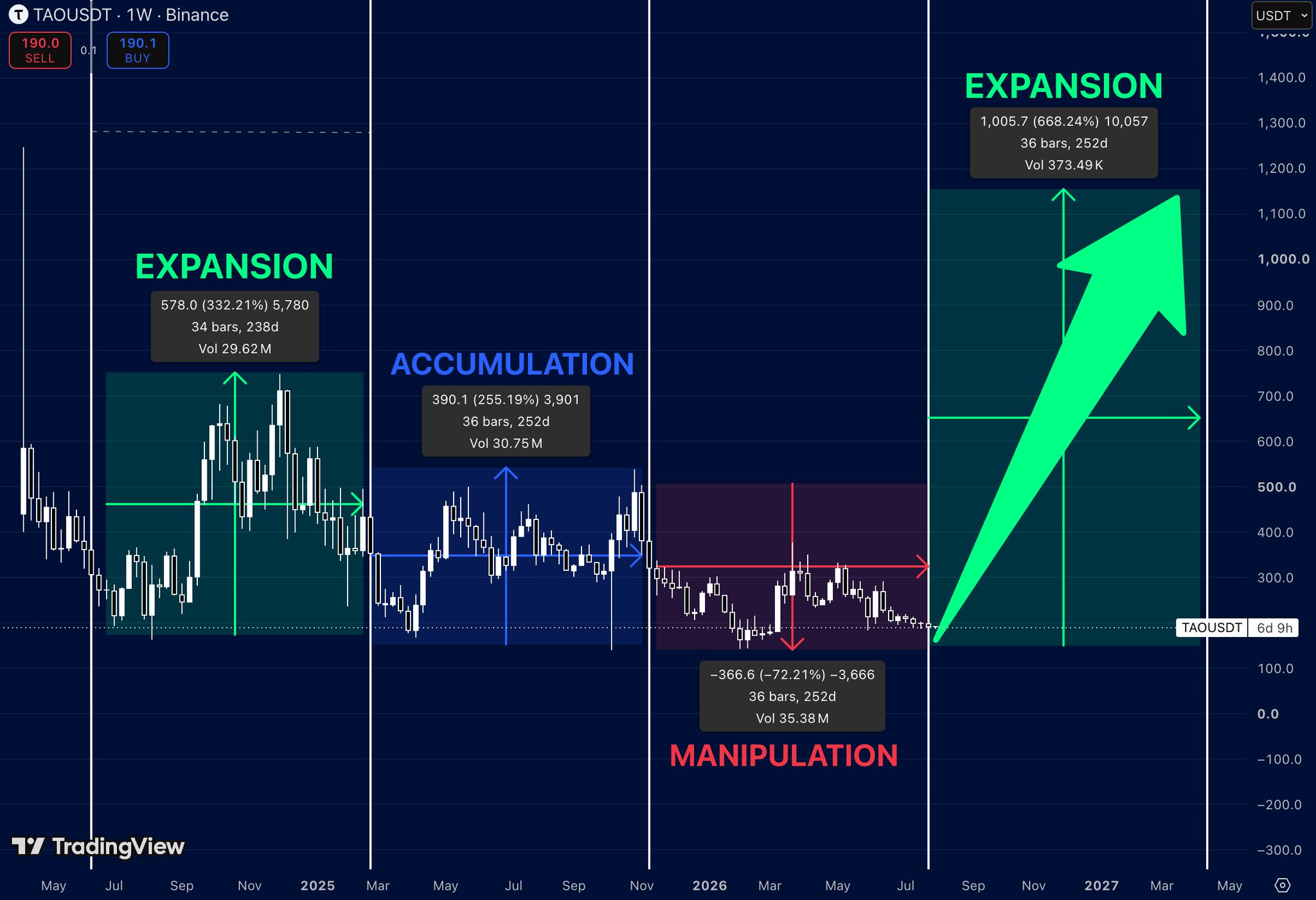
After a period of absorption and shake‑out, the author predicts that TAO will experience a strong rally.
$TAO has been doing one thing for months.
Making people lose interest.
The hype disappeared.
The volatility faded.
Everyone moved on to the next shiny narrative.
And that’s usually when the market quietly starts preparing for its next move.
First came the expansion.
Then a long accumulation phase.
After that, months of manipulation that made it look like the trend was completely dead.
That’s exactly how strong trends often reset.
Not with excitement.
With boredom.
Now imagine what happens if buyers finally take control again.
The same people ignoring $TAO today will be chasing green candles a few months later.
Price doesn’t wait for the crowd.
The crowd waits for price.
If this structure plays out, the next expansion could be the strongest move we’ve seen since the last major rally.
The biggest opportunities almost never feel exciting at the bottom.
That’s why so few people are there before the move begins.
 1
0
172
1
0
172
2026-08-03 15:08
Trend of TAO after release
Extremely Bullish
After a period of absorption and shake‑out, the author predicts that TAO will experience a strong rally.

Kyoshi.tao
Founder
Dev
A
1.6K @KyoshiTakeshiro Bullish
The tweet stresses that investing in Bittensor ecosystem projects requires due diligence and praises EnigmaSN63's innovative governance model.
Good to see more people doing actual due diligence before investing their bittensor:native into subnets.
Don’t just look for reasons to buy.
Look for reasons not to.
More often than not, you’ll find plenty.

Ragnarao (ᚱᚱ) D
919 @LordRagnarao My last post was really about project-specific risk.
The more I look around #Bittensor, the more I appreciate teams that spend as much time thinking about incentives and governance as they do the technology itself.
That’s what caught my attention about @EnigmaSN63.
Thank you, @Timmer56566787, for pointing me towards them!
They became the first subnet to implement the treasury wallet model, where prize funds are controlled by validator consensus instead of a single wallet. That makes large, winner-take-all research challenges possible without relying on trust in one operator.
It’s a clever way to fund deep‑tech research without asking participants to simply trust one team with the prize pool.
Whether I invest my $TAO or not is a separate question 😅
But I enjoy learning from projects like @EnigmaSN63 that experiment with governance mechanisms like this.
 1
0
101
1
0
101
2026-08-03 14:37
Trend of TAO after release
Bullish
The tweet stresses that investing in Bittensor ecosystem projects requires due diligence and praises EnigmaSN63's innovative governance model.
Price Prediction
When is a good time to buy TAO? Should I buy or sell TAO now?
When deciding whether it’s a good time to buy or sell Bittensor (TAO), it’s important to first align with your own trading strategy and risk profile.Long-term investors and short-term traders often interpret market conditions differently, so your decision should reflect your personal approach. According to the latest TAO 4-hour technical analysis, the current trading signal is Hold.

Beacon Prediction
Probabilistic Price Forecast (Next 24 Hours)Beacon Prediction Disclaimer
The data results displayed on this page are analyzed based on actual trading data (OHLCV) of the selected trading pair along with corresponding technical indicators.
This prediction is an experimental technical product and is provided for reference purposes only. It does not constitute investment advice. Unexpected real-world events may significantly impact market behavior. Traders should make decisions with caution.
This prediction is an experimental technical product and is provided for reference purposes only. It does not constitute investment advice. Unexpected real-world events may significantly impact market behavior. Traders should make decisions with caution.
About Bittensor
Bittensor (TAO) is a cryptocurrency launched in 2021and operates on the Bittensor platform. Bittensor has a current supply of 21,000,000 with 11,535,152.9447983 in circulation. The last known price of Bittensor is 261.76193113 USD and is down -0.61 over the last 24 hours. It is currently trading on 327 active market(s) with $299,844,216.24 traded over the last 24 hours. More information can be found at https://bittensor.com.
Read More
Buy TAO
Trade TAO