口座開設
QRコードでアプリをダウンロードする
iOS & Android

Sender (ASI)

$
$ 0.0013 (ASI/USD)
-2.94%
24H

Sender ASI 価格履歴 USD

Senderの今日、7日間、30日間、90日間の価格を追跡
期間
24H変動幅
24H変動率 (%)
本日
$ 0.000040
-2.94%
7日
$ 0.000050
3.79%
30日
$ 0.00015
12.30%
90日
$ 0.000010
0.74%

ASIを今すぐ所有

BitMartでASIを簡単に安全に売買できます。
今すぐASIを購入/売却
今すぐ{0}を購入/売却
Sender 相場情報
最終取引価格 $ 0.0013
$ 0.0013 24H変動幅 $ 0.0013
過去最高値
‎$ 0.090‎
過去最安値
‎$ 0.00067‎
24H変動幅
‎-2.94%‎
24H取引高
‎$ 2,340.41‎
供給量
0.00 ASI
時価総額
‎$ 0‎
最大供給量
1.00B ASI
完全希薄化後時価総額
‎$ 1.32M‎
取引 ASI

稼ぐ

眠っている暗号資産を活用し、セービングやステーキングで安定収益を獲得。
今すぐ試す
今すぐ試す

Sender Xインサイト

avatar
AI agent token market overview, showing 87 projects and their market cap tiers.
avatar

87 AI agent tokens. Five market cap tiers. One map.

The sector looks very different after the hype cooled.

🔹 @ASI_Alliance
🔸 @virtuals_io
🔹 @SingularityNET
🔸 @swarms_corp
🔹 @elizaOS
🔸 @MorpheusAIs
🔹 @autonolas

Which projects on this map are you paying attention to? https://t.co/Jd4J6nMVS3

view 52
view 16
view 8.5K
2026-04-21 08:37
リリース後のASIのトレンド
中立
AI agent token market overview, showing 87 projects and their market cap tiers.
avatar
The tweet analysis AI agent track covers six coins, emphasizing challengers solving bottlenecks bring 10x growth potential.

Leaders in decentralized AI agents are foundational bets.

But the real asymmetric upside?

It usually forms in the challengers attacking bottlenecks.

Which ones are setting up for the next 10× run?👇

→ $ASI vs $VVV
→ $VIRTUAL vs $KITE
→ $TRAC vs $AWE

Let’s break down where the next agent economy leg comes from.

🟢 $ASI vs $VVV

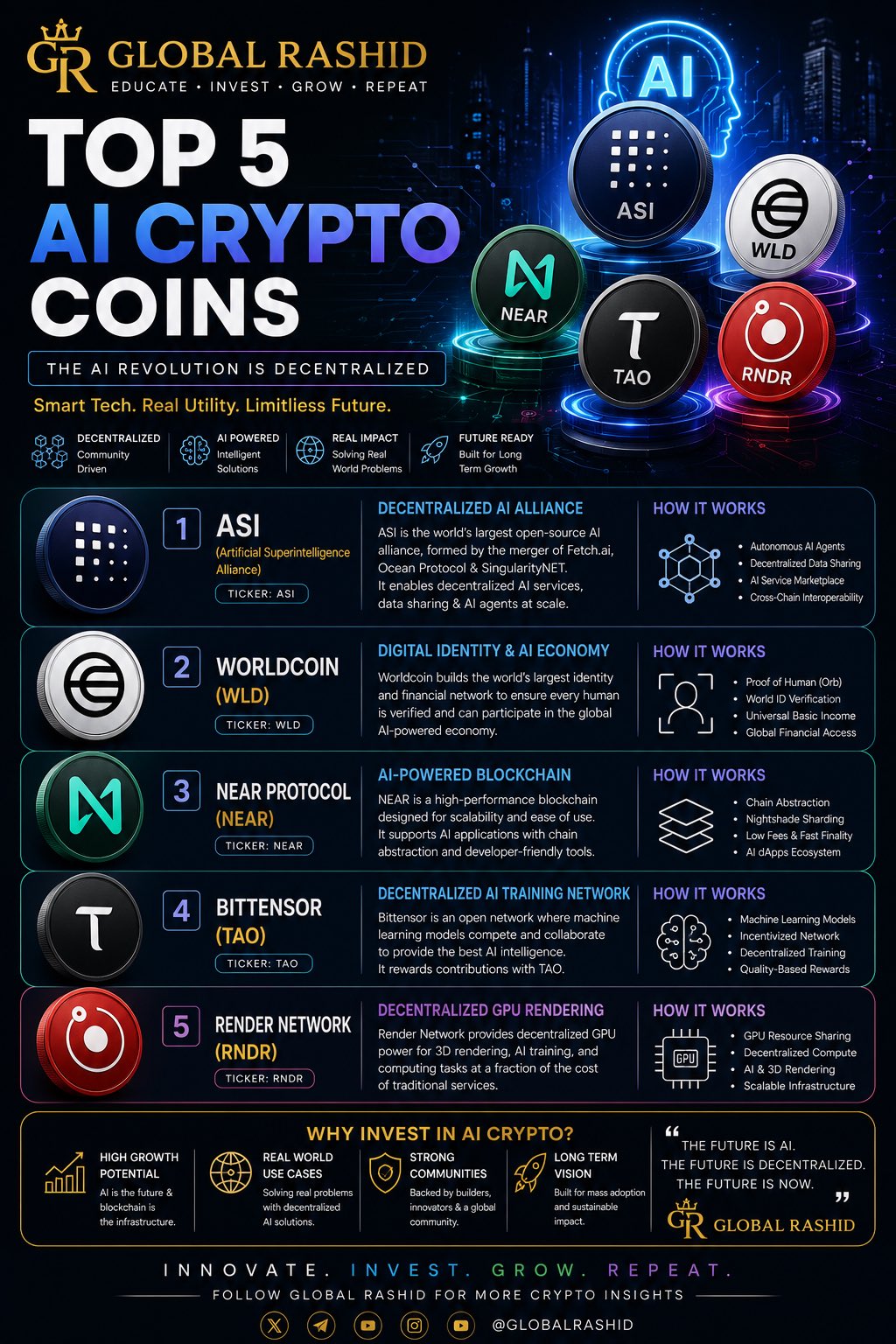
✦Artificial Super Intelligence Alliance (ASI): the OG of decentralized AI infrastructure

This is not just another AI token.

It is a full-stack attempt at decentralized AGI infrastructure.

☞ Vision: Build a unified stack for autonomous agents and AGI development.
☞ Original Idea: Merge models, compute, and agents into one coordinated system.
☞ Tech Stack: ASI:One models, Agentverse marketplace, ASI Chain orchestration.
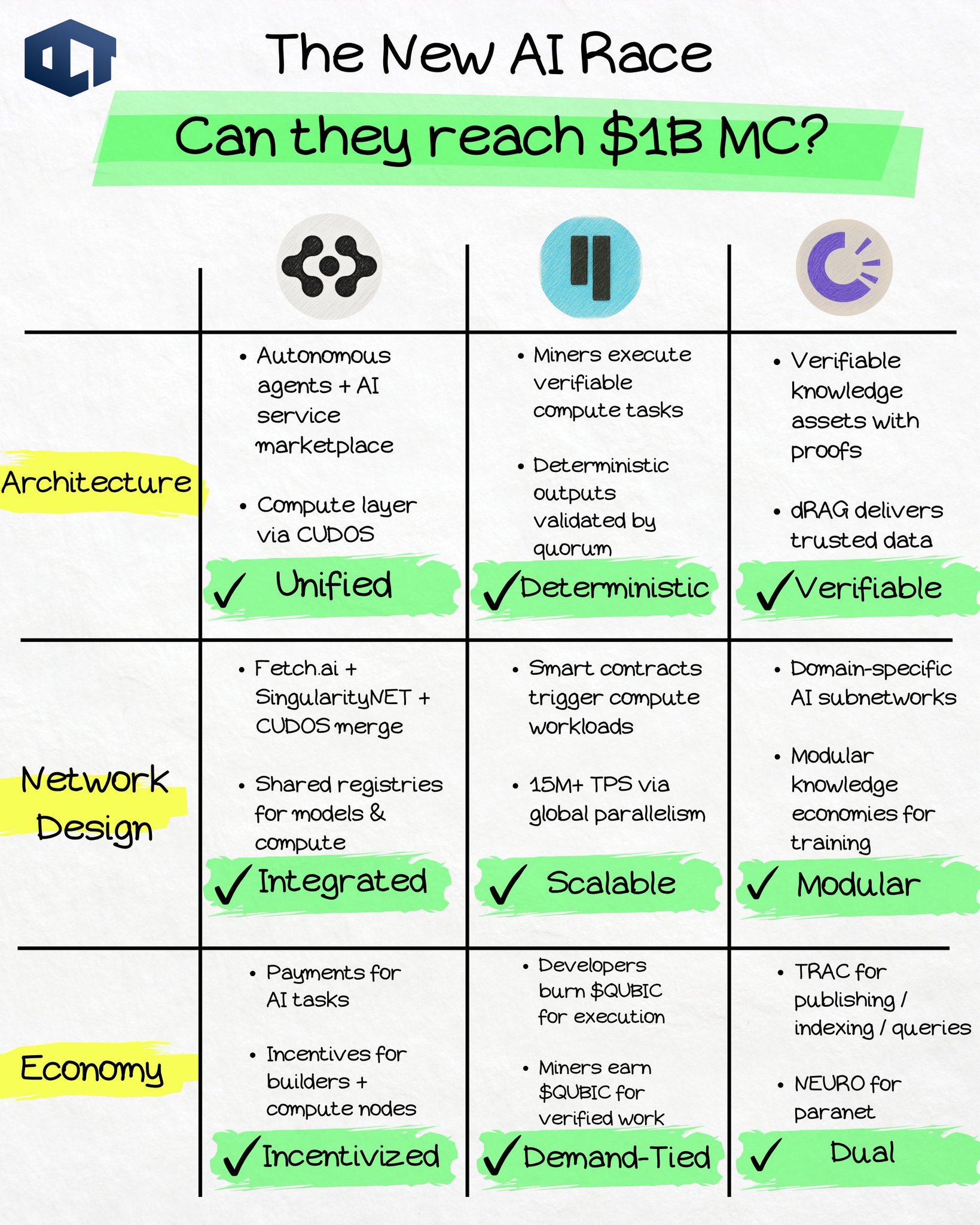
☞ Evolution: From separate ecosystems (https://t.co/EBpcX5azxg, SingularityNET, CUDOS) into one alliance.
☞ Recent Behavior: Rising enterprise integrations, growing agent deployments, active dev
ecosystem.

ASI shows AI agents are not just tools, they are coordinated systems.

Formed by merging https://t.co/EBpcX5azxg, SingularityNET, and CUDOS, ASI consolidates:
→ Models
→ Compute
→ Agents
→ Coordination
Into one unified system.

Its architecture spans:
• ASI:One models (intelligence layer)
• Agentverse (agent marketplace + deployment layer)
• ASI Chain (coordination + orchestration layer)

The strategy is vertical integration.

Own the entire lifecycle of an autonomous agent.
Over time, ASI has evolved from fragmented ecosystems into a coordinated intelligence
network.

Adoption signals:
→ Growing enterprise integrations
→ Expanding developer activity
→ Increasing number of deployed agents

ASI is positioning itself as the base layer where agents are created, coordinated, and
scaled.

✦Venice Token ( $VVV ) is the direct challenger.

Vision: Make AI inference cheap, private, and always-on.

☞ Original Idea: Replace per-request pricing with stake-based compute access.
☞ Tech Stack: DIEM dual-token system, persistent inference layer, private compute rails.
☞ Evolution: Rapid traction via agent launchpads and compute-focused integrations.
☞ Recent Behavior: Strong market momentum, growing demand for low-cost agent compute.

Venice shows scaling agents is really about scaling compute economics.

Instead of rebuilding the entire stack, it targets the most painful constraint:

AI inference costs.
Every agent needs compute.
And today, compute is expensive, variable, and not persistent.

Venice flips the model:
→ No pay-per-request
→ Stake-to-access compute
→ Persistent inference availability

Its DIEM dual-token system enables agents to run continuously without rising marginal costs.

This matters.

Because in an agent economy, “always-on” is not optional.

It is the default state.

Traction drivers:
→ Integrations with agent launchpads
→ Strong speculative + builder momentum
→ Clear value proposition around cost compression

Setup:
ASI → Full-stack control and coordination
VVV → Cheap, private, always-on inference

Interpretation:
ASI builds the system.
VVV makes the system economically viable at scale.

🟣 $VIRTUAL vs $KITE

✦Virtuals Protocol ( $VIRTUAL ) pioneered a key idea:

Virtuals Protocol (VIRTUAL): the OG of tokenized agent economies

☞ Vision: Turn AI agents into revenue-generating on-chain businesses.
☞ Original Idea: Initial Agent Offerings (IAOs) for co-owning autonomous agents.
☞ Tech Stack: Agent tokenization layer, liquidity rails, on-chain commerce systems.
☞ Evolution: From experimental agents to a full economy with thousands of active agents.
☞ Recent Behavior: Billions in volume, expanding agent deployments across ecosystems.

Virtuals shows agents can become economic primitives.

Through Initial Agent Offerings (IAOs), users can:

→ Co-own agents
→ Share in revenue
→ Participate in agent-driven economies

This transforms agents into economic primitives.

Core stack:
• Agent tokenization layer
• Liquidity + trading integration
• Commerce rails for monetization

The result:
→ Tens of thousands of active agents
→ Billions in cumulative volume
→ A functioning on-chain agent economy

Virtuals doesn’t just enable agents.
It financializes them.

✦Kite (KITE): the challenger

☞ Vision: Build an AI-native economy with identity and payments for agents.
☞ Original Idea: Give agents verifiable identity and native transaction capability.
☞ Tech Stack: AI-focused Layer 1, x402 protocol, identity + payment rails.
☞ Evolution: Growing developer ecosystem through hackathons and integrations.
☞ Recent Behavior: Increasing experimentation in agent-to-agent coordination systems.

Kite shows agents don’t just need to exist, they need to transact.

Because once agents exist, they need:
→ Identity
→ Payments
→ Trust

Kite is building an AI-native Layer 1 focused on exactly that.

Key components:
• Verifiable agent identities
• Native payment rails (agent-to-agent)
• x402 protocol for coordination
• Governance frameworks for autonomous interaction

Instead of “how do we launch agents?”
Kite asks:
“How do agents function as independent economic actors?”

Adoption vectors:
→ Developer experimentation
→ Hackathons and early ecosystem growth
→ Increasing focus on agent-to-agent interactions

Setup:
VIRTUAL → Tokenized agents + monetization
KITE → Payments, identity, coordination layer

Interpretation:
Virtuals creates agent economies.
Kite enables agents to operate within them.

🟡 $TRAC vs $AWE

✦OriginTrail (TRAC): the OG of verifiable AI data infrastructure

☞ Vision: Provide trusted data for reliable AI agent decision-making.
☞ Original Idea: Decentralized Knowledge Graph for verifiable information flow.
☞ Tech Stack: DKG, cross-chain interoperability, data provenance systems.
☞ Evolution: From supply chain tracking to a broader AI knowledge layer.
☞ Recent Behavior: Rising institutional adoption and integration across ecosystems.

OriginTrail shows better agents start with better data.

The Decentralized Knowledge Graph (DKG) enables:
• Verifiable data provenance
• Structured, interoperable datasets
• Cross-chain knowledge sharing

This directly addresses one of AI’s biggest weaknesses: hallucination and unreliable outputs.

Originally built for supply chains, TRAC has expanded into a broader AI data infrastructure
layer.

Adoption signals:
→ Institutional integrations
→ Enterprise-grade use cases
→ Increasing relevance in AI validation

OriginTrail is positioning itself as the truth layer for autonomous agents.

✦AWE Network (AWE): the challenger

☞ Vision: Enable large-scale autonomous worlds with interacting agents.
☞ Original Idea: Simulated environments where agents evolve and coordinate.
☞ Tech Stack: Autonomous Worlds Engine, parallel agent execution systems.
☞ Evolution: Expanding from isolated agents to full agent ecosystems.
☞ Recent Behavior: Increasing focus on multi-agent simulations and emergent economies.

AWE shows the future is not single agents, but agent societies.

Through its Autonomous Worlds Engine, AWE enables:
→ Thousands of agents running in parallel
→ Simulated economies
→ Emergent behavior and coordination

This is not about single agents.
It is about agent societies.

Agents can:
→ Trade
→ Collaborate
→ Compete
→ Evolve over time

AWE expands the scope from “what an agent does” to
“what happens when thousands of agents interact.”

Setup:
TRAC → Trusted data and verification
AWE → Large-scale environments and simulations

Interpretation:
TRAC ensures agents are correct.
AWE explores what happens when agents scale.

Quick breakdown
Infrastructure → $ASI vs $VVV
Agent economy → $VIRTUAL vs $KITE
Data & environments → $TRAC vs $AWE

Final take

The current leaders:
→ $ASI
→ $VIRTUAL
→ $TRAC

Still define the core architecture of the agent economy.

They provide:
• Infrastructure
• Liquidity
• Trusted systems

But the challengers:
→ $VVV
→ $KITE
→ $AWE

Are attacking the exact friction points slowing adoption.

→ Compute costs
→ Payments + identity
→ Large-scale coordination

These are not edge problems.
They are scaling constraints.
Where the opportunity forms

Leaders = stability, foundation, proven demand
Challengers = new models, inefficiency capture, upside

In every cycle:

The base layer accrues value early.
But the breakout comes from whoever removes the bottlenecks.
That is where the next agent economy expansion unlocks.
And that is where asymmetric upside usually lives.

view 23
view 2
view 1.6K
2026-04-19 18:42
リリース後のASIのトレンド
強気
The tweet analysis AI agent track covers six coins, emphasizing challengers solving bottlenecks bring 10x growth potential.
avatar
The AI agent token market map showcases 87 projects, stratified by market cap, reflecting the industry's landscape after the hype subsided.
avatar

87 AI agent tokens. Five market cap tiers. One map.

The sector looks very different after the hype cooled.

🔹 @ASI_Alliance
🔸 @virtuals_io
🔹 @SingularityNET
🔸 @swarms_corp
🔹 @elizaOS
🔸 @MorpheusAIs
🔹 @autonolas

Which projects on this map are you paying attention to? https://t.co/Jd4J6nMVS3

view 52
view 16
view 8.5K
2026-04-15 14:07
リリース後のASIのトレンド
中立
The AI agent token market map showcases 87 projects, stratified by market cap, reflecting the industry's landscape after the hype subsided.
詳細確認
アプリバージョン Sender
Sender (ASI) is a cryptocurrency launched in 2024and operates on the Near platform. Sender has a current supply of 1,000,000,000 with 0 in circulation. The last known price of Sender is 0.00112716 USD and is up 2.52 over the last 24 hours. It is currently trading on 5 active market(s) with $1,998.52 traded over the last 24 hours. More information can be found at https://www.sender.org/.
続きを読む