Sky (SKY)

$0.05564  -4.56%  24H

ソーシャル・センチメント・インデックス(SSI)

マーケット・パルス・ランキング(MPR)

Xへの投稿

  • slappjakke FA_Analyst Tokenomics_Expert C
     61.01K  @Slappjakke
    slappjakke FA_Analyst Tokenomics_Expert C
     61.01K  @Slappjakke

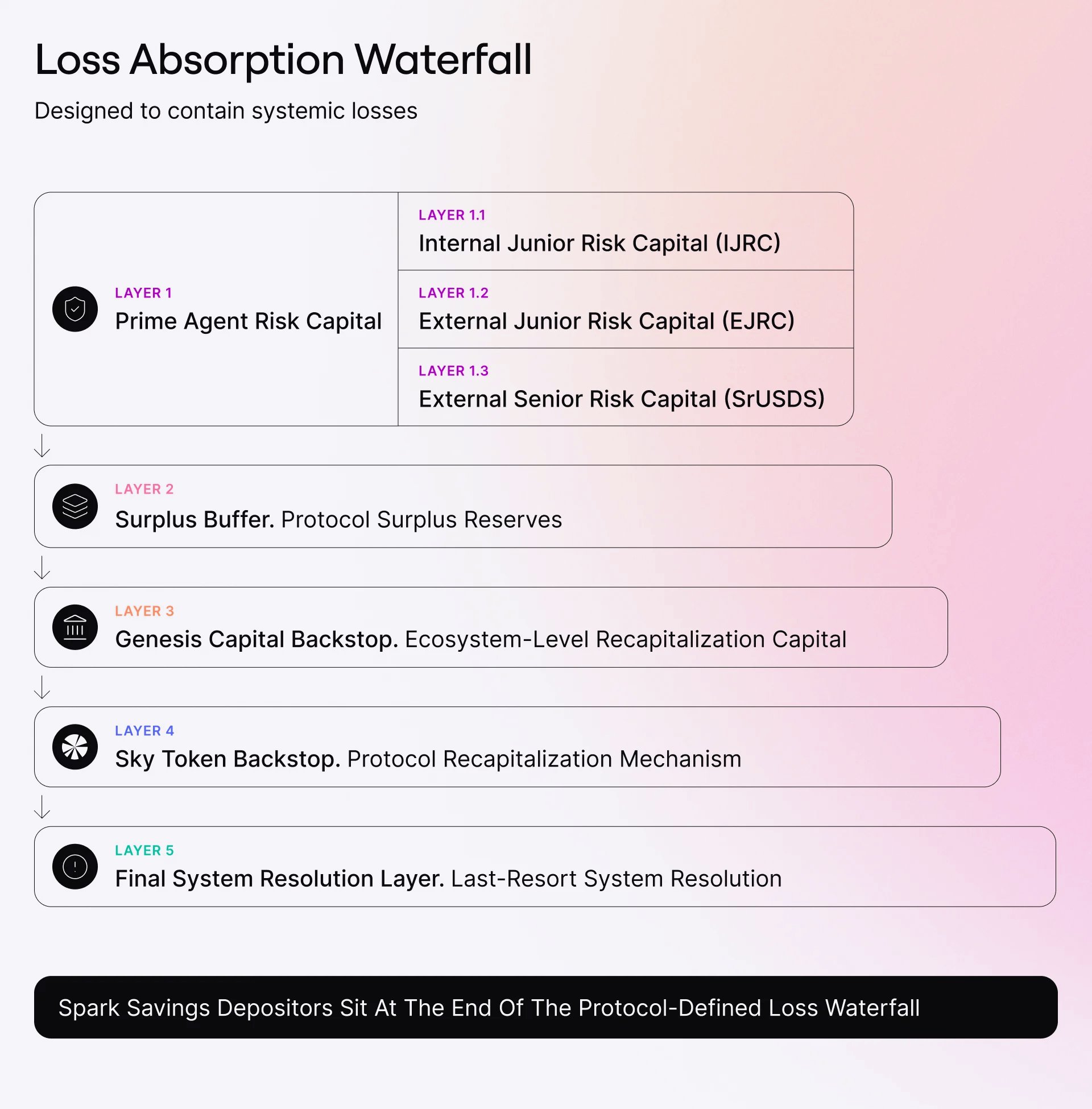
    When reviewing a DeFi protocol security should always be in mind. Moneymarkets are spending millions on audits, and have Risk Teams monitoring and reviewing collateral assets, but do you know who's first in line to absorb losses if funds are actually lost in the protocols you deploy your assets into? @sparkdotfi SparkLend breaks down the waterfall of loss absorption through 5 layers Layer 1: Prime Agent Risk Capital Spark eats its own losses first through internal treasury capital, then pulls in external junior money, and only after that touches the senior layer Layer 2: Surplus Buffer Protocol fees and liquidation revenue pile up here as a system-wide shock absorber Layer 3: Genesis Capital Backstop New layer (pending governance) where excess capital sitting idle across the Sky ecosystem gets tapped before SKY dilution kicks in Layer 4: Sky Token Backstop If everything above is depleted, the protocol mints SKY to recapitalize. Minting SKY is governance-controlled and designed for genuine tail scena

     43  8  1.27K
    オリジナル >
    リリース後のSKYのトレンド
     強気
    SparkLend enhances protocol security and protects depositor funds through a five-layer loss absorption mechanism.
  • Eli5DeFi DeFi_Expert OnChain_Analyst C
     46.16K  @Eli5defi
    Eli5DeFi DeFi_Expert OnChain_Analyst C
     46.16K  @Eli5defi

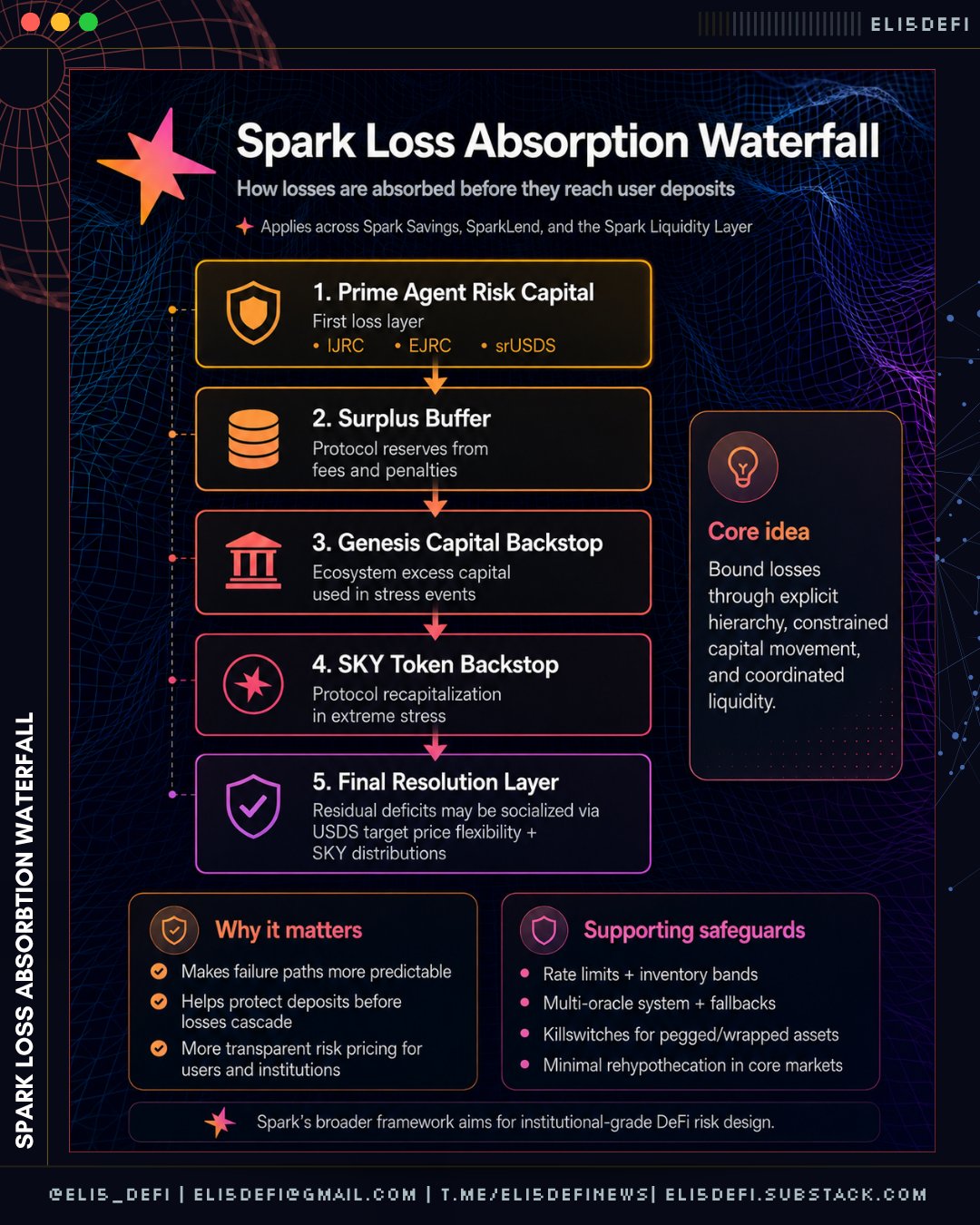
    Spark just published one of the clearer security frameworks in scaled DeFi. Not through vague “security” claims, but through a proper loss absorption waterfall. In simple terms: It explains how losses are absorbed before they reach user deposits across Spark Savings, SparkLend, and the Spark Liquidity Layer. That matters more after the latest wave of DeFi exploits. The recent KelpDAO rsETH exploit showed how one weak cross-chain component can spread stress across lending markets, trigger emergency freezes, and turn “isolated risk” into ecosystem-wide liquidity pressure. This is exactly why explicit risk design matters. Spark’s core idea is bounded capital movement → Explicit loss hierarchy → Programmatic liquidity coordination → Multi-oracle safeguards → Governance-constrained automation. In plain english: → Losses flow in order: prime agent capital, surplus buffer, genesis backstop, sky backstop, then final resolution → Only approved collateral; depegs can trigger emergency shutdown via special pri

     36  18  2.84K
    オリジナル >
    リリース後のSKYのトレンド
     強気
    Spark has released a clear loss absorption framework aimed at protecting user deposits from DeFi risk.
  • Eli5DeFi DeFi_Expert OnChain_Analyst C
     46.16K  @Eli5defi
    Eli5DeFi DeFi_Expert OnChain_Analyst C
     46.16K  @Eli5defi

    Spark just published one of the clearer security frameworks in scaled DeFi. Not through vague “security” claims, but through a proper loss absorption waterfall. In simple terms: It explains how losses are absorbed before they reach user deposits across Spark Savings, SparkLend, and the Spark Liquidity Layer. That matters more after the latest wave of DeFi exploits. The recent KelpDAO rsETH exploit showed how one weak cross-chain component can spread stress across lending markets, trigger emergency freezes, and turn “isolated risk” into ecosystem-wide liquidity pressure. This is exactly why explicit risk design matters. Spark’s core idea is bounded capital movement → Explicit loss hierarchy → Programmatic liquidity coordination → Multi-oracle safeguards → Governance-constrained automation. In plain english: → Losses flow in order: prime agent capital, surplus buffer, genesis backstop, sky backstop, then final resolution → Only approved collateral; depegs can trigger emergency shutdown via special pri

     36  18  2.84K
    オリジナル >
    リリース後のSKYのトレンド
     非常に強気
    Spark releases a clear DeFi security framework to protect user funds.
  • slappjakke FA_Analyst Tokenomics_Expert C
     61.01K  @Slappjakke

    When reviewing a DeFi protocol security should always be in mind. Moneymarkets are spending millions on audits, and have Risk Teams monitoring and reviewing collateral assets, but do you know who's first in line to absorb losses if funds are actually lost in the protocols you deploy your assets into? @sparkdotfi SparkLend breaks down the waterfall of loss absorption through 5 layers Layer 1: Prime Agent Risk Capital Spark eats its own losses first through internal treasury capital, then pulls in external junior money, and only after that touches the senior layer Layer 2: Surplus Buffer Protocol fees and liquidation revenue pile up here as a system-wide shock absorber Layer 3: Genesis Capital Backstop New layer (pending governance) where excess capital sitting idle across the Sky ecosystem gets tapped before SKY dilution kicks in Layer 4: Sky Token Backstop If everything above is depleted, the protocol mints SKY to recapitalize. Minting SKY is governance-controlled and designed for genuine tail scena

     43  8  1.27K
    オリジナル >
    リリース後のSKYのトレンド
     非常に強気
    SparkLend enhances protocol security and protects depositor funds through a five-layer loss absorption mechanism.
  • Eli5DeFi DeFi_Expert OnChain_Analyst C
     46.16K  @Eli5defi
    Eli5DeFi DeFi_Expert OnChain_Analyst C
     46.16K  @Eli5defi

    Spark just published one of the clearer security frameworks in scaled DeFi. Not through vague “security” claims, but through a proper loss absorption waterfall. In simple terms: It explains how losses are absorbed before they reach user deposits across Spark Savings, SparkLend, and the Spark Liquidity Layer. That matters more after the latest wave of DeFi exploits. The recent KelpDAO rsETH exploit showed how one weak cross-chain component can spread stress across lending markets, trigger emergency freezes, and turn “isolated risk” into ecosystem-wide liquidity pressure. This is exactly why explicit risk design matters. Spark’s core idea is bounded capital movement → Explicit loss hierarchy → Programmatic liquidity coordination → Multi-oracle safeguards → Governance-constrained automation. In plain english: → Losses flow in order: prime agent capital, surplus buffer, genesis backstop, sky backstop, then final resolution → Only approved collateral; depegs can trigger emergency shutdown via special pri

     36  18  2.84K
    オリジナル >
    リリース後のSKYのトレンド
     強気
    Spark releases a DeFi loss-absorption framework, protecting user deposits through multi-layer safeguards.
  • Eli5DeFi DeFi_Expert OnChain_Analyst C
     46.16K  @Eli5defi
    Eli5DeFi DeFi_Expert OnChain_Analyst C
     46.16K  @Eli5defi

    Spark just published one of the clearer security frameworks in scaled DeFi. Not through vague “security” claims, but through a proper loss absorption waterfall. In simple terms: It explains how losses are absorbed before they reach user deposits across Spark Savings, SparkLend, and the Spark Liquidity Layer. That matters more after the latest wave of DeFi exploits. The recent KelpDAO rsETH exploit showed how one weak cross-chain component can spread stress across lending markets, trigger emergency freezes, and turn “isolated risk” into ecosystem-wide liquidity pressure. This is exactly why explicit risk design matters. Spark’s core idea is bounded capital movement → Explicit loss hierarchy → Programmatic liquidity coordination → Multi-oracle safeguards → Governance-constrained automation. In plain english: → Losses flow in order: prime agent capital, surplus buffer, genesis backstop, sky backstop, then final resolution → Only approved collateral; depegs can trigger emergency shutdown via special pri

     36  18  2.84K
    オリジナル >
    リリース後のSKYのトレンド
     強気
    Spark released a clear DeFi security framework that protects user deposits through a multi-layer loss absorption mechanism.
  • Eli5DeFi DeFi_Expert OnChain_Analyst C
     46.16K  @Eli5defi

    Spark just published one of the clearer security frameworks in scaled DeFi. Not through vague “security” claims, but through a proper loss absorption waterfall. In simple terms: It explains how losses are absorbed before they reach user deposits across Spark Savings, SparkLend, and the Spark Liquidity Layer. That matters more after the latest wave of DeFi exploits. The recent KelpDAO rsETH exploit showed how one weak cross-chain component can spread stress across lending markets, trigger emergency freezes, and turn “isolated risk” into ecosystem-wide liquidity pressure. This is exactly why explicit risk design matters. Spark’s core idea is bounded capital movement → Explicit loss hierarchy → Programmatic liquidity coordination → Multi-oracle safeguards → Governance-constrained automation. In plain english: → Losses flow in order: prime agent capital, surplus buffer, genesis backstop, sky backstop, then final resolution → Only approved collateral; depegs can trigger emergency shutdown via special pri

     36  18  2.84K
    オリジナル >
    リリース後のSKYのトレンド
     非常に強気
    Spark has released a clear loss absorption framework aimed at protecting user deposits from DeFi risk.
  • 吴说区块链 Media Educator D
     177.49K  @wublockchain12

    Wu says he learned that, according to on-chain analyst余烬 monitoring, a suspected Dragonfly‑related address transferred 137 million SKY to Coinbase 10 minutes ago, worth about $9.05 million.余烬 stated that the SKY associated with this address likely originated from a conversion of MKR holdings moved from Binance in August 2021, which was worth about $20.45 million at the time; it has now shrunk by more than half, valued at about $9.05 million. https://t.co/3SE9T1jLit

     1  2  2.17K
    オリジナル >
    リリース後のSKYのトレンド
     弱気
    SKY transferred to Coinbase, value shrank by more than half, indicating increased selling pressure.
  • Milk Road Influencer Educator D
     101.02K  @MilkRoad
    Kyle Reidhead | Milk Road Media Influencer C
     16.46K  @KyleReidhead

    the onchain finance protocols that focus on integrating the worlds best assets will perform the best overtime this is why $SKY and $HYPE are performing well during this “bear market” it’s why @USDai_Official had a great TGE too we’re building a new capital markets system onchain it’s value comes from servicing the best assets in the world which currently, are not digital assets

     14  5  4.05K
    オリジナル >
    リリース後のSKYのトレンド
     強気
    SKY, HYPE and USDai are driven by on-chain asset integration, outlook positive
  • Crypto Banter Media Influencer D
     439.92K  @crypto_banter

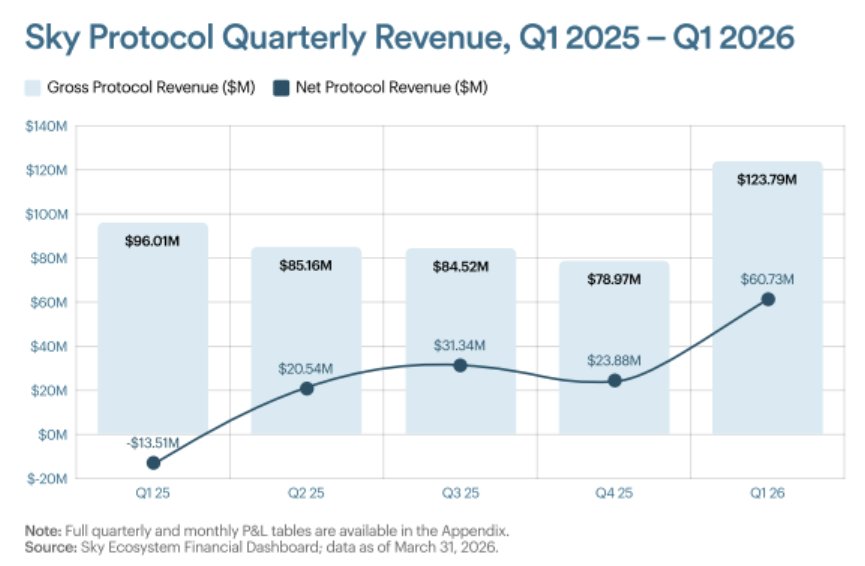
    Sky Protocol just posted record $123.79M gross revenue in Q1 2026, up 57% QoQ and 29% YoY, with ~$46M net surplus driven by USDS growth. Right now the protocol is delivering stronger fundamentals and higher revenue than during previous valuation peaks. Feeling kind of undervalued here. They've reduced buybacks via the Smart Burn Engine from 75% to 7.5% of surplus, after a March 2026 governance vote, to build a $150M solvency reserve. Currently at ~$79M and on pace to hit the $125M restoration threshold in ~2 months. Once there, buybacks are expected to scale back up. This value accrual and proven performance makes $SKY one definitely worth keeping an eye on.

     17  9  3.49K
    オリジナル >
    リリース後のSKYのトレンド
     非常に強気
    Sky Protocol Q1 2026 revenue hits record, fundamentals strong, $SKY undervalued.