
The key shift: it’s not tokens that are competing, but payment stacks.
The winner won’t be the most high-profile launch, but the stack that can move money through the “fiat → settlement → money again” process with clear compliance and custody.
Comprar cripto
tarjeta
Comercio P2P
Compra USDT en un marketplace
Tarjeta de crédito/débito
Compre criptomonedas con Visa o MasterCard
Pago vía prestadores
Compre criptomonedas a través de MoonPay, Simplex y más
Tarjeta BitMart
Impulsando su experiencia con las criptomonedas
Tarjeta prepago de criptomonedas
Obtenga una Mastercard lista para usar al instante
Comerciar
USDⓈ-M
Utilizando USDⓈ como colateral
COIN-M
Utilizando la propia moneda como colateral
TradFi
Trading integral para metales, acciones y forex
Operativa de demostración
Aprenda a operar con riesgo cero
Resumen de futuros
Plataforma única para todo lo relacionado con futuros
Rey de Futuros
Pool de premios de 478 000 USDT
Crecer
Resumen de Earn
Activos inactivos, gane con facilidad
Ahorros
Gane intereses conservando su portafolio.
Staking
Staking sencillo, cuantiosas retribuciones.
Gestión de patrimonio
Aumente su riqueza con un equipo de activos top
RWA
Mantenga BMRUSD, disfrute del rendimiento
Exclusivo VIP
Gane de forma estable para usuarios VIP
Rewards
Centro de recompensas
Descubra recompensas exclusivas por valor de hasta 14 000 USDT
LaunchPrime
Una plataforma para lanzar tokens y NFT
Programa de afiliados
Únase para ganar cuantiosas comisiones
Powerdrop
¡La solución AirDrop de próxima generación ya está AQUÍ!
Centro de eventos
El centro unificado para todas las operaciones de trading
Sorteo diario de futuros
100 % de probabilidades de ganar con operaciones diarias
Sorteo diario de Spot
Gane 8888 USDT en grandes premios
Recarga móvil
Recargue móviles de forma fácil, online y segura
Send
Send money globally, fast and secure
BitMart Mall
Viva de las criptomonedas
PayPal USD Datos de precios en tiempo real
El precio de hoy de PayPal USD es de $ 0.99 (PYUSD/USD). Con una capitalización de mercado de $ 2.80B USD. Volumen de trading en 24 horas de $ 70.79M USD, Un cambio de precio en 24 horas de +0.00%. Y un suministro circulante de 2.80B PYUSD.
PayPal USD PYUSD Historial de precios USD
Siga el precio de PayPal USD para hoy, 7 días, 30 días y 90 días
Periodo
Cambiar
Cambio (%)
Hoy
$ 0
0.00%
7días
--
--
30días
--
--
90días
--
--
Sea propietario de PYUSD ahora
Compra y vende PYUSD fácil y seguro en BitMart.
PayPal USD Información de mercado
$ 0.99 Autonomía de 24 horas $ 0.99
Máximo histórico
$ 0
El mínimo histórico
$ 0
Cambio en 24 h
0.00%
Volumen en 24 h
$ 70,792,275.24
Suministros en circulación
3.51B
PYUSD
Market Cap
$ 3.52B
Suministro máximo
3.51B
PYUSD
Capitalización de mercado totalmente diluida
$ 3.52B
Trade PYUSD
Ganar
Pon a trabajar tus criptomonedas inactivas y obtén ingresos pasivos a través de ahorros, staking y más.
PayPal USD X Insight

Aalexxx
Founder
Media
D
 3.5K @Aaleks_crypt
 Alcista
PYUSD's payment stack on Polygon will become the next winner in compliant payments.

CoinBlog D
327 @coinblogHQ PYUSD on Polygon, the Hyundai test (transfer in ~7 minutes), the Swift blockchain ledger, and Circle Bank with OCC approval-the market is assembling full-fledged payment stacks. https://t.co/xNWZBRA3IE
 2
2
 0
0
 28
28
2026-07-30 11:57
Tendencia de PYUSD tras el lanzamiento
Alcista
PYUSD's payment stack on Polygon will become the next winner in compliant payments.

BitKE
Regulatory_Expert
Media
D
10.4K @BitcoinKE Alcista
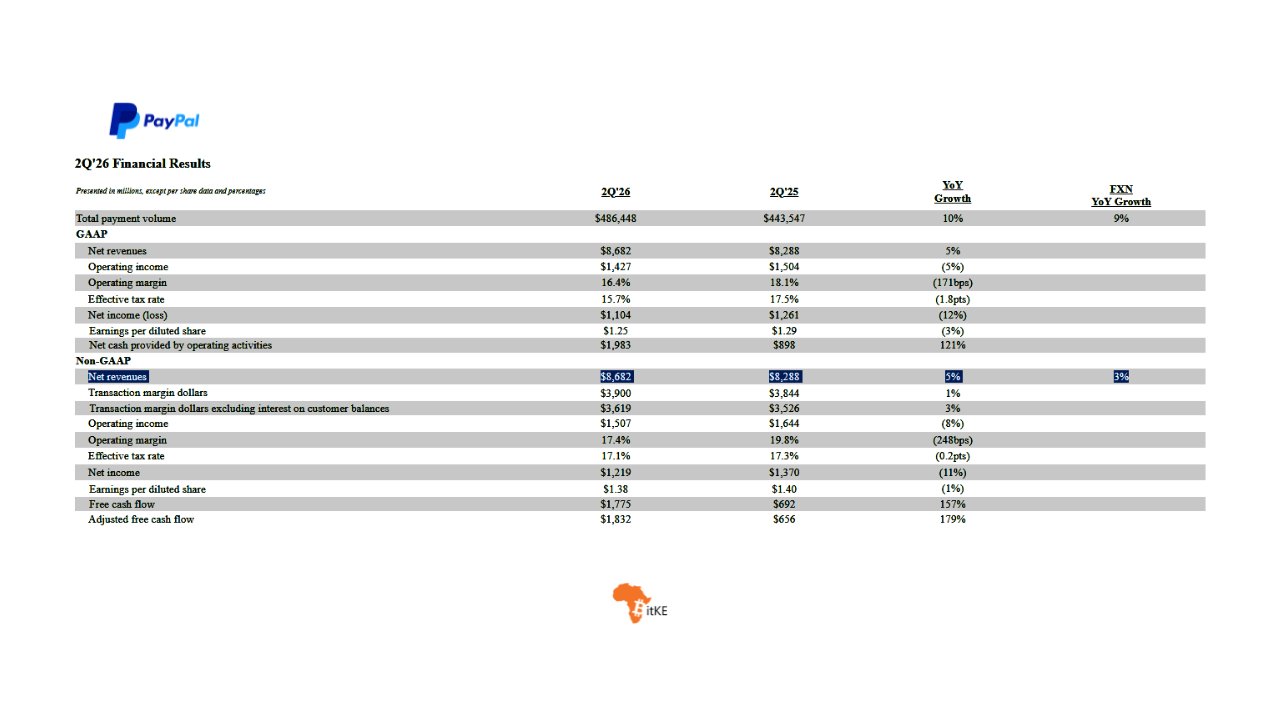
PayPal Q2 revenue exceeded expectations, highlighting PYUSD stablecoin as a key growth driver.
STABLECOINS | @PayPal Doubles Down on #Stablecoins as Revenue Beats Estimates in Q2 2026
During its Q2 2026 earnings update, #PayPal highlighted its dollar-backed stablecoin, $PYUSD, alongside AI-powered commerce tools as key growth initiatives.
Details: https://t.co/s7jkpx1lKy
#Stablecoins2026 #Stablecoins2026H1 #2026H1 #PayPalEarningsCall #PYPL
 0
0
153
0
0
153
2026-07-29 08:12
Tendencia de PYUSD tras el lanzamiento
Alcista
PayPal Q2 revenue exceeded expectations, highlighting PYUSD stablecoin as a key growth driver.

Marco Salzmann 🇩🇪🇻🇪 Ħ
Tokenomics_Expert
Researcher
S
3.3K @MarcoSalzmann80 Extremadamente alcista
PYUSD gets Kraken support on Stellar, and the Stellar ecosystem continues to grow.
🧵PayPal’s PYUSD continues expanding on Stellar.
PYUSD on @StellarOrg is now supported on @krakenfx.
It may look like a simple exchange listing.
In reality, it is another step in expanding the accessibility of one of the world’s largest regulated stablecoins. 👇
PYUSD is issued by @PayPal in partnership with @Paxos
Its expansion to @StellarOrg reflects growing confidence in the network’s ability to support fast, low-cost and production-ready digital payments.
Now, @krakenfx users can deposit and use PYUSD directly on Stellar.
This is not happening in isolation.
@StellarOrg has steadily become one of the strongest ecosystems for regulated digital dollars:
• USDC
• EURC
• PYUSD
• Native Circle CCTP
• MoneyGram Access
• Stripe’s Bridge operating in production via Airtm
Each addition strengthens the overall network.
The payment infrastructure is already being used at scale.
Through Airtm and Bridge, nearly 50% of enterprise payout volume flowed through Stellar during 2024.
More than $1.2 billion in stablecoin transaction volume was processed.
This is real‑world financial infrastructure, not a proof of concept.
Stellar is also becoming increasingly attractive for institutions.
Recent developments include:
• @MoneyGram joining as a Tier 1 validator
• Tradable bringing up to $1 billion in tokenized private credit
• Growing adoption across wallets, payment providers and exchanges
The ecosystem continues to mature.
What makes Stellar increasingly interesting is not a single partnership.
It is how each piece complements the others.
Stablecoins, tokenized assets, cross‑border payments, wallets and regulated financial services are all reinforcing the same network.
@krakenfx supporting PYUSD on Stellar is another building block in that strategy.
Each integration increases liquidity, accessibility and network effects.
The biggest stories are often not created by one announcement.
They emerge when many independent pieces begin fitting together.

Kraken Listings D
20.4K @krakenlistings PYUSD on @StellarOrg is now supported on Kraken.
Stellar is an open-source network built for fast, low-cost cross-border payments and tokenized assets.
Deposit now → https://t.co/xiqZWNzub1 https://t.co/Gq1oAruaG9
 108
1
2.9K
108
1
2.9K
2026-07-29 03:57
Tendencia de PYUSD tras el lanzamiento
Extremadamente alcista
PYUSD gets Kraken support on Stellar, and the Stellar ecosystem continues to grow.
Predicción de precios
¿Cuándo es un buen momento para comprar PYUSD? ¿Debería comprar o vender PYUSD ahora?
Al decidir si es un buen momento para comprar o vender PayPal USD (PYUSD), es importante ajustarse primero a su propia estrategia de trading y perfil de riesgo. Los inversores a largo plazo y los traders a corto plazo suelen interpretar las condiciones del mercado de forma diferente, por lo que su decisión debe reflejar su enfoque personal. Según el último análisis técnico de 4 horas de PYUSD, la señal de trading actual es Hold.

Predicción de Beacon
Pronóstico probabilístico de precios (próximas 24 horas)Descargo de responsabilidad de la predicción de Beacon
Los resultados de los datos que se muestran en esta página se analizan en función de los datos de trading reales (OHLCV) del par de trading seleccionado junto con los indicadores técnicos correspondientes.
Esta predicción es un producto técnico experimental y se proporciona solo con fines de referencia. No constituye un consejo de inversión. Los acontecimientos inesperados del mundo real pueden influir significativamente en el comportamiento del mercado. Por tanto, los traders deben tomar decisiones con precaución.
Esta predicción es un producto técnico experimental y se proporciona solo con fines de referencia. No constituye un consejo de inversión. Los acontecimientos inesperados del mundo real pueden influir significativamente en el comportamiento del mercado. Por tanto, los traders deben tomar decisiones con precaución.
Sobre PayPal USD
PayPal USD (PYUSD) is a cryptocurrency launched in 2023and operates on the Ethereum platform. PayPal USD has a current supply of 2,802,363,980.2473137. The last known price of PayPal USD is 0.99982349 USD and is up 0.02 over the last 24 hours. It is currently trading on 177 active market(s) with $26,989,926.14 traded over the last 24 hours. More information can be found at https://www.paypal.com/pyusd.
Leer más
Enlaces oficiales
Redes sociales
Explorador de blockchain
Comprar PYUSD
Trade PYUSD