Comprar cripto
tarjeta
Comercio P2P
Compra USDT en un marketplace
Tarjeta de crédito/débito
Compre criptomonedas con Visa o MasterCard
Pago vía prestadores
Compre criptomonedas a través de MoonPay, Simplex y más
Tarjeta BitMart
Impulsando su experiencia con las criptomonedas
Tarjeta prepago de criptomonedas
Obtenga una Mastercard lista para usar al instante
Comerciar
USDⓈ-M
Utilizando USDⓈ como colateral
COIN-M
Utilizando la propia moneda como colateral
TradFi
Trading integral para metales, acciones y forex
Operativa de demostración
Aprenda a operar con riesgo cero
Resumen de futuros
Plataforma única para todo lo relacionado con futuros
Rey de Futuros
Pool de premios de 478 000 USDT
Crecer
Resumen de Earn
Activos inactivos, gane con facilidad
Ahorros
Gane intereses conservando su portafolio.
Staking
Staking sencillo, cuantiosas retribuciones.
Gestión de patrimonio
Aumente su riqueza con un equipo de activos top
RWA
Mantenga BMRUSD, disfrute del rendimiento
Exclusivo VIP
Gane de forma estable para usuarios VIP
Rewards
Centro de recompensas
Descubra recompensas exclusivas por valor de hasta 14 000 USDT
LaunchPrime
Una plataforma para lanzar tokens y NFT
Programa de afiliados
Únase para ganar cuantiosas comisiones
Powerdrop
¡La solución AirDrop de próxima generación ya está AQUÍ!
Centro de eventos
El centro unificado para todas las operaciones de trading
Sorteo diario de futuros
100 % de probabilidades de ganar con operaciones diarias
Sorteo diario de Spot
Gane 8888 USDT en grandes premios
Recarga móvil
Recargue móviles de forma fácil, online y segura
Send
Send money globally, fast and secure
BitMart Mall
Viva de las criptomonedas

MX Token (MX)
$ 1.88 (MX/USD)
1.62%
24H
MX Token Datos de precios en tiempo real
El precio de hoy de MX Token es de $ 1.88 (MX/USD). Con una capitalización de mercado de $ 172.60M USD. Volumen de trading en 24 horas de $ 6.66M USD, Un cambio de precio en 24 horas de +1.62%. Y un suministro circulante de 91.84M MX.
MX Token MX Historial de precios USD
Siga el precio de MX Token para hoy, 7 días, 30 días y 90 días
Periodo
Cambiar
Cambio (%)
Hoy
$ 0.029
1.62%
7días
$ 0.039
2.20%
30días
$ 0.11
6.90%
90días
$ 0.20
12.73%
Sea propietario de MX ahora
Compra y vende MX fácil y seguro en BitMart.
MX Token Información de mercado
$ 1.85 Autonomía de 24 horas $ 1.89
Máximo histórico
$ 2.14
El mínimo histórico
$ 1.58
Cambio en 24 h
1.62%
Volumen en 24 h
$ 6,659,595.25
Suministros en circulación
91.83M
MX
Market Cap
$ 172.60M
Suministro máximo
413.78M
MX
Capitalización de mercado totalmente diluida
$ 777.70M
Trade MX
Ganar
Pon a trabajar tus criptomonedas inactivas y obtén ingresos pasivos a través de ahorros, staking y más.
MX Token X Insight

OGAudit🛡️Crypto Reviews
Customodi myen
BAB
The
C
 22.4K @OGAudit
 Extremadamente bajista
MEXC is a new token discovery platform but faces quality, customer service, and regulatory risks, suggesting a wait-and-see approach.
OGAudit🛡️Crypto Reviews
Customodi myen
BAB
The
C
22.4K @OGAudit Spotlighting our expert reviews on: @MEXC
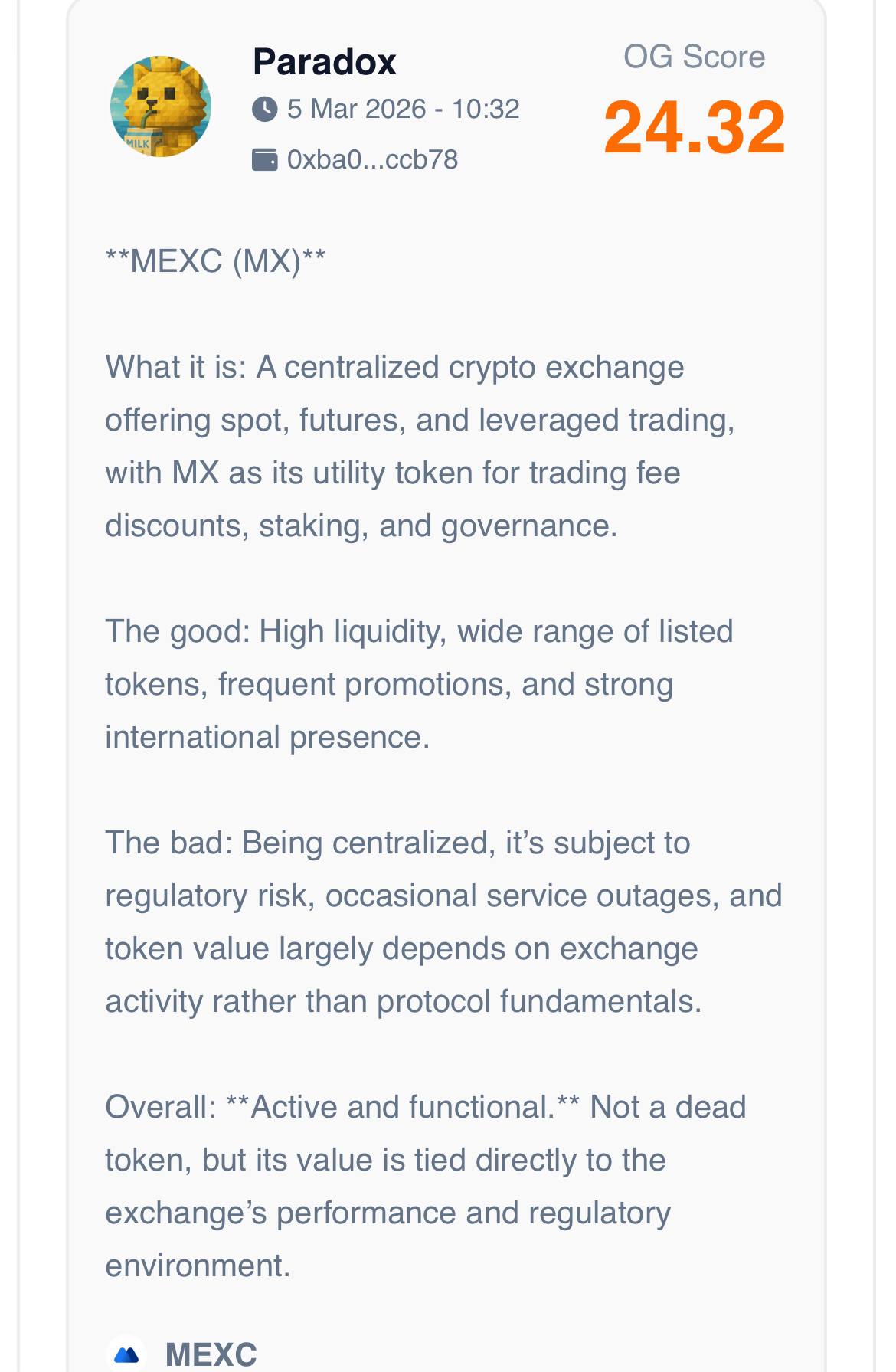
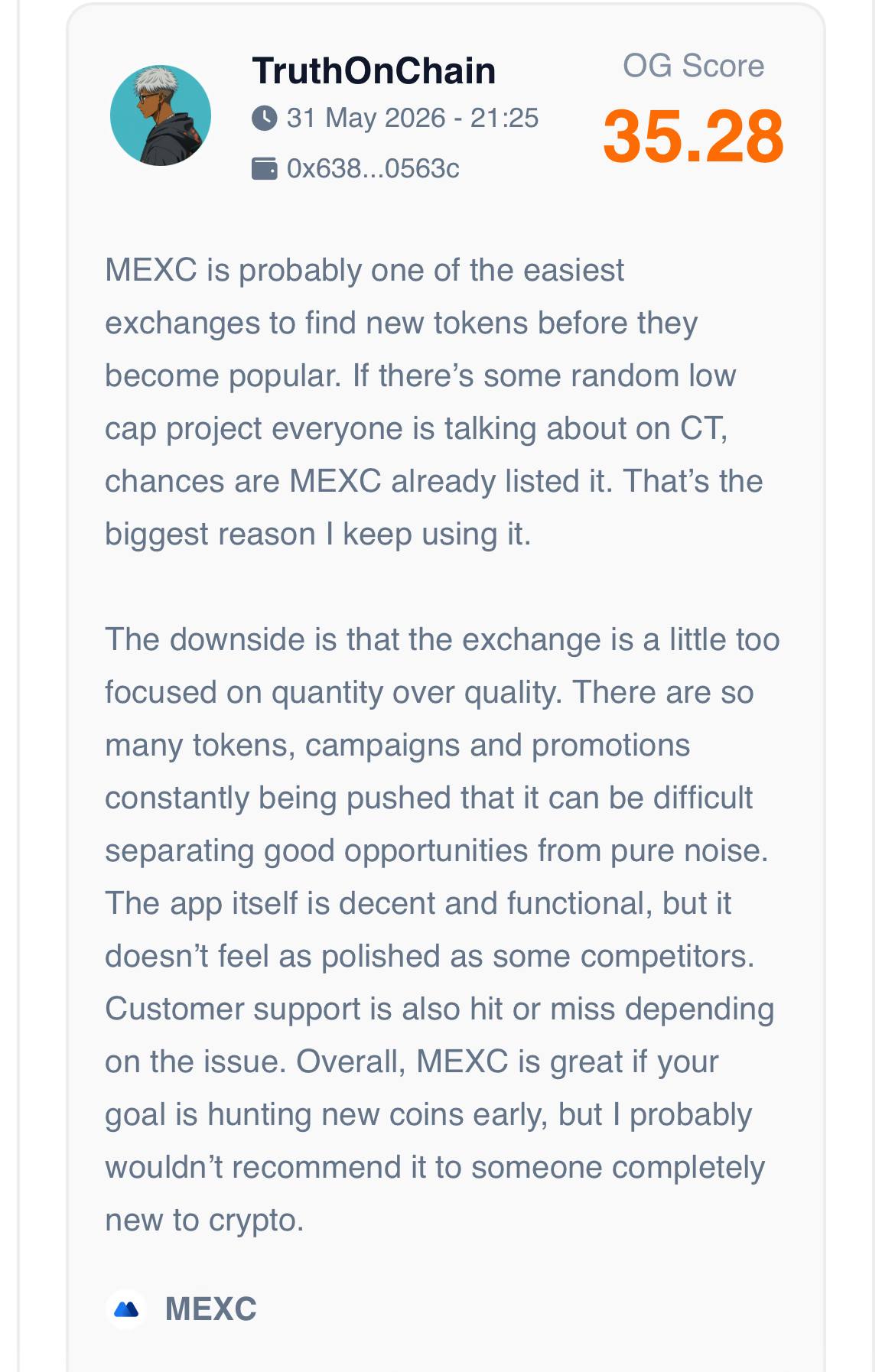
Our OG expert reviewers note that MEXC has become one of the go to exchanges for discovering new and emerging tokens before they reach larger platforms. Its broad asset selection, deep listings catalogue and active promotional ecosystem make it particularly attractive to traders hunting early opportunities.
However, that same strength can also be a weakness. The platform’s focus on listing large numbers of assets makes quality control harder to assess, while customer support and overall platform polish often receive mixed reviews. MEXC has also faced regulatory scrutiny in some jurisdictions, a common challenge for globally operating exchanges that aggressively expand listings and services.
Can MEXC maintain its edge as the first stop for new token discovery or will quality, trust and regulation become bigger factors than simply listing assets first?
Category: Centralized Exchange
24H Volume: $1.593B
Markets: 3091
Fees: Spot: Spot: 0.00% maker, 0.05% taker. Future
 12
12
 1
1
 310
310
2026-06-09 13:42
Tendencia de MX tras el lanzamiento
Bajista
MEXC is a new token discovery platform but faces quality, customer service, and regulatory risks, suggesting a wait-and-see approach.
OGAudit🛡️Crypto Reviews
Customodi myen
BAB
The
C
22.4K @OGAudit Neutral
MEXC is a new token discovery platform but faces quality, customer service, and regulatory risks, suggesting a wait-and-see approach.
Spotlighting our expert reviews on: @MEXC
Our OG expert reviewers note that MEXC has become one of the go to exchanges for discovering new and emerging tokens before they reach larger platforms. Its broad asset selection, deep listings catalogue and active promotional ecosystem make it particularly attractive to traders hunting early opportunities.
However, that same strength can also be a weakness. The platform’s focus on listing large numbers of assets makes quality control harder to assess, while customer support and overall platform polish often receive mixed reviews. MEXC has also faced regulatory scrutiny in some jurisdictions, a common challenge for globally operating exchanges that aggressively expand listings and services.
Can MEXC maintain its edge as the first stop for new token discovery or will quality, trust and regulation become bigger factors than simply listing assets first?
Category: Centralized Exchange
24H Volume: $1.593B
Markets: 3091
Fees: Spot: Spot: 0.00% maker, 0.05% taker. Future
12
1
310
2026-06-08 12:42
Tendencia de MX tras el lanzamiento
Neutral
MEXC is a new token discovery platform but faces quality, customer service, and regulatory risks, suggesting a wait-and-see approach.
OGAudit🛡️Crypto Reviews
Customodi myen
BAB
The
C
22.4K @OGAudit Extremadamente bajista
The MX token has burned 40% of its supply but still underperforms peers; lack of regulatory licensing is the main obstacle.
OGAudit Web3 Research: @MEXC $MX - The Exchange Token That Burned 40% of Its Supply but Still Underperforms?
MX is the native utility and governance token of MEXC Exchange, one of the earliest altcoin listing exchanges with 40M users and the most aggressive token burn program in exchange token history:
- MEXC operates in 170+ countries with 3,000+ tradeable cryptocurrencies, bi-monthly proof of reserves exceeding 100% on all major assets, a $526M Insurance Fund, spot, futures, margin, ETF, staking and launchpad products and industry leading early listing of new and emerging tokens giving MX holders fee discounts of 20% on spot and futures, exclusive Launchpad and Kickstarter token sale access, governance voting and staking rewards.
- MX Token 2.0 commits 40% of quarterly exchange profits to buyback and burn targeting a 100M circulating supply ceiling, burning 2.39M MX in Q2 2025 and 3.39M in Q4 2024 with Q2 2026 burn imminent. Approximately 40% of total MX supply has been permanently destroyed bringing circulating supply from 470M+ down to 91.84M.
- Despite burning 40% of supply, MX declined 31.27% year on year while peer tokens BGB surged 452% and OKB surged 197.68% with analysts citing the need for publicly verifiable regulatory licensing progress before burns translate into sustained price appreciation rather than just a supply floor.
Is the most aggressive exchange token burn program in crypto targeting a 100M supply ceiling with 40% already destroyed and a Q2 2026 burn imminent the setup for MX’s breakout once the remaining supply is burned down to target or do BGB and OKB’s outperformance and the regulatory credibility gap confirm that burns without institutional trust cannot close the performance gap with top tier exchange tokens?
Category: Exchange Token / Centralized Exchange
Coin Name: $MX
Circulating Supply: 91.84M
Market Cap: $161.5M
Market Cap Rank: #153
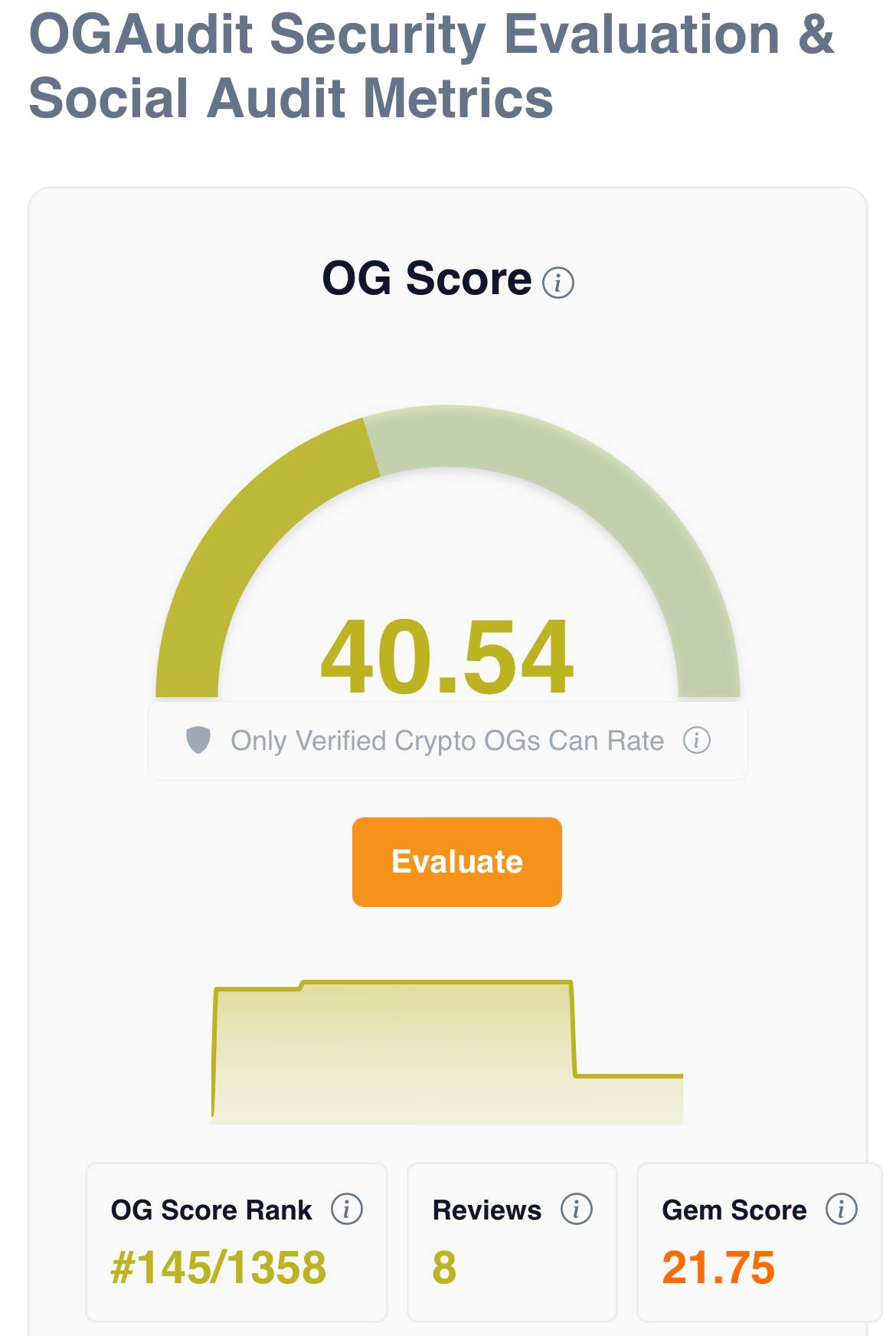
OG (Trust) Score: 40.54
OG Score Rank: #145/1358
Reviewed by 8 OG Auditors.
See the Social Audit with Reviews by crypto OG’s and more on the $MX Coin page: ogaudit(.)com/crypto/mx-mx
https://t.co/kifE4SCMSk

 9
1
417
9
1
417
2026-06-04 10:12
Tendencia de MX tras el lanzamiento
Bajista
The MX token has burned 40% of its supply but still underperforms peers; lack of regulatory licensing is the main obstacle.
Predicción de precios
¿Cuándo es un buen momento para comprar MX? ¿Debería comprar o vender MX ahora?
Al decidir si es un buen momento para comprar o vender MX Token (MX), es importante ajustarse primero a su propia estrategia de trading y perfil de riesgo. Los inversores a largo plazo y los traders a corto plazo suelen interpretar las condiciones del mercado de forma diferente, por lo que su decisión debe reflejar su enfoque personal. Según el último análisis técnico de 4 horas de MX, la señal de trading actual es Hold. Según el último análisis técnico de 1 día de MX, la señal actual es Hold.

Predicción de Beacon
Pronóstico probabilístico de precios (próximas 24 horas)Descargo de responsabilidad de la predicción de Beacon
Los resultados de los datos que se muestran en esta página se analizan en función de los datos de trading reales (OHLCV) del par de trading seleccionado junto con los indicadores técnicos correspondientes.
Esta predicción es un producto técnico experimental y se proporciona solo con fines de referencia. No constituye un consejo de inversión. Los acontecimientos inesperados del mundo real pueden influir significativamente en el comportamiento del mercado. Por tanto, los traders deben tomar decisiones con precaución.
Esta predicción es un producto técnico experimental y se proporciona solo con fines de referencia. No constituye un consejo de inversión. Los acontecimientos inesperados del mundo real pueden influir significativamente en el comportamiento del mercado. Por tanto, los traders deben tomar decisiones con precaución.
Sobre MX Token
MX Token (MX) is a cryptocurrency and operates on the Ethereum platform. MX Token has a current supply of 409,024,834 with 91,837,334 in circulation. The last known price of MX Token is 1.88608943 USD and is up 3.34 over the last 24 hours. It is currently trading on 37 active market(s) with $5,291,869.48 traded over the last 24 hours. More information can be found at https://www.mexc.com.
Leer más
Enlaces oficiales
Explorador de blockchain