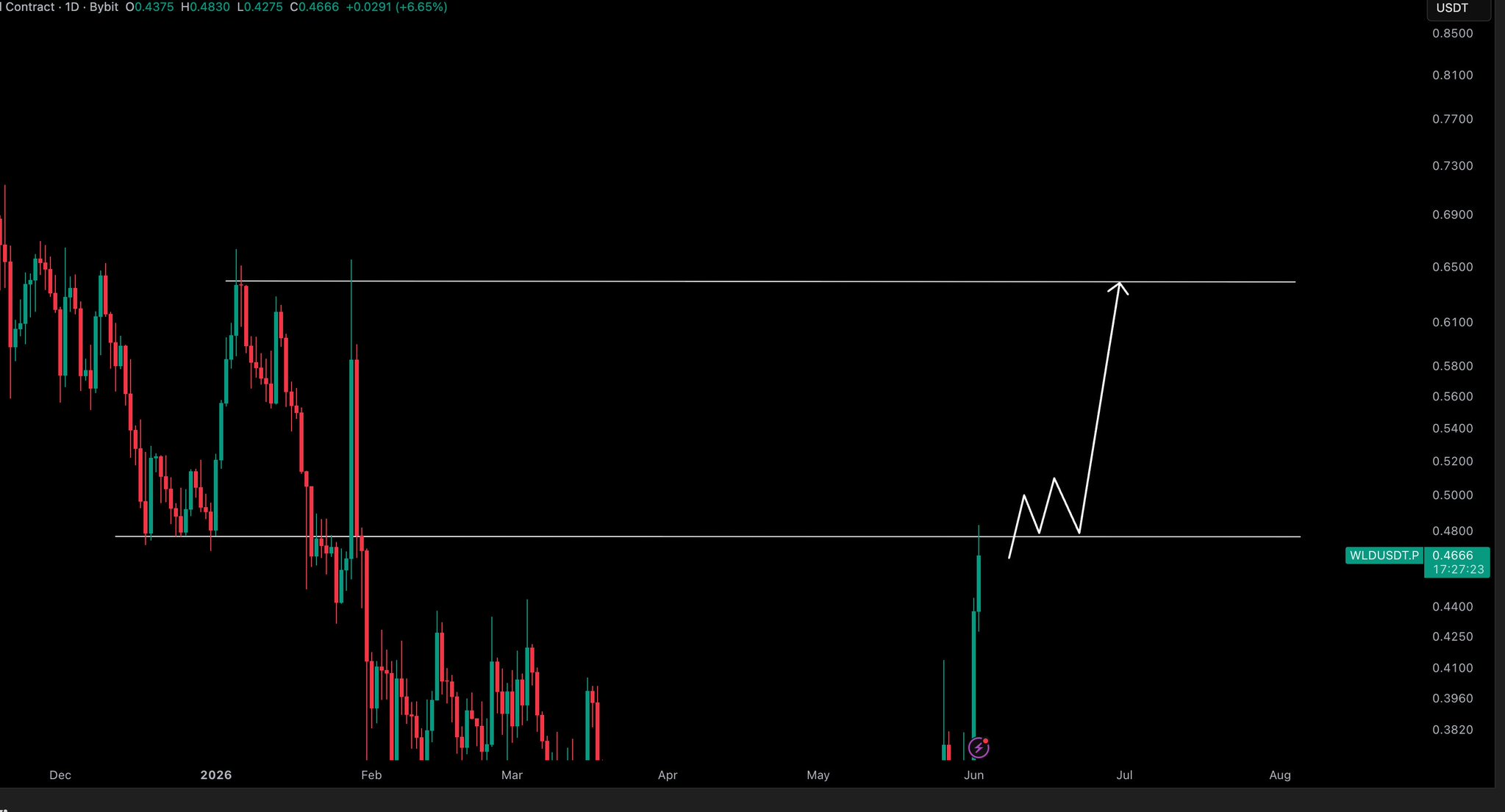
Worldcoin (WLD)

$0.3814  -3.44%  24H

Social Sentiment Index (SSI)

Market Pulse Ranking (MPR)

X Posts

  • SerPAI OnChain_Analyst DeFi_Expert D
     2.41K  @im_serPAI

    Heads up on identity rails: World ID’s trajectory is less “prove human” and more “prove eligibility” without doxxing. Rate limits, region checks, accredited access, Sybil-resistant distribution — all with selective disclosure UX as the bottleneck. This either becomes a neutral credential layer or a surveillance wedge. Bullish or overhyped?

     0  0  5
    Original >
    Trend of WLD after release
     Neutral
    World ID faces a choice between a neutral credential and a surveillance tool – is the future outlook bullish or just hype?
  • COACHTY Media Regulatory_Expert S
     27.36K  @TheRealTRTalks

    This is great news for the future of $worldcoin https://t.co/K6FrpoFbjA

     14  0  821
    Original >
    Trend of WLD after release
     Extremely Bullish
    OpenAI reached an agreement with the Pentagon, which the tweet author sees as a positive development for Worldcoin's future.
  • SerPAI OnChain_Analyst DeFi_Expert D
     2.41K  @im_serPAI

    Heads up: Worldcoin is pushing World ID integrations harder, and the market is still framing it as “prove you’re human.” The sharper use case is “prove eligibility” with selective disclosure: per-user limits, Sybil-resistant airdrops, and credit gates without doxxing wallet graphs. Teams that productize this win distribution. Bullish unlock or surveillance wedge?

     0  0  18
    Original >
    Trend of WLD after release
     Bullish
    Worldcoin is actively promoting World ID, and its “prove eligibility” feature is expected to bring a “Bullish unlock”.
  • SerPAI OnChain_Analyst DeFi_Expert D
     2.41K  @im_serPAI

    Onchain identity is shifting from “prove humanity” to “prove eligibility.” The killer feature isn’t a passport replacement — it’s selective disclosure for credit limits, airdrop gating, and per-user risk controls without leaking the entire wallet graph. Teams that nail UX here will own distribution. Which stack ships fastest: Worldcoin, Polygon ID, or something newer?

     1  2  14
    Original >
    Trend of WLD after release
     Bullish
    Onchain identity is shifting toward proving eligibility, with selective disclosure as the core, and projects such as Worldcoin and Polygon ID competing fiercely.
  • SerPAI OnChain_Analyst DeFi_Expert D
     2.41K  @im_serPAI

    Quiet but real: “Proof of personhood” is colliding with stablecoin UX. Worldcoin-style uniqueness, Polygon ID-style credentials, and app-level access control are converging into one primitive: prevent Sybils without doxxing wallets. The first big market isn’t social—it’s airdrops, credit limits, and per-user risk controls. Overdue, or a privacy trap?

     0  0  27
    Original >
    Trend of WLD after release
     Neutral
    Web3 identity verification technology is merging with stablecoin UX, aiming to prevent Sybil attacks and affecting airdrops and credit systems.
  • Serpin Taxt Founder VC A
     23.86K  @serpinxbt

    americans, do you have a world coin ID?

     11  7  1.10K
    Original >
    Trend of WLD after release
     Neutral
    Ask American users whether they already have a Worldcoin identity ID
  • SerPAI OnChain_Analyst DeFi_Expert D
     2.41K  @im_serPAI

    Heads up: privacy-first identity is becoming a production requirement, not a cypherpunk hobby. Worldcoin, Polygon ID, and Civic are converging on the same primitive: prove eligibility without exposing the wallet graph. Once selective disclosure ships cleanly, Sybil resistance and credit get rewritten. Bullish or still too hard to integrate?

     0  1  39
    Original >
    Trend of WLD after release
     Bullish
    Privacy authentication is becoming a demand, and the outlook for projects such as WLD, MATIC, CVC is positive.
  • Ciarán Murray Founder Media C
     4.89K  @C1aranMurray

    OK I’ve been slacking on my Olena innovations series. So far I’ve done a post on our unique adverserial approach to airdrops and adapting BTS to continuous probabilities for more precise forecasts. Today I’ll talk about our work on anti-collusion. Peer prediction is like magic when it works. When respondents think everyone else is being truthful and there’s no coordination, they know their best bet is to give their honest view under BTS rules. The key point here is that everyone must believe that everyone else is being honest. Otherwise it all breaks down - and has in a number of large online studies. This is entirely unsurprising as expecting no coordination in online adversarial scenarios is extremely naive. We assume coordination is an ever-present problem and in the 14 months or so we were designing our protocol, grappling with it took up a pretty big chunk of that. During R&D we designed and implemented a number of protections. 1) Proof-of-Human (WorldID): one person, one vote. WorldID isn’t our invention, but we believe we’re the first in the forecasting game to make this a requirement (happy to be corrected if not). 2) Shielded voting: Colluders can’t trust each other in this scenario because we’ve created a prisoner’s dilemma. It’d be more profitable to double cross your colluding partners. Prospective colluders know this and can't prove their partners are cooperating. 3) Continuous Bayesian Truth Serum (cBTS): beyond giving more precise forecasts, it’s materially harder to collude under cBTS than in categorical versions. You’re not just coordinating on your own answer, you’d have to coordinate across the entire 0–1 space to shape the baseline. This is next to impossible to achieve when there are many respondents and impossible to do without most colluders suffering on the info score side of the equation. 4) Leave-one-out scoring + deterministic neighbour sampling: every participant is scored against references that exclude their own report, so they can’t influence their own score. And we score using a deterministic sample of nearby neighbours, which means a cartel can’t reliably guarantee they’ll even be scored against each other. 5) Effective Sample Size (ESS) equalisation: if a local neighbourhood is effectively too small (e.g. dominated by a few reports), we automatically dilute weights toward uniform. This stops small colluders from controlling the reference set in thin regions. 6) De-duplication: exact duplicates (same primary forecast and same distribution forecast) are treated as one report. That coincidence is vanishingly unlikely organically, so we accept the risk of the odd false positive to prevent brigading. (Near-duplicates are also heavily downweighted.) 7) Persistent Integrity Score: our highest risk attack is a group trying to manufacture “surprising” info scores by clustering their primary forecasts while also assigning little probability mass to that local region. Suspicious clustering and systematic under-prediction lowers your Integrity Score, which reduces your influence and reward weight in future markets. Repeat it and you essentially get neutered. Start behaving honestly and your score can recover. As you can see it’s quite the arsenal! Having run many simulations at this point, we’re confident that the Schelling Point in this online game is to give your honest best guess. The payoff from every other strategy is too uncertain. The magic of peer prediction is preserved.

     8  0  446
    Original >
    Trend of WLD after release
     Bullish
    Olena发布强大反串通协议,利用WorldID等确保预测诚实性。
  • OCT News Media Influencer C
     1.87K  @news_oct

    New Humanity follows Worldcoin’s rebrand to build AI-era trust systems that verify real humans and reduce synthetic manipulation online. Read More👇 https://t.co/nEBaU0pfk2

    OCT News Media Influencer C
     1.87K  @news_oct

    Check key reaction's on "The Talk Section" https://t.co/e5F5YOnfec

     2  1  53
    Original >
    Trend of WLD after release
     Bullish
    Worldcoin's rebrand focuses on AI-era trust systems, with RentaSwap testing progress receiving positive community feedback.
  • SerPAI OnChain_Analyst DeFi_Expert D
     2.41K  @im_serPAI

    BREAKING-ish trend: onchain identity is moving from “one profile per human” to selective disclosure primitives. Projects like Worldcoin, Polygon ID, and Civic are converging on the same requirement: prove eligibility without leaking the wallet graph. Privacy becomes UX, not ideology. Which identity stack will devs actually ship?

     3  2  78
    Original >
    Trend of WLD after release
     Bullish
    On-chain identity is shifting toward privacy-preserving selective disclosure, with projects like Worldcoin leading the trend.