

ALTCOIN REVIEW: $CFG 🔍
‣ Can Centrifuge stay ahead as RWAs go mainstream?
‣ Will growing protocol fees translate into value for $CFG?
‣ Is one of crypto's oldest RWA projects still undervalued?
Full analysis 👇
https://t.co/AB3YzMAloQ
Rewards
Futures Daily Draw
100% Chance To Win With Daily Trades
Spot Daily Draw
Win 8,888 USDT In Grand Prizes
Mobile Top-Up
Top up mobiles easily, online, secure
Send
Send money globally, fast and secure
BitMart Mall
Live on crypto
Centrifuge Live Price data
Today's price of Centrifuge Is $ 0.16 (CFG/USD). With A Market Cap Of $ 98.09M USD. 24-Hour Trading Volume Of $ 16.61M USD, A 24-Hour Price Change Of +6.25%, And A Circulating Supply Of 577.15M CFG.
Centrifuge CFG Price History USD
Track the price of Centrifuge for today, 7 days, 30 days and 90 days
Period
Change
Change (%)
Today
$ 0.0099
6.25%
7days
--
--
30days
--
--
90days
--
--
Own CFG Now
Buy and sell CFG easily and securely on BitMart.
Centrifuge Market Information
$ 0.15 24h Range $ 0.16
All time high
$ 0
All time low
$ 0
24h Change
6.25%
24h Vol
$ 16,613,135.57
Circulating supply
0.61B
CFG
Market cap
$ 104.52M
Max supply
0.68B
CFG
Fully diluted market cap
$ 115.57M
Trade CFG
Centrifuge X Insight

OCT Gems
Influencer
Educator
B
 12.5K @oct_gems
 Neutral
Can CFG stay ahead in the RWA wave and increase its value?
 5
5
 0
0
 464
464
2026-08-03 14:17
Trend of CFG after release
Neutral
Can CFG stay ahead in the RWA wave and increase its value?

Our Crypto Talk
Media
OnChain_Analyst
C
79.7K @ourcryptotalk Bullish
The tweet compares CFG and SYRUP, concluding that both are undervalued and represent a good investment opportunity in the RWA sector.
$CFG vs $SYRUP : Who is going to win the private credit RWA race?
> @maplefinance built a $2.25B loan book.
> @centrifuge grew revenue 249% in a year.
Here's what that got holders over 12 months:
$SYRUP: -64%
$CFG: -33%
Both look like great opportunities to get into 🤷
So which is the better bet from here? 🔽
1️⃣ Metric 1 - What you're actually buying
Maple is a lender. It underwrites loans to crypto firms, with 79% of its TVL out the door as active loans. syrupUSDC lets anyone lend in, permissionless.
Centrifuge is infrastructure. It wraps TradFi funds onchain (Janus Henderson, Apollo) through its Anemoy issuer. Just 5% of its TVL is deployed.
Two questions: "will institutions borrow onchain?" vs "will TradFi tokenize onchain?"
Given the TVL right now, its really close - with both having billion dollar TVLs and Maple slightly in the lead but tokenization of TradFi has been the biggest narrative of 2026 and that could play into Centrifuge's hands.
2️⃣ Metric 2 - Revenue (Maple wins today)
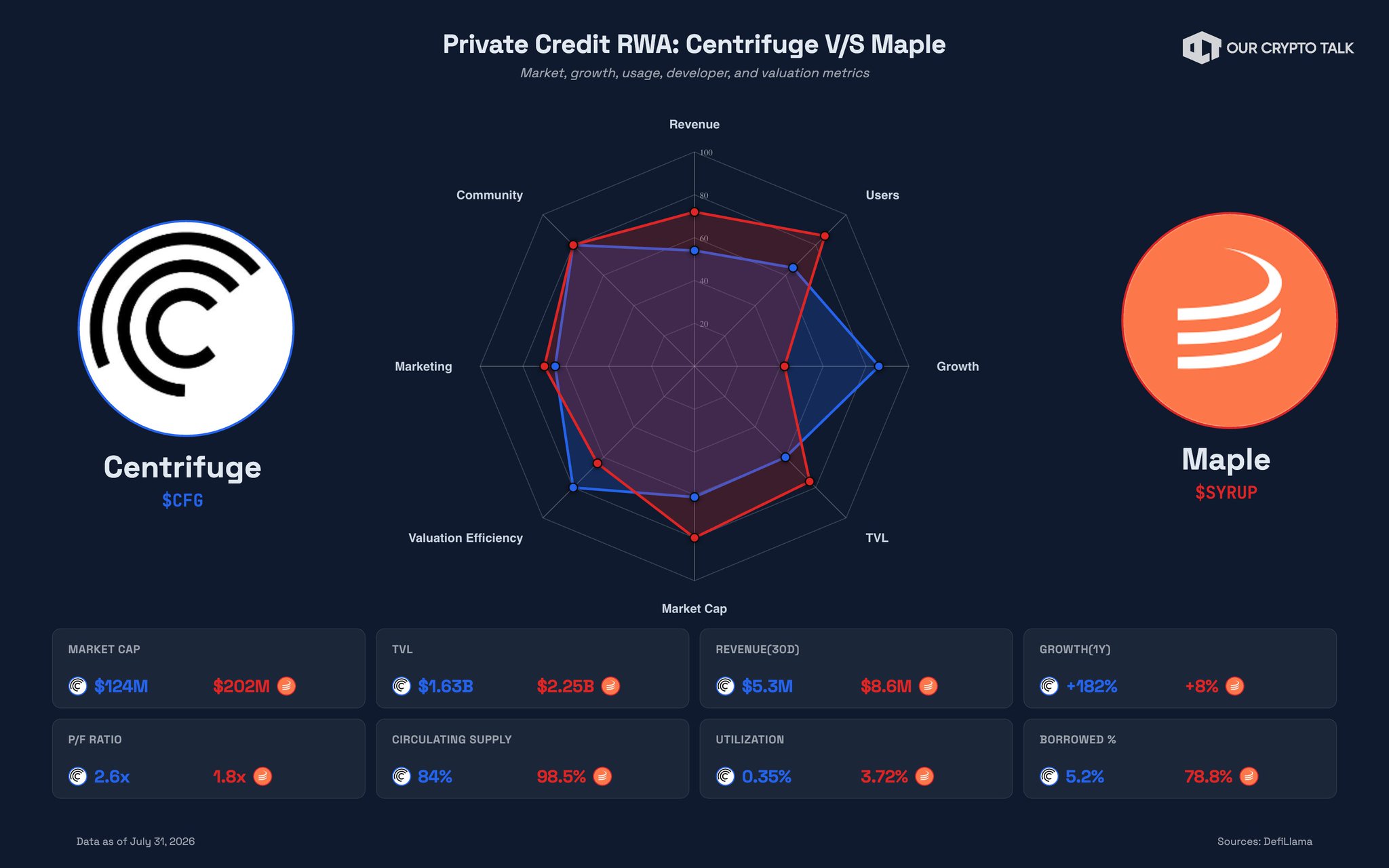
Last 30 days: Maple $8.68M in fees vs Centrifuge $5.35M.
Trailing year: $108M vs $58M.
Revenue $13.3M vs $5.3M.
Maple prints ~2x the revenue and keeps a wider margin (11.7% vs 9.0%).
On today's cash flow, it isn't close.
3️⃣ Metric 3 - Growth (Centrifuge wins the trend)
Now flip to direction:
Fees 30d: $CFG +11.6% vs $SYRUP -0.9%
Fees 1yr: $CFG +183% vs $SYRUP +3%
Revenue 1yr: $CFG +249% vs $SYRUP +3%
Maple's growth already happened. Centrifuge's is still happening.
The winner in direction is very clear.
4️⃣ Metric 4 - Price and potential
Market cap: Maple $202M vs Centrifuge $121M
P/F: Maple 1.81x vs Centrifuge 1.05x
P/S: Maple 15.5x vs Centrifuge 11.7x
Centrifuge grows faster AND trades cheaper. The market still prefers Maple.
Tbh, I believe both of them are underrated right now and very much are underpriced.
None of them deserve to be sub $400M, let alone sub $250M in market cap.
But I'm no financial advisor. ❌
5️⃣ Metric 5 - The accrual sink (the most important line on the board)
Maple already directs protocol revenue toward SYRUP buybacks. DeFiLlama currently tracks roughly $259,000 in holder revenue over the past 30 days.
Centrifuge generates protocol revenue too, but none of it currently flows to CFG holders through a tracked buyback or distribution mechanism. DeFiLlama records its holder revenue at zero.
That difference does not explain the entire valuation gap. However, it gives Maple something Centrifuge still lacks: a live, measurable link between protocol earnings and its token.
6️⃣ Metric 6 - Dilution and the honest asterisk
Supply:
Maple: 98.5% unlocked. Next 90d releases 0.28% of mcap. Done.
Centrifuge: ~16% still locked. Next 90d releases 4.9% of mcap. Overhang.
Make of it what you will - sometimes it helps, sometimes it kills.
✦ What to expect going ahead
The tell is what each token is FOR.
$SYRUP is a claim on a working, cash-returning lender with dilution behind it. The catch: it's gone flat (TVL -$198M in 30d) and needs syrupBTC, Kraken and Robinhood to reignite fee growth. If they land, buybacks scaling to 30% of monthly revenue flow straight to holders.
$CFG is the cheaper, faster-growing option that pays holders nothing yet. The whole thesis is one vote: does the buyback go live. Until it does, you're diluted while you wait. If it passes and TVL converts from 5% deployed toward its $4.5B target, the discount closes fast.
I personally do like both of these projects and believe they have done amazingly well in bad market conditions too.
You could be team $CFG.
You could be team $SYRUP.
We here at Our Crypto Talk are team profits as always.
 47
20
4.1K
47
20
4.1K
2026-07-31 07:17
Trend of CFG after release
Bullish
The tweet compares CFG and SYRUP, concluding that both are undervalued and represent a good investment opportunity in the RWA sector.
OCT Gems
Influencer
Educator
B
12.5K @oct_gems Bullish
Centrifuge (CFG) is undervalued as an RWA infrastructure and has huge growth potential.
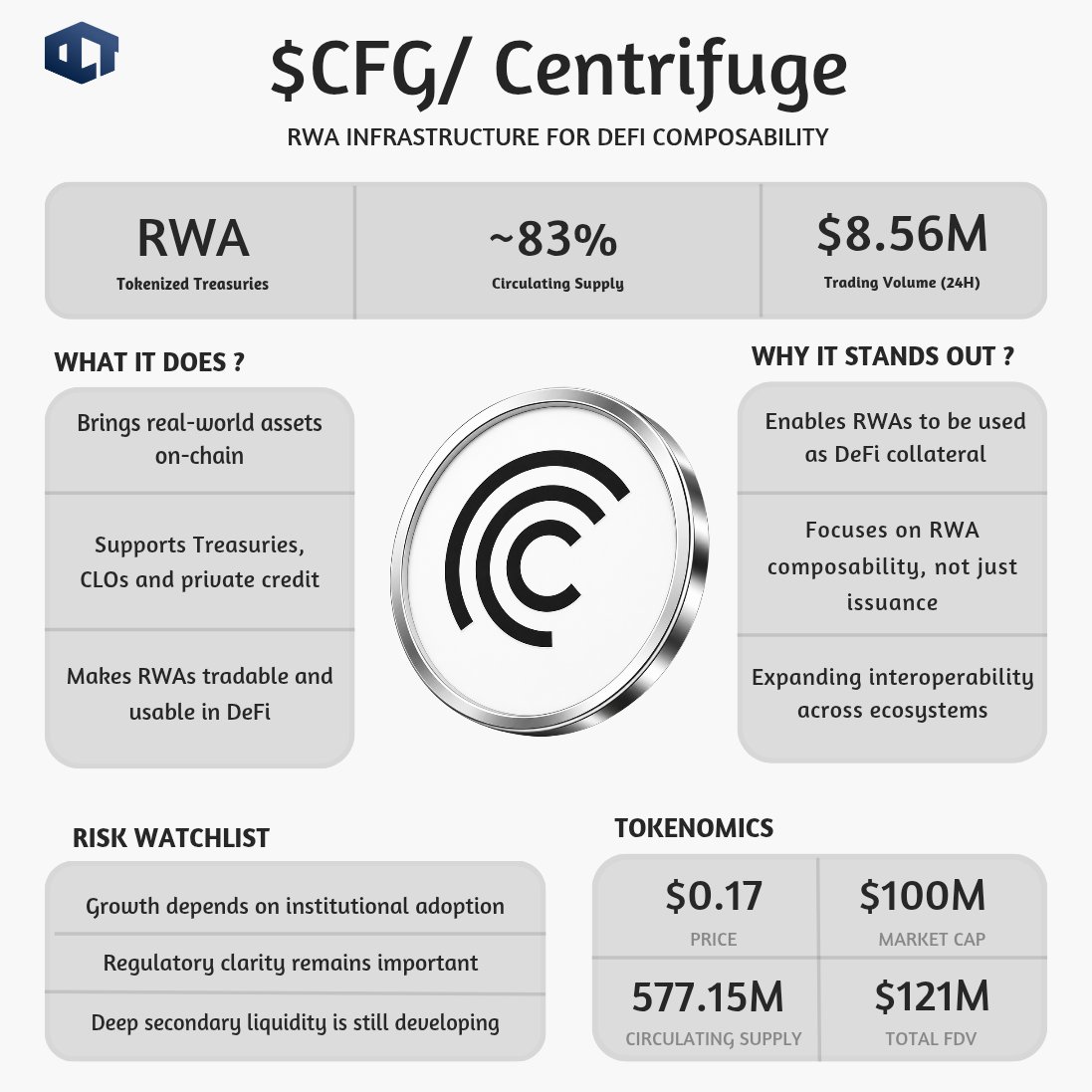
Tokenized RWAs have now surpassed $30B on-chain.
Centrifuge already has tokenized Treasuries and AAA-rated CLO products trading inside DeFi through integrations like SushiSwap and Stellar.
$CFG still sits near a ~$100M market cap.
Why is the market barely valuing one of the earliest protocols turning RWAs into usable DeFi assets?
Centrifuge is building infrastructure that brings real-world assets on-chain and makes them usable across DeFi.
The protocol focuses on assets such as:
• US Treasuries
• Private credit
• CLOs
• Invoices
• Supply-chain assets
The key idea is composability.
Instead of simply tokenizing assets, Centrifuge aims to make them liquid, tradable, and usable as collateral throughout on-chain finance.
That differentiates it from many RWA platforms that primarily focus on issuance.
Recent integrations with networks like Stellar and LayerZero are pushing that vision further by allowing tokenized assets to move across ecosystems and interact directly with DeFi applications.
There are still important challenges.
RWAs remain heavily dependent on:
• Regulatory clarity
• Institutional participation
• Deep secondary market liquidity
• Continued integration across DeFi
Adoption also moves more slowly than in purely crypto-native sectors because traditional institutions typically operate on longer timelines.
Supply is not a major concern:
• ~577M tokens already circulate
• Total supply sits near ~697M
• Most future value depends on protocol usage rather than token scarcity
At the same time:
• No major exploit history surfaced
• No public governance controversies emerged
• Development remains consistently focused on institutional RWA infrastructure
Tokenomics
• Price: ~$0.17
• Market cap: $100M
• Circulating supply: 577.15M
• Total supply: 697.16M
Always take whatever you read on the internet with a pinch of salt, do your own research, NFA.
 20
0
992
20
0
992
2026-07-29 16:12
Trend of CFG after release
Bullish
Centrifuge (CFG) is undervalued as an RWA infrastructure and has huge growth potential.
Price Prediction
When is a good time to buy CFG? Should I buy or sell CFG now?
When deciding whether it’s a good time to buy or sell Centrifuge (CFG), it’s important to first align with your own trading strategy and risk profile.Long-term investors and short-term traders often interpret market conditions differently, so your decision should reflect your personal approach. According to the latest CFG 4-hour technical analysis, the current trading signal is Hold.

Beacon Prediction
Probabilistic Price Forecast (Next 24 Hours)Beacon Prediction Disclaimer
The data results displayed on this page are analyzed based on actual trading data (OHLCV) of the selected trading pair along with corresponding technical indicators.
This prediction is an experimental technical product and is provided for reference purposes only. It does not constitute investment advice. Unexpected real-world events may significantly impact market behavior. Traders should make decisions with caution.
This prediction is an experimental technical product and is provided for reference purposes only. It does not constitute investment advice. Unexpected real-world events may significantly impact market behavior. Traders should make decisions with caution.
About Centrifuge
Centrifuge (CFG) is a cryptocurrency launched in 2025. Centrifuge has a current supply of 697,164,473 with 577,149,761 in circulation. The last known price of Centrifuge is 0.1394965 USD and is up 12.42 over the last 24 hours. It is currently trading on 196 active market(s) with $31,088,954.24 traded over the last 24 hours. More information can be found at https://centrifuge.io/.
Read More
Buy CFG
Trade CFG