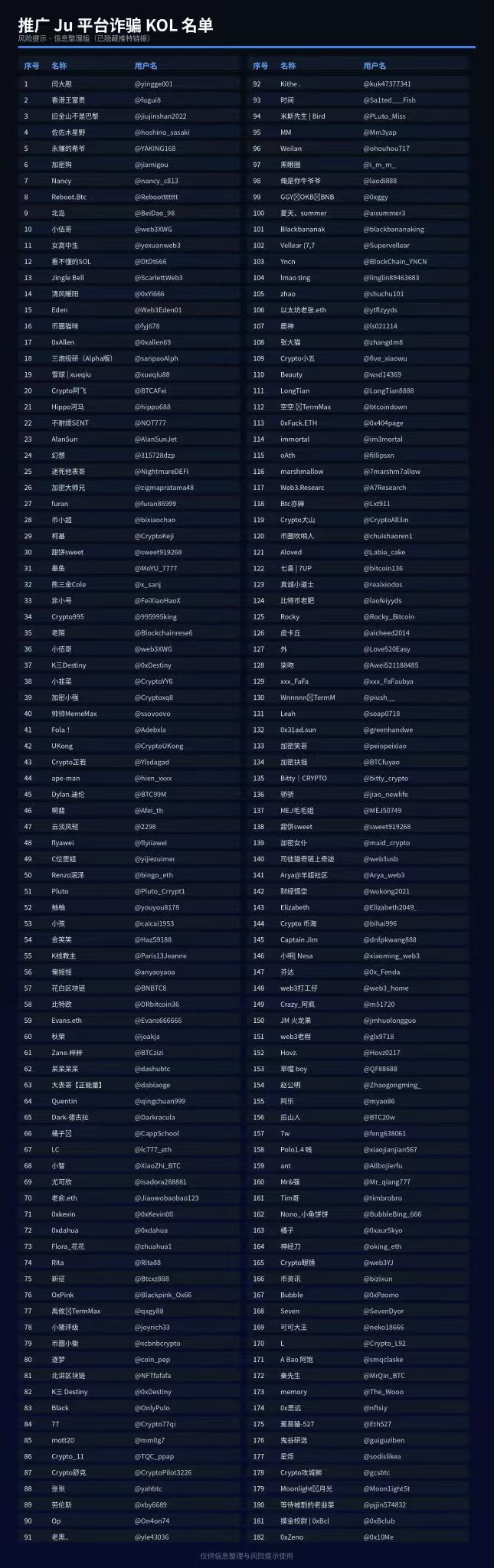
Jubi explosion, list of 182 promotional KOLs leaked.
In May this year, Jubi suddenly restricted withdrawals and transfers citing reasons such as listing audit, KYC upgrade, wallet migration, leaving a large amount of user funds trapped.
The platform then published a reserve proof, showing total reserves exceeding $500 million and a reserve ratio over 123%, attempting to calm users.
However, the so‑called USDT/USDC are likely wrapped tokens on its own public chain JuChain, not real repayment capability.
Merkle Tree can only prove that these amounts exist on‑chain, it cannot show whether they can actually be redeemed, nor can it reveal if the funds have been misappropriated.
Now victims in many areas have united to defend their rights, and places such as Beijing and Shanghai have officially filed fraud reports.
Starting May 2025, Jubi continuously launched numerous high‑yield financial products, 5M protocol daily return 3%, OneAgent AI robot arbitrage 24 hours, 7‑day locked‑in daily rate 0.5%, 360‑day up to 1.5%, annualized returns exceeding 500%.
The flagship JU token once rose more than 300% in about half a month, and the platform kept sharing profit screenshots, transaction records, successful withdrawal cases, prompting more and more people to increase positions, even borrowing money to invest.
In April‑May, at its peak, a large number of KOLs promoted trades, offering promotion rewards of 5% and community rewards up to 85%, posting in public domains to redirect to private green bubbles, and using FeiFei to pull groups for traffic.
After the platform collapsed, the list containing 182 promotional KOLs circulated online; these KOLs are likely to be called to assist investigations and give statements.
The new regulations introduced in 2026 have defined KOL promotional actions in more detail, such as which platform they trade on, whether there is obvious endorsement, the commission rate taken, and private chat records, all of which may serve as evidence.
This is not the first time Jubi has done this. When it was founded in 2013, it was called Bitcoin Trading Net, later renamed BitEgg, BaoCoin, Jubi Global; over the past decade each rebranding followed the same script. The whole process relies on high interest rates and KOLs to draw money in, uses fake proof to steady confidence, and runs away when it can no longer attract funds.
Always pay attention to fund safety and protect your wallet!