Blockchain ecosystems are walled gardens.
Ethereum contracts can't talk to Solana. Solana can't read Avalanche etc. This forces devs to pick a chain. I've met a lot of devs and they're rarely as 'tribal' as bag holders. They want to be multi-chain. But this requires:
Krypto kaufen
Karte
P2P-Handel
USDT über Marketplace kaufen
Kredit-/Debitkarte
Kaufen Sie Kryptowährungen mit Visa oder Mastercard
Zahlung durch Dritte
Kaufen Sie Krypto über MoonPay, Simplex und mehr.
BitMart-Karte
Stärken Sie Ihr Krypto-Leben
Krypto-Prepaid-Karte
Erhalten Sie sofort eine Mastercard, die Sie verwenden können
Handeln
USDⓈ-M
Verwendung von USDⓈ als Sicherheit
COIN-M
Coin selbst als Sicherheit einsetzen
TradFi
Handel mit Metallen, Aktien und Devisen aus einer Hand
Demo-Handel
Erfahren Sie, wie Sie ohne Risiko handeln können
Futures-Übersicht
Die zentrale Plattform für alles rund um Futures
Futures King
Preispool in Höhe von 478.000 USDT
Wachsen
Earn-Übersicht
Mit ungenutzten Assets mühelos verdienen
Ersparnisse
Zinsen mit Beständen verdienen
Staking
Einfaches Staking, hohe Prämien.
Vermögensverwaltung
ermehren Sie Ihr Vermögen mit einem erstklassigen Asset-Team
RWA
Halten Sie BMRUSD, nutzen Sie den Ertrag
Exklusiv für VIP
Stabiles Verdienen für VIP-Benutzer
Rewards
Prämienzentrale
Entdecken Sie exklusive Belohnungen im Wert von bis zu 14.000 USDT
LaunchPrime
Eine Plattform zur Einführung von Token und NFT
Partnerprogramm
Melden Sie sich an, um hohe Provisionen zu verdienen
Powerdrop
Die Airdrop-Lösung der nächsten Generation ist LIVE!
Veranstaltungszentrale
Der zentrale Hub für alle Geschäftsabläufe
Futures Tagesverlosung
100% Gewinnchance bei täglichen Trades
Spot-Tagesziehung
Gewinnen Sie 8.888 USDT an Hauptpreisen insgesamt
Staking zur Stimmabgabe
Verdienen Sie Airdrops durch Abstimmung
Institution
Professionelle und exklusive Services
VIP
Exklusive Rewards freischalten
Academy
Machen Sie sich schnell mit dem Handel und der Blockchain vertraut
BitMart-Praktikum
Beginnen Sie hier Ihre Krypto-Karriere
BitMart Travel
Weltweite Reisedienstleistungen aus einer Hand
Mobiles Aufladen
Laden Sie Mobiltelefone einfach, online und sicher auf.
Send
Send money globally, fast and secure
BitMart Mall
Leben mit Krypto

AO (AO)
$ 5.04 (AO/USD)
-0.98%
24H
AO Live Kursdaten
Der heutige Preis von AO ist $ 5.04 (AO/USD). Mit einer Marktkapitalisierung von $ 37.98M USD. 24-Stunden-Handelsvolumen von $ 278.54K USD, Eine 24-Stunden-Preisänderung von -0.98%, Sowie einer Umlaufmenge von 7.54M AO.
AO AO Preisverlauf USD
Verfolgen Sie den Preis von AO für heute, 7 Tage, 30 Tage und 90 Tage
Zeitraum
Ändern
Veränderung (%)
Heute
$ 0.049
-0.98%
7Tage
$ 0.54
12.25%
30Tage
$ 2.37
88.76%
90Tage
$ 3.01
148.28%
Besitzen Sie AO jetzt
Kaufen und verkaufen Sie AO einfach und sicher auf BitMart.
AO Marktinformationen
$ 4.99 24-Std.-Bereich $ 5.12
Allzeithoch
$ 15.23
Allzeittief
$ 1.57
24-Std.-Veränderung
-0.98%
Menge 24 Std.
$ 278,536.24
Zirkulierendes Angebot
7.53M
AO
Marktobergrenze
$ 37.98M
Nettomenge
21.00M
AO
Vollständig verwässerte Marktobergrenze
$ 105.81M
Handel AO
Verdienen
Setzen Sie Ihre ungenutzten Kryptowährungen ein und erzielen Sie passives Einkommen durch Ersparnisse, Staking und mehr.
AO X Insight

kyall
VC
FA_Analyst
B
 2.5K @kyall_pcap
 Bullisch
The tweet introduces AO as a computation layer designed to solve blockchain interoperability issues, enable multi-chain deployment, and new use cases, but it is currently still in the testnet phase.
kyall
VC
FA_Analyst
B
2.5K @kyall_pcap - Multiple deployments (one per chain)
- Bridge protocols (hacks waiting to happen)
- Different security models
- Fragmented liquidity
- Compatibility nightmares
kyall
VC
FA_Analyst
B
2.5K @kyall_pcap Devs are better off building deep than wide. Build more features for your current users, than expand to more segments.
Plus, crypto history is littered with the bodies of those who tried to go wide - mostly due to inherent failure of bridging ($2B+ stolen in 2022-2023).
kyall
VC
FA_Analyst
B
2.5K @kyall_pcap AO actually does solve this. It operates above the chain layer. One smart contract, that can send prompts to any chain!
No bridges needed. No redeployments. No fragmented liquidity.
AO is not a blockchain. It's a computation layer.
So what does this mean for devs?
kyall
VC
FA_Analyst
B
2.5K @kyall_pcap Build once. Deploy everywhere.
But it solves so much more than just the multi-chain problem.
By separating computation from consensus users pay for security (cheap) and storage (one-time), with computation running at near-zero marginal cost.
This unlocks many new use cases such as running AI models on-chain, complex scientific calculations and real on-chain gaming.
Right now it's basically a testnet. But it's interesting tech worth watching imo.
 4
4
 2
2
 176
176
2025-10-28 22:19
Trend von AO nach Veröffentlichung
Bullisch
The tweet introduces AO as a computation layer designed to solve blockchain interoperability issues, enable multi-chain deployment, and new use cases, but it is currently still in the testnet phase.

Matt 💮. efh
Trader
TA_Analyst
B
1.7K @mattfromblock Extrem bullisch
The Anyone project released an updated roadmap, showcasing parallel development progress and future plans for the network, protocol, token, and hardware, which provides positive reference for the project's prospects.

ANyONe Protocol D
73.3K @AnyoneFDN We’re building hard in parallel: the network, protocol, token and hardware.
Check out the next steps in our updated roadmap 👇 https://t.co/xTEc2Dq9NH
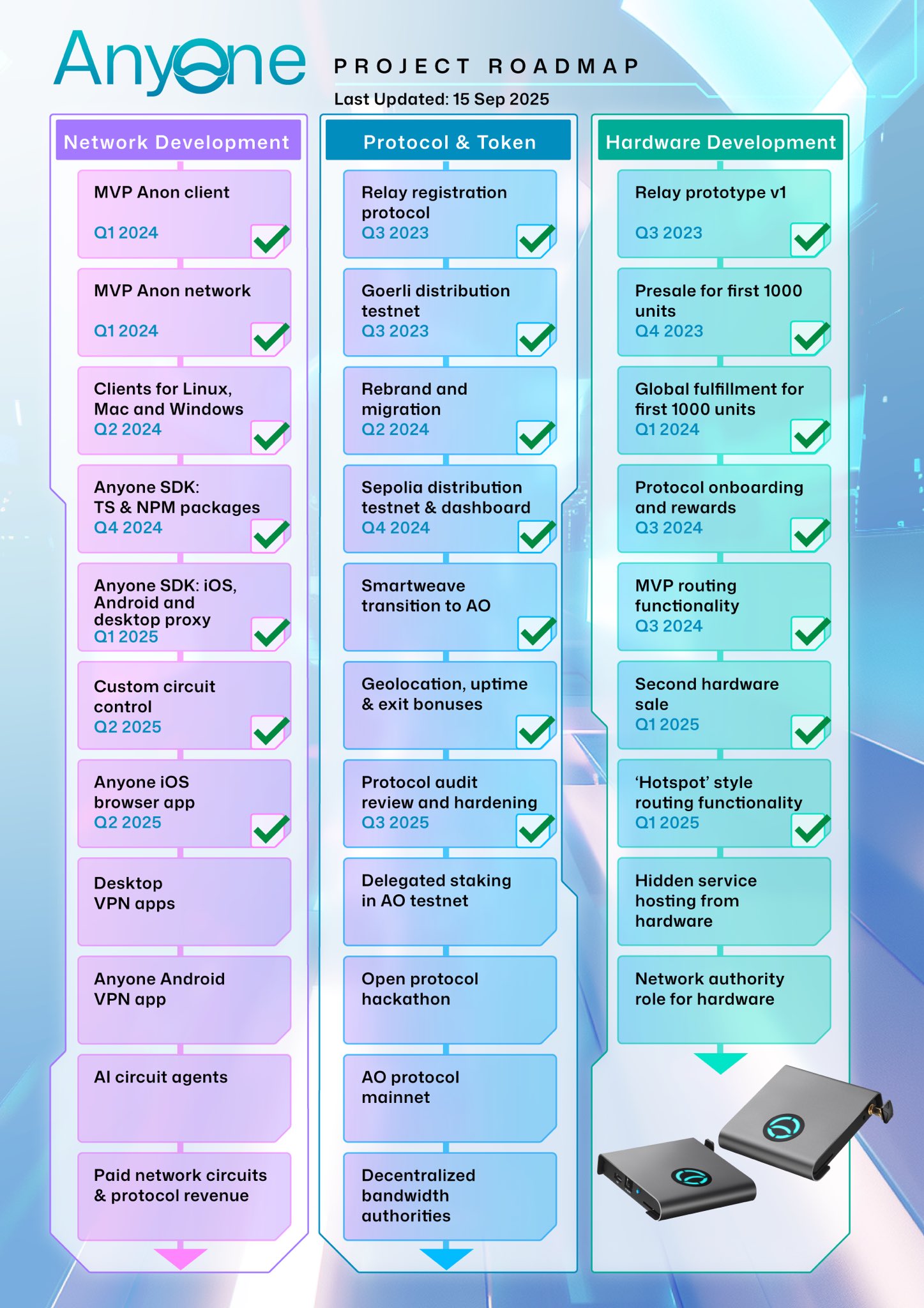 375
32
20.6K
375
32
20.6K
2025-09-18 17:39
Trend von AO nach Veröffentlichung
Extrem bullisch
The Anyone project released an updated roadmap, showcasing parallel development progress and future plans for the network, protocol, token, and hardware, which provides positive reference for the project's prospects.
Preisprognose
Wann ist ein guter Zeitpunkt, um AO zu kaufen? Soll ich AO jetzt kaufen oder verkaufen?
Bei der Entscheidung, ob es ein guter Zeitpunkt ist, AO (AO) zu kaufen oder zu verkaufen, ist es wichtig, sich zunächst an der eigenen Handelsstrategie und Ihrem Risikoprofil zu orientieren. Langfristig orientierte Anleger und kurzfristig orientierte Trader interpretieren Marktbedingungen oft unterschiedlich, daher sollte Ihre Entscheidung Ihre persönliche Herangehensweise widerspiegeln. Laut der neuesten vierstündigen technischen Analyse von AO lautet das aktuelle Handelssignal Halten. Laut der neuesten eintägigen technischen Analyse von AO lautet das aktuelle Signal Halten.

Beacon Vorhersage
Probabilistische Preisprognose (nächste 24 Stunden)Haftungsausschluss für Beacon-Vorhersagen
Die auf dieser Seite angezeigten Datenergebnisse werden basierend auf tatsächlichen Handelsdaten (OHLCV) des ausgewählten Handelspaares und den entsprechenden technischen Indikatoren analysiert.
Diese Prognose ist ein experimentelles technisches Produkt und wird lediglich zu Informationszwecken angegeben. Dies stellt keine Anlageberatung dar. Unerwartete Ereignisse in der realen Welt können erhebliche Auswirkungen auf das Marktverhalten haben. Händler sollten Entscheidungen mit Vorsicht treffen.
Diese Prognose ist ein experimentelles technisches Produkt und wird lediglich zu Informationszwecken angegeben. Dies stellt keine Anlageberatung dar. Unerwartete Ereignisse in der realen Welt können erhebliche Auswirkungen auf das Marktverhalten haben. Händler sollten Entscheidungen mit Vorsicht treffen.
Über AO
AO (AO) is a cryptocurrency launched in 2025. AO has a current supply of 7,537,354.73025519. The last known price of AO is 4.88826252 USD and is up 5.29 over the last 24 hours. It is currently trading on 20 active market(s) with $217,160.95 traded over the last 24 hours. More information can be found at https://ao.arweave.net/.
Mehr lesen